
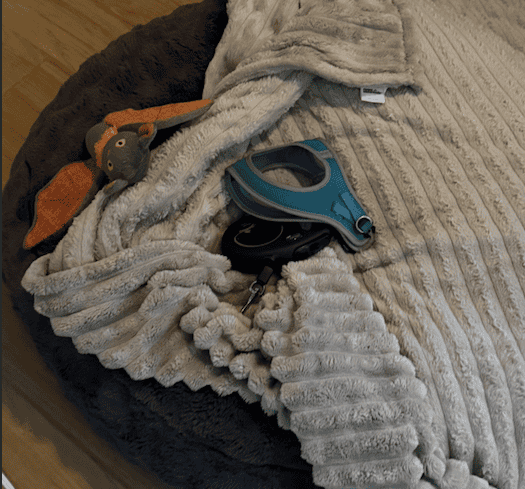
My dog came from a rescue and she was attacked before I got her. In a city that shapes almost everything: dogs appear on sidewalks without warning, they appear in the grass field where she needs to go, and she has an opinion about it that no piece of equipment is going to change. Noise is the other half. For her first month, the ordinary sound of a city made a two minute bathroom trip into an event. This page is about the gear that helps you manage those two things, and it is honest about the fact that gear manages them rather than solves them.
A note
Nothing here is behavioral advice or a substitute for a professional. A dog with a history like hers is worth working through with a trainer or a vet behaviorist, and equipment supports that work rather than replacing it. If your dog is reactive or fearful, that is the route.
Quick Verdict
A harness you trust is the whole ballgame, because the sidewalk is where the surprises are. Everything else makes the surprises less frequent or less loud.
Key Takeaways
- City walks are unpredictable. Your control of the dog is the equipment that matters.
- Noise is constant and cumulative, not dramatic. It wears on a nervous dog.
- Distance is the tool. Gear that buys you distance is doing the real work.
- Gear does not fix reactivity. It manages a walk while you work on it properly.
- Timing your walks does more than anything you can buy.
1. A Harness That Cannot Be Escaped, Best Overall
The single most important item, and in a city it is a control question rather than a comfort one.
Sidewalks produce surprises. A dog comes round a parked car, or out of a doorway, or is already in the grass you were heading for. If your dog has a reason to react, that is the moment, and the moment is not when you want to discover that a small dog can reverse out of a loose harness.
I use a lightweight mesh one, which suits the heat here, and the thing I care about is fit rather than features. Snug enough that backing out is not an option, loose enough not to rub. That is a measuring job, not a shopping job.
Front clip versus back clip is worth understanding rather than guessing at, since they steer differently. Choosing a harness for small dogs covers sizing, front clip vs back clip covers the difference, and harnesses for small dogs covers the field.
Best for: every city dog, before anything else on this page.
Check Price on Amazon2. A Short Fixed Leash, Best for Sidewalk Control
Unglamorous, cheap, and it is the difference between managing a surprise and reacting to one.
A fixed leash of a few feet keeps your dog in a known position. You know where she is without looking, and if something appears you can shorten the distance instantly rather than reeling.
The reason this matters in a city specifically is that the surprises are close. A trail gives you sightlines. A sidewalk gives you a parked van and then a dog. Reaction time is measured in feet, and a retractable leash is a device for not having those feet.
This is also the cheapest meaningful upgrade on the page. Retractable vs standard covers the case, and leashes for small dogs covers the options.
Best for: anyone walking somewhere with blind corners, which is a city.
Check Price on Amazon3. A Treat Pouch, Best for the Work You Are Actually Doing
Because the gear that helps most on a city walk is the gear that supports training rather than restraining.
When I was building trust with her early, the thing that worked was an open hand with treats and letting her come to me. Time was the actual ingredient, and treats were how the time was spent. On a walk, the same principle applies in a different setting: having something good available at the moment something difficult happens is the whole method.
A pouch matters because pockets do not work. Fumbling for a treat while managing a leash and a surprise is a failure of logistics rather than intention, and it happens every time.
This item is a support for proper work, not a substitute for it. Building trust with a rescue dog covers what that work looks like, and treat pouches covers the options.
Best for: anyone doing the work rather than just getting round the block.
Check Price on Amazon4. A Bag Dispenser on the Leash, Best Small Fix
Trivial, and it belongs here because of what city walking actually is.
I do three or four trips a day and every one of them is a short, purposeful, transactional walk in a shared space. Forgetting bags is not an embarrassment in a field. It is a problem on a sidewalk with people on it.
The dispenser clips to the leash, which means the bags are attached to the object you cannot leave without. That is the entire feature and it is enough. I own one and it removed a recurring failure.
Worth pairing with wipes if you are in an apartment, since what comes back in with you is its own category. Poop bags and dispensers covers it, and what to bring on a dog walk covers the rest of the kit.
Best for: everyone. It costs almost nothing and removes a repeated mistake.
Check Price on Amazon5. A Sound Machine, Best for What Happens Indoors
Because the city does not stop when you get home, and this is the half people forget.
Noise was the big thing for her early. Not one dramatic sound, but the constant background of a place with traffic and people and doors, arriving through walls at all hours. It made the first weeks harder than anything on the sidewalk did.
A sound machine works by masking rather than silencing. A steady sound gives the sharp ones less to stand out against, which is a modest mechanism and a real one. It does not make a city quiet.
The honest note is that it took about a month for her to acclimate, and I cannot tell you how much of that was the room and how much was time passing. Time was doing most of the work. Why dogs startle at noises covers the mechanism, and helping a dog with PTSD covers the situation properly if that is where you are.
Best for: apartments where the noise is constant rather than occasional.
Check Price on Amazon6. A Bed in a Corner, Best Thing You Can Set Up
Not a city product, and it is on this page because a city is exactly where it earns its place.
Hers is in a corner with a blanket, and it became her spot. When the building is loud or the day has been a lot, that is where she goes. Buying a bed was the best purchase I made, and in a small noisy apartment the reason is not comfort so much as having somewhere that is reliably hers.
The corner is doing work here. Two walls means fewer directions for things to arrive from, which in a place with constant sound seems to matter more than the bed itself.
She also sleeps on my bed, which is not a contradiction. One is where she chooses to be with me and the other is where she goes when she wants her own. Creating a safe space covers the setup, and where to put the bed covers placement, which is most of it.
Best for: any city dog, and any nervous one anywhere.
Check Price on AmazonCity Kit Priorities
| Item | Which problem | Priority |
|---|---|---|
| Escape-proof harness | Sidewalk surprises | First, and not close |
| Short fixed leash | Reaction time in feet | Cheapest real upgrade |
| Treat pouch | Supports actual training | If you are doing the work |
| Bag dispenser | 3-4 trips a day, shared space | Trivial, do it |
| Sound machine | Constant indoor noise | Masks, does not silence |
| Bed in a corner | Somewhere reliably hers | Best purchase overall |
Distance Is the Actual Tool
The thing that took me longest to understand and costs nothing.
If your dog has a reason to be wary of other dogs, the intervention that works is distance. Not a device, not a correction, not a better leash. Space between her and the thing, early enough that she notices it from far away rather than close up.
Everything on this page is in service of that. A harness you trust means you can move without worrying about what the harness does. A short leash means she is where you expect when you need to change direction. A treat pouch means you have something to offer while the distance does its work.
Which reframes the shopping. You are not buying reactivity solutions. You are buying the ability to control position on a sidewalk, and position is the only thing that reliably helps in the moment.
Timing Beats Equipment
Honest, and it is free.
A city at seven in the morning is a different place from a city at six in the evening. Fewer dogs, fewer people, less noise, more room to see something coming. For a dog who finds other dogs difficult, choosing when to go out does more than anything in this list.
Same for the grass. If the field is busy, it is a different field. Going earlier or later is not a compromise, it is the single highest-return change available and it does not involve buying anything.
I would go further: if you are considering a purchase to solve a problem that a different walk time would solve, buy the walk time. How often to walk your dog and walking at night both cover the scheduling side.
What Gear Cannot Do
Worth being plain about on a page selling six things.
None of this changes how a dog feels about other dogs. A harness controls a body. A leash controls distance. A sound machine changes a room. None of them reach the thing underneath, and buying more of them is a way of feeling active about a problem that wants patience and, often, professional help.
With mine, what actually worked was time. Not a product. An open hand, treats, letting her decide, and about a month of it before the city stopped being an event. The gear made those weeks manageable. It did not do the work.
If your dog is reactive or fearful in a way that is shaping your life, that is a trainer or a vet behaviorist conversation. Helping a dog with PTSD and a dog scared of strangers cover more of it than this page can.
Recommended Reading
See building trust with a rescue dog, helping a dog with PTSD, and creating a safe space.
City Dog Gear FAQ
What is the most important gear for a city dog?
A harness you trust completely. Sidewalks produce surprises at close range, and a small dog reversing out of a loose harness is the worst possible version of that moment. Fit is the whole thing, and it is a measuring job rather than a shopping one.
Retractable or fixed leash in a city?
Fixed, and short. A city gives you a parked van and then a dog, so reaction time is measured in feet. A retractable leash is a device for not having those feet, which is fine on a trail and wrong on a sidewalk.
How do I handle other dogs on the sidewalk?
Distance, early. Space between your dog and the thing, noticed from far away rather than close up. No device does this. Gear helps by making it possible to control position, which is why the harness and leash matter more than anything marketed as a solution.
Does a sound machine help a nervous dog in an apartment?
It masks rather than silences, which is a modest and real mechanism. City noise is constant background rather than dramatic events, and a steady sound gives sharp ones less to stand out against. It will not make a city quiet.
How long does it take a dog to get used to city noise?
For mine it was about a month, and I cannot tell you how much was the setup and how much was time simply passing. Time was doing most of the work. That is the honest answer and it is not one a product page usually gives.
What free change helps most?
Walk timing. A city at seven in the morning is a different place from six in the evening: fewer dogs, less noise, more room to see something coming. If a purchase is meant to fix something a different walk time would fix, buy the walk time.
Why a bed in a corner?
Two walls means fewer directions for things to arrive from, which seems to matter in a place with constant sound. Hers is in a corner with a blanket and it became her spot. She also sleeps on my bed, which is not a contradiction: one is with me, the other is hers.
Can gear fix a reactive dog?
No. A harness controls a body and a leash controls distance, and neither reaches the thing underneath. If reactivity is shaping your life, that is a trainer or vet behaviorist conversation. Equipment makes the walks manageable while the real work happens elsewhere.
Related guides: our picks for dog gear that lasts, choosing gear for a visiting dog, common dog gear mistakes.
See the complete guide: the complete guide to choosing dog gear.
