
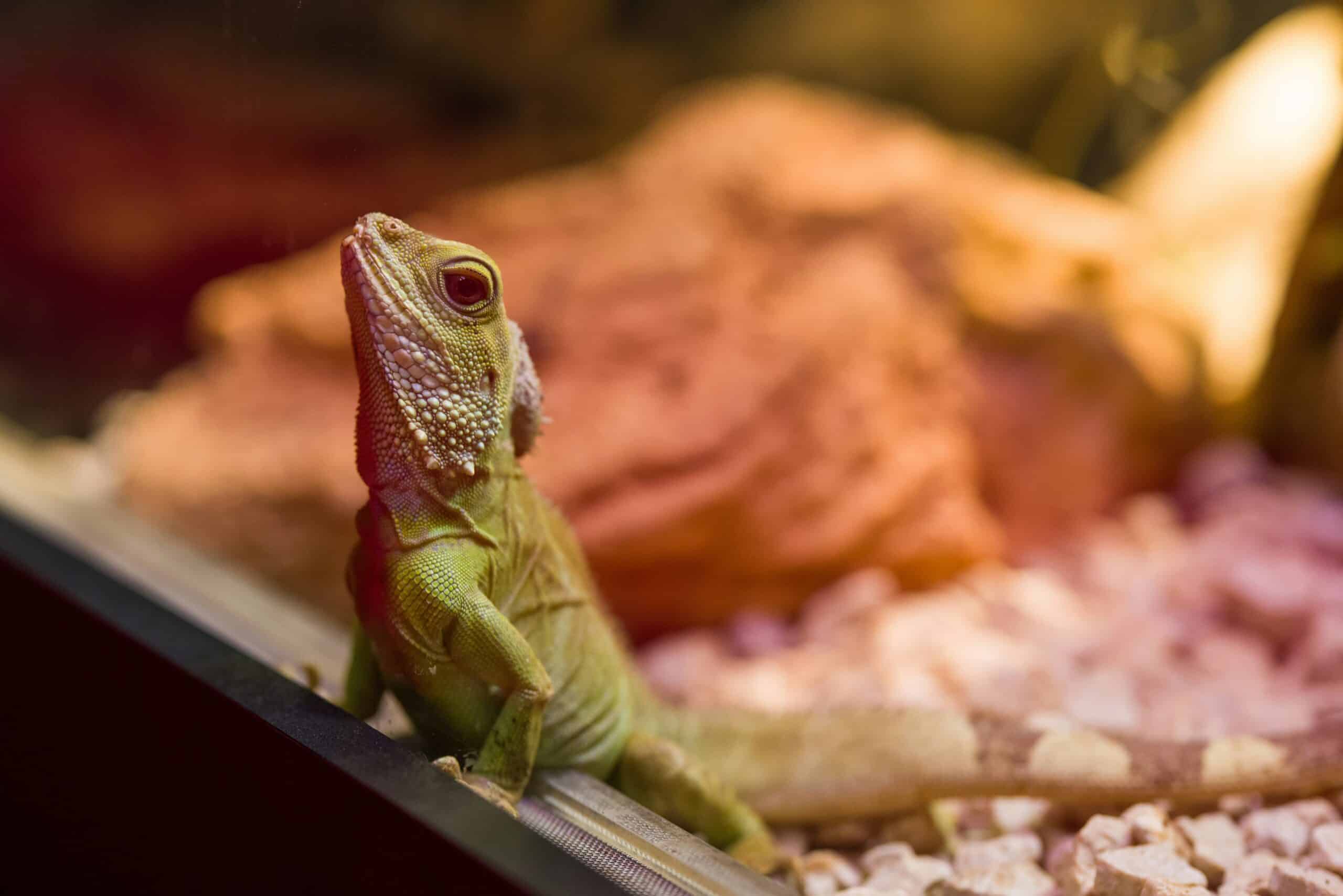
UVB lighting is a separate system from heat, and a linear T5 tube in a reflector fixture is what most keepers should be running. The best reptile UVB lighting and fixtures are chosen by enclosure size and species requirement rather than by wattage, because UVB output falls off sharply with distance and is blocked entirely by glass and plastic mesh. A bulb that still glows can have stopped producing useful UVB months earlier.
Heat is a different question with different hardware, and mixing the two up is the usual starting mistake. Our roundup of reptile heat lamps covers the heating side in full, and nothing here replaces it.
Quick Verdict
Buy a linear T5 high-output tube with a reflective fixture sized to run most of the enclosure length. Mount it according to the species requirement and the fixture guidance, and replace it on the manufacturer’s stated schedule rather than when it fails. Compact coil bulbs are a last resort for small enclosures.
Key Takeaways
- UVB and heat are separate systems that happen to share a hood.
- Glass and most plastics block UVB, so the lamp cannot sit outside a closed lid.
- Linear tubes spread UVB across a gradient, which is what a basking animal needs.
- Output declines long before the bulb stops lighting, so replacement is scheduled.
- A reflector fixture does more for usable output than a stronger bulb.
- Requirements differ enormously by species, so the species decides the setup.
How We Picked This Lighting
We grouped these by lamp technology, since the shape of the lamp determines how UVB is distributed and that is the thing that matters inside an enclosure.
Then we weighted the fixture as seriously as the bulb. A good tube in a bare socket without a reflector wastes much of what it produces.
We have not kept animals under these or taken measurements, so nothing here is presented as a result from our own setups, and no lamp here is claimed to prevent or treat any condition. Species requirements and mounting distances are a conversation for a reptile veterinarian or a species-specific care sheet rather than a general roundup.
1. Linear T5 High-Output Tubes, Best Overall
Why It Stands Out
A long tube produces UVB along its whole length, which creates a gradient an animal can move through rather than a single hot spot. That choice is the point of the whole system.
T5 high-output tubes also project further than older designs, so they can sit above a mesh lid and still deliver usefully to a basking site below.
Worth Knowing
Tube strength is sold in tiers aimed at different species groups, and picking the wrong tier matters more than picking the wrong brand. Match it to your animal’s requirement.
You are also buying a controller and fixture that fits that tube length, so the enclosure dimensions constrain the choice from the start.
This suits almost every enclosure big enough to take a tube. Skip it only where the enclosure is too small. Best for: the standard UVB setup for a basking species.
Check Price on Amazon2. Reflective Tube Fixtures, Best Output Upgrade
Why It Stands Out
A polished reflector sends light downward that would otherwise be lost upward, so the same tube delivers considerably more where the animal actually sits. It is the cheapest meaningful improvement available.
Enclosed fixtures also protect the tube and keep the wiring tidy above a mesh lid.
Worth Knowing
Because a reflector increases what reaches the animal, the mounting height that suited a bare fixture may now be too close. Changing fixture changes the geometry.
Fixtures are length-specific, so a replacement tube has to match rather than merely fit the socket type.
This suits anyone already running a tube without a reflector. Skip it only if your fixture already has one. Best for: getting more from a tube you already own.
Check Price on Amazon3. Compact and Coil UVB Bulbs, Best for Small Enclosures
Why It Stands Out
A screw-fit coil bulb goes into an ordinary dome and suits an enclosure with no room for a tube. For a small arboreal setup it is sometimes the only option that fits.
They are cheap and widely stocked, which makes them an easy emergency replacement.
Worth Knowing
Output is concentrated in a small area, so an animal gets a narrow spot rather than a gradient. Keepers generally treat these as the weakest option available.
Mounting distance is critical with a concentrated source, and a hide directly below one defeats the purpose. Reptile hides and climbing decor covers positioning those properly.
This suits enclosures too small for a tube. Skip it where a linear tube will fit. Best for: small setups with no space for a fixture.
Check Price on Amazon4. Mercury Vapor Bulbs, Best Heat and UVB Combined
Why It Stands Out
These produce heat, visible light and UVB from one bulb, which simplifies a large enclosure down to a single fixture. For a big basking species that is a real convenience.
They also project strongly, so they work at the heights a tall enclosure requires.
Worth Knowing
The convenience is also the limitation, because heat and UVB are now tied together. You cannot dim one without changing the other, and these cannot run on a thermostat.
This is the crossover between the two systems, and it appears in our heat lamp roundup for that reason. Treat it as a heating decision as much as a lighting one.
This suits large, tall, warm enclosures for strong basking species. Skip it where temperatures need separate control. Best for: one fixture doing both jobs in a big enclosure.
Check Price on Amazon5. Metal Halide Lamps, Best for Large Bright Setups
Why It Stands Out
Metal halide produces intense visible light alongside UVB and heat, which suits a large planted enclosure where brightness matters to both animal and plants. The light quality is noticeably better than alternatives.
For a tall enclosure with a high basking site, the projection distance is the main argument.
Worth Knowing
These are expensive to buy and they need a compatible ballast or fixture, so it is a system purchase rather than a bulb purchase.
Intensity also means mounting distance is unforgiving, and a planted bioactive setup brings its own considerations, covered in reptile terrariums and enclosures.
This suits large planted enclosures for bright-light species. Skip it for small or modest setups. Best for: brightness and reach in a large enclosure.
Check Price on Amazon6. UV Index Meters, Best Way to Stop Guessing
Why It Stands Out
A meter turns the whole question from estimation into measurement, so you can see what reaches the basking site and when a tube has faded. Nothing else tells you that.
It also pays for itself by preventing both unnecessary replacements and dangerously close mounting.
Worth Knowing
The reliable meters cost considerably more than cheap UV testers, and the cheap ones are widely regarded as not worth owning.
A reading only means something against a target for your species, so the meter is a tool rather than an answer. Where that target sits is a species question.
This suits keepers with several enclosures or a species with narrow requirements. Skip it for a single simple setup on a strict replacement schedule. Best for: knowing what the animal is actually receiving.
Check Price on AmazonReptile UVB Options at a Glance
| Type | Coverage | Produces Heat | Suits |
|---|---|---|---|
| Linear T5 HO tube | Gradient along the length | No | Most basking enclosures |
| Reflective fixture | Improves any tube | No | Anyone running a bare tube |
| Compact coil bulb | Narrow spot | Minimal | Enclosures too small for a tube |
| Mercury vapor bulb | Single strong basking spot | Yes | Large, tall, warm enclosures |
| Metal halide lamp | Bright directional spot | Yes | Large planted setups |
| UV index meter | Measures, does not emit | No | Multiple or demanding setups |
How to Choose a UVB Setup
Start from the species
A desert basking lizard and a shade-dwelling gecko have completely different needs, and some species are kept without UVB at all. The animal decides the system, so a species care sheet comes before a shopping list.
Measure the enclosure, then the lamp
Tube length should cover a good proportion of the enclosure so the animal has a gradient to use. Height from the lamp to the basking surface then sets which tube strength is appropriate.
Check what sits between lamp and animal
Glass and acrylic block UVB almost entirely, and fine mesh absorbs a meaningful share. A lamp outside a closed glass lid is doing nothing useful at all.
Plan the replacement before you buy
UVB output declines while the lamp keeps lighting, so replacement runs on the manufacturer’s schedule rather than on failure. Write the install date on the tube and diary the change.
Linear Tube or Compact Bulb
Tubes give a gradient
A reptile regulates its own exposure by moving, which it can only do if exposure varies across the enclosure. A long tube creates that variation, and it is the main reason tubes are the default recommendation.
Compacts give a spot
A coil bulb concentrates output into a small area, so the animal gets a strong patch and nothing elsewhere. That suits a small enclosure where a tube cannot fit, and it is accepted as a compromise rather than a preference.
Common UVB Mistakes to Avoid
Treating a heat lamp as a UVB lamp
Ceramic emitters and ordinary basking bulbs produce heat and no useful UVB. The two systems look similar in a hood and do entirely different jobs.
Shining it through glass
A lamp sitting on a closed glass lid delivers essentially nothing. The lamp has to be inside the enclosure or above open mesh.
Running a bulb until it dies
Visible light continues long after UVB has faded, so a lit enclosure can be a UVB-free one. Replacement is scheduled, not reactive.
Blocking the gradient with decor
A large hide or a dense plant directly under the lamp removes the exposure the animal was meant to choose. Position decor so the basking route stays open, and keep substrate depth in mind, which reptile substrate and bedding covers.
Recommended Reading
Worth reading next: bird cages for another enclosure-lighting setup, bird perches and toys, bird food and seed mixes, and guinea pig cages for the small-mammal side of the same shelf.
Reptile UVB FAQ
What is the best reptile UVB lighting and fixture setup
A linear T5 high-output tube in a reflective fixture, sized to run much of the enclosure length, suits most basking species. Mercury vapor and metal halide cover large tall enclosures where heat and UVB can share a fixture. Compact coil bulbs are a fallback for small setups.
Do all reptiles need UVB
No. Requirements vary widely by species, and some are routinely kept without it while others depend on it heavily. The species care requirements and a reptile veterinarian are the right sources, not a general rule.
How often should you replace a UVB bulb
On the schedule the manufacturer states for that specific lamp, because output falls while the bulb still produces light. A UV index meter is the only way to confirm what a particular lamp is still delivering.
Does UVB pass through glass
Ordinary glass and acrylic block it almost completely, which is why a lamp cannot sit outside a closed lid. Mesh passes a reduced amount, and finer mesh absorbs more, so mounting has to account for whatever is in the way.
Can one bulb provide heat and UVB
Mercury vapor and metal halide lamps do both, which simplifies a large enclosure to one fixture. The trade is that you lose independent control, and neither type can run on a thermostat.
How far should a UVB lamp be from the animal
That depends on the lamp strength, the fixture, what the beam passes through, and the species target, so there is no single distance worth quoting. The lamp’s own guidance plus a species care sheet is the right starting point.
Are coil UVB bulbs safe
They are widely used but widely considered the weakest option, mainly because output is concentrated rather than spread. Mounting distance matters more with these than with any other type, and keepers generally prefer a tube where one fits.
When should you see a reptile vet
Changes in posture, limb use, appetite, or tremors all warrant an appointment rather than a lighting change. Lighting is husbandry, and anything that looks like a health problem needs a veterinarian who treats reptiles.
