
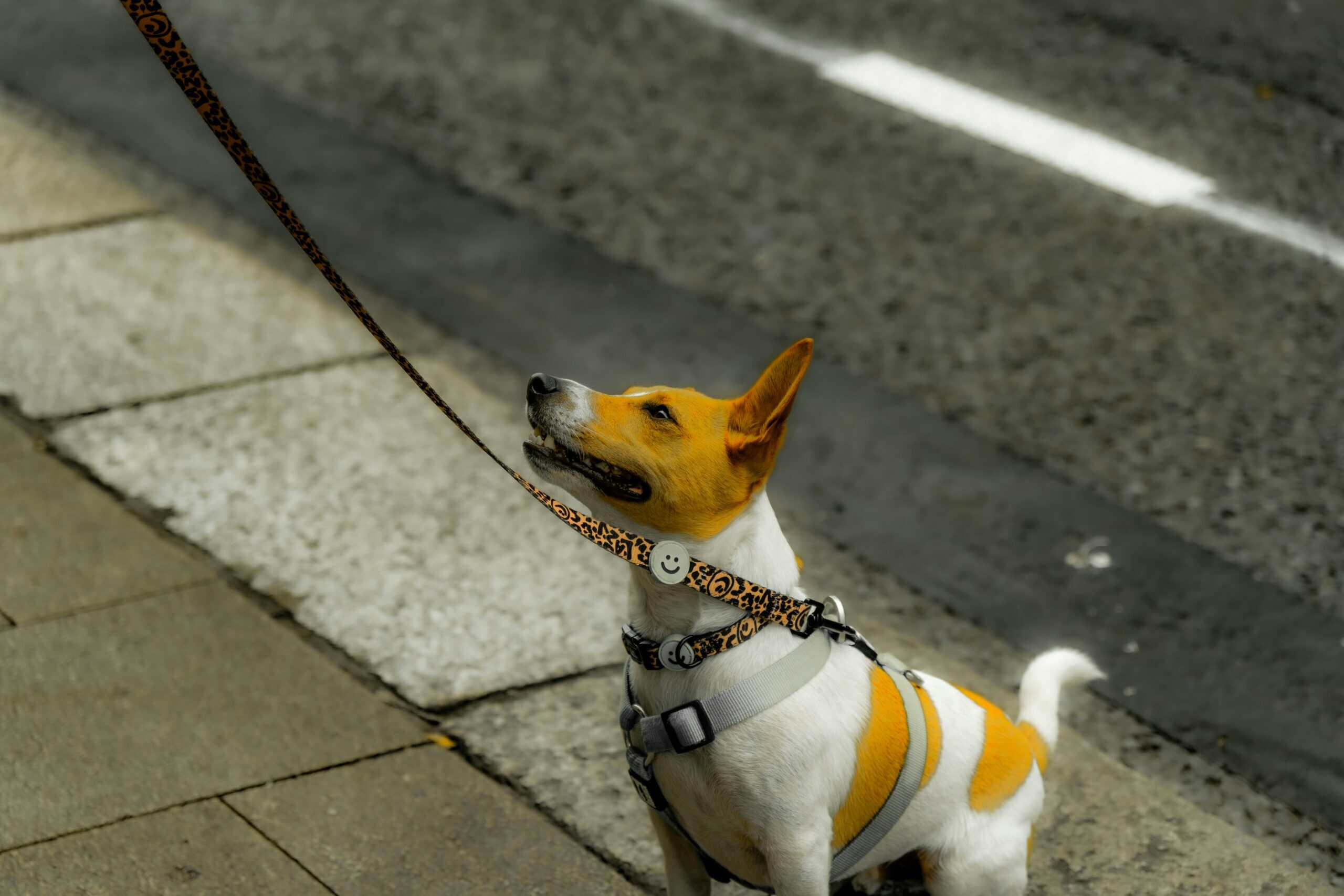
Girth is the only measurement that fits a dog, and the weight ranges printed on packaging are a rough proxy that fails on any dog built outside the average. A dog harness and collar size finder works from two numbers instead: neck girth for the collar, and chest girth at the widest point for the harness.
The relationship between those two numbers also matters on its own. When a neck is nearly as thick as the chest, a flat collar can pull straight over the head, which is a different problem from a strap being too long, and the collar against harness question turns partly on exactly that.
A Quick Note
This page offers general fitting guidance, not veterinary advice. Rubbing, hair loss or sores under a strap, or a dog that suddenly resists being harnessed, are worth having looked at rather than fixed with a tighter adjustment.
Quick Answer
For a collar, measure the neck and add about two inches, which is the two-finger rule in numbers. For a harness, measure the chest girth just behind the front legs at its widest and size on that figure, not the neck and not the weight. Where the two measurements land in different bands, the chest wins.
Key Takeaways
- Measure girth with a soft tape, snug against the coat without compressing it.
- Collar length is neck girth plus roughly two inches.
- Harness size comes from chest girth, measured just behind the front legs.
- A neck close to chest thickness means slip risk, and a martingale shape addresses it.
- Weight ranges on packaging are the least reliable sizing input available.
- Check the manufacturer’s own girth chart; bands are not standard across brands.
Enter the neck and chest girth, then set the build and how the harness will mostly be used.
| Chest girth | Harness band | Neck girth | Collar length |
|---|---|---|---|
| Under 16 in | XS | Under 8 in | Under 10 in |
| 16 to 22 in | S | 8 to 12 in | 10 to 14 in |
| 22 to 28 in | M | 12 to 16 in | 14 to 18 in |
| 28 to 34 in | L | 16 to 20 in | 18 to 22 in |
| 34 to 42 in | XL | Over 20 in | Over 22 in |
| Over 42 in | XXL | Measure and check chart | Measure and check chart |
Bands are a browsing filter rather than a specification. Two brands can label the same girth differently, so the chart on the product page overrides this one every time.
Why Chest Girth Decides the Harness
A harness carries load across the chest and shoulders, so the strap that has to close is the one around the ribcage. Neck measurements only set the top opening, which is usually adjustable across a wide range.
That is why a dog can need a Medium collar and a Large harness without anything being wrong. The two numbers describe different parts of the dog.
Measure at the widest point, just behind the front legs, and keep the tape level. A reading taken too far back lands on the waist and undersizes the harness, which is the usual cause of a strap that will not close on arrival.
The Neck to Chest Ratio Nobody Measures
Close to one means slip risk
Sighthounds and some bull breeds have a neck nearly as thick as the skull is wide, so a flat collar tightened to a safe fit can still come off backwards.
A martingale closes the gap
A martingale tightens a limited amount under pressure and loosens again, which prevents backing out without the mechanics of a choke.
Harnesses need a second strap
For a dog that has slipped a harness, the fix is a design with an additional strap behind the ribcage rather than a tighter setting on a two-strap model.
Check the fit while backing up
A harness that fits a standing dog can open up when the dog reverses and drops its shoulders, which is the exact moment an escape happens.
Where Fit and Pulling Get Confused
A harness that fits correctly does not stop a dog pulling, and tightening one that already fits will not either. Pulling is about the attachment point and about training, not about the last hole on the strap.
A front clip changes the pull angle so a straining dog turns rather than driving it forward, which is the mechanical difference behind no-pull harnesses for large dogs.
Fit still matters for comfort and safety, and a correctly sized harness distributes load off the throat. The step-by-step is in fitting a dog harness.
How to Take the Two Measurements
Use a soft tape, not a rigid one
A sewing tape follows the body shape. A hardware tape bridges across the curve and reads short, often by an inch or more on a barrel-chested dog.
No soft tape at hand? Use a length of string, mark where the ends meet, then lay the string along a ruler. The result is accurate enough for sizing.
Measure a standing dog
Girth readings taken on a lying dog come out small, because the ribcage flattens. Get the dog up on all four feet first, even if it takes a second person.
Find the widest point by feel
Slide the tape back from the front legs an inch at a time and watch the number. The reading rises to a peak and then falls as you reach the waist.
That peak is the figure harness sizing uses. Writing it down matters, since you will want it again for the next harness.
Take the neck low, where a collar sits
A collar rests at the base of the neck, not up behind the ears. Measuring high gives a number two or three inches too small on most dogs.
When to Re-Measure
Puppies need a fresh measurement monthly until growth slows. A harness bought three sizes ahead and worn loose creates the slip risk it was meant to prevent.
Adult dogs change too, just slowly. Weight gain or loss of ten percent moves chest girth enough to shift a band, and so does a seasonal coat.
Check the fit every few months by sliding two fingers under each strap. Where that stops working, re-measure rather than reaching for the next adjustment hole.
What Trips People Up
Sizing by weight
Two 45 pound dogs can differ by six inches of chest girth. Weight ranges exist because they are easy to print, not because they fit.
Measuring over a thick coat
A double coat can add an inch or more. Press the tape gently to the body rather than reading the fur, and re-check after a seasonal clip.
Buying one size for a growing dog
A puppy will move through two or three sizes, so an inexpensive adjustable harness now beats an oversized one worn loose, which is the slip risk again. Smaller adult dogs have their own fit problems, covered in harnesses for small dogs.
Ignoring the collar once a harness arrives
Most harnesses are removed indoors, so identification still lives on the collar. That is an argument for a correctly sized everyday collar regardless, along with ID tags.
Harness and Collar Size FAQ
How do I measure my dog for a harness?
Run a soft tape around the chest at its widest point, just behind the front legs, keeping it level and snug without compressing the coat. That girth figure is what harness size bands are built on.
How tight should a collar be?
Two fingers should slide flat between the collar and the neck. In measurements that works out to roughly the neck girth plus two inches for most dogs, less on a very small one.
Should I size on neck or chest?
Chest, for a harness. The chest strap is the one that has to close, while the neck opening is usually adjustable across a wide range.
Why does my dog keep slipping out of the harness?
Usually a neck close in thickness to the chest, combined with a two-strap design. A model with an additional strap behind the ribcage, fitted while the dog backs up rather than stands still, is the fix.
Can I use the weight chart instead of measuring?
Only as a first guess. Build varies enough at any given weight that the girth measurement will often land a band away from what the weight chart suggests.
What if my dog is between two sizes?
Take the larger band if the dog is still growing or has a thick coat, and the smaller one if the harness has limited adjustment at the bottom of its range. Check where each size’s adjustment range starts and ends, since that decides which one actually works. Lightweight designs tend to have the widest range, as mesh harnesses show.
