
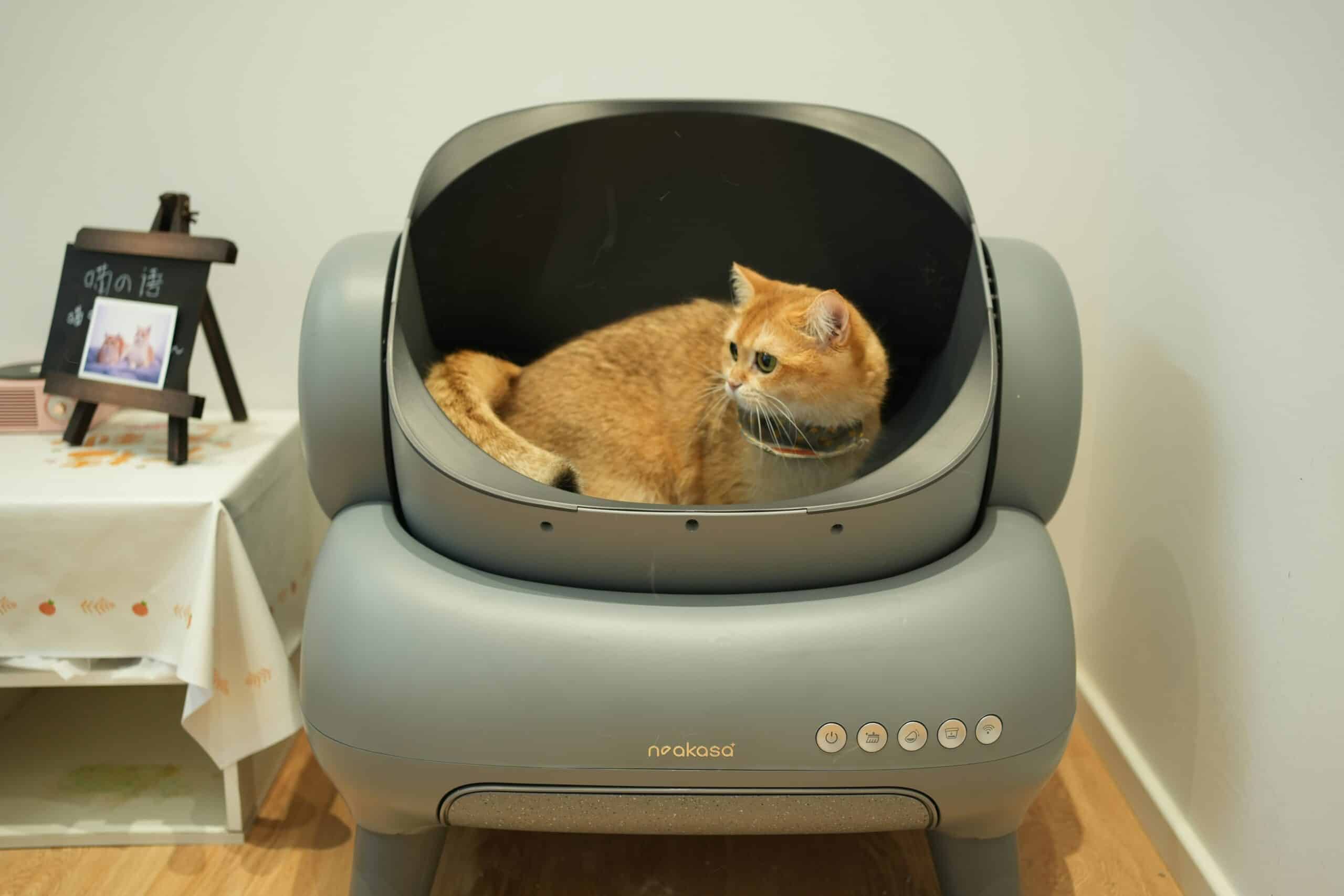
Keeping a dog out of the litter box comes down to one measurement: an opening wide enough for your cat and too small for your dog’s head and shoulders. Every other approach, from covers to placement to training, works around that same principle or fails to. Dogs are drawn to litter boxes for reasons that have nothing to do with mischief, and no amount of correction removes the interest, so physical separation is what actually holds. Our guide to introducing a dog and cat covers the wider household dynamic.
Enclosure Options at a Glance
| Approach | Blocks by | Works for | Weakness |
|---|---|---|---|
| Furniture enclosure | Small side entry | Medium and large dogs | Small dogs still fit |
| Top-entry box | Vertical access | Most dogs | Hard for senior cats |
| Gate with cat door | Room separation | Any dog too big for the flap | Needs a suitable doorway |
| Elevated placement | Height | Dogs that cannot jump | Not for arthritic cats |
| Covered box with narrow door | Opening width | Larger dogs only | Cheapest, least reliable |
| Dog-proof feeding-style pen | Full barrier | All dogs | Takes real floor space |
The short version: measure your dog at the shoulders and your cat at the same point, then buy for the gap between them. A large dog and a small cat make this easy. A dachshund and a big cat make it nearly impossible, and room separation is the answer instead.
How We Picked
Options are grouped by the physical mechanism that stops the dog, since that is what determines whether a solution holds. Cat comfort is weighted equally, because an enclosure a cat refuses to enter creates a worse problem than the one it solved.
Selections reflect how each approach performs against different size gaps rather than time spent in one household.
1. A Furniture-Style Enclosure, Best Overall
Why It Stands Out
A cabinet with a cat-sized side opening hides the box, contains scatter, and keeps a dog out in one product. For most households with a medium or large dog, the opening size does the whole job.
These also solve the aesthetic problem, which matters because litter boxes get placed badly when people are hiding them from guests.
Worth Knowing
Small dogs fit through cat-sized openings without difficulty, so this fails against terriers and toy breeds. Measure before assuming. Our roundup of litter box furniture covers the format in more depth.
This suits homes with a dog clearly larger than the cat. Skip it if your dog is small.
2. A Top-Entry Litter Box, Best Simple Fix
Why It Stands Out
Entry through a hole in the lid requires jumping up and dropping in, which most dogs will not attempt and many physically cannot. It costs a fraction of an enclosure and takes no assembly.
The lid also cuts litter scatter substantially, which is a separate benefit worth having.
Worth Knowing
Older cats, arthritic cats, and kittens struggle with the climb. If your cat has any mobility issue this is the wrong choice. Our picks for low-entry boxes cover the opposite requirement.
This suits healthy adult cats. Skip it for senior or arthritic cats.
3. A Pet Gate With a Cat Door, Best for Room Separation
Why It Stands Out
Putting the box in a room the dog cannot enter solves the problem completely rather than partially. A gate with a small pass-through lets the cat come and go while the dog stays out.
This is also the approach that works regardless of the size gap, since the flap can be sized precisely.
Worth Knowing
You need a doorway to gate, and the room has to be somewhere the cat is willing to go. A litter box in a room the cat avoids is not a solution. Our roundup of cat doors and flaps covers the pass-through options.
This suits homes with a spare room or utility space. Skip it in an open-plan layout.
4. An Elevated Platform or Shelf Setup, Best for Non-Jumping Dogs
Why It Stands Out
Height beats most dogs. A box on a sturdy platform, a wide shelf, or the top of a washing machine puts it somewhere a cat reaches easily and a dog does not.
It also uses space you already have rather than adding furniture to a room.
Worth Knowing
Stability is the safety issue, since a box that shifts under a landing cat will not be used twice. Older cats also lose the ability to make the jump, sometimes gradually enough that you miss it. Our roundup of cat stairs covers keeping height accessible.
This suits agile cats and dogs that cannot jump. Skip it for senior cats.
5. A Covered Box With a Narrow Door, Best Budget Option
Why It Stands Out
A hooded box with a small front opening is the cheapest thing that changes the geometry. Against a genuinely large dog, the opening alone can be enough.
It also contains odor and scatter better than an open tray, which are reasons to own one regardless.
Worth Knowing
This is the least reliable option, since a determined dog will push a hood off or reach through a flap. Some cats also dislike hooded boxes and will use them less consistently.
This suits large dogs and tolerant cats. Skip it if your dog is persistent.
6. A Pen or Barrier Around the Box, Best for Small Dogs
Why It Stands Out
When the size gap is small, geometry stops working and you need a real barrier. A pen with a top and a cat-sized entry, or a barrier the cat jumps and the dog cannot, handles the hardest version of this problem.
It also works when the dog is smaller than the cat, which no opening-based approach does.
Worth Knowing
This takes the most floor space and looks the least like furniture. Our roundup of cat condos covers larger structures that can be adapted to the same job.
This suits small dogs and awkward size gaps. Skip it if a simpler approach fits your household.
What to Look For
What is the size gap?
Measure both animals at the shoulder and compare. A large dog and a small cat leave plenty of room to work with. A small dog and a large cat leave almost none, and only room separation reliably works.
Can your cat still get in comfortably?
This is the constraint people underestimate. Cats that find a box awkward will go elsewhere, and a house-soiling problem is worse than the one you started with.
Is the cat aging?
Top-entry and elevated solutions depend on jumping. A setup that works today can quietly stop working as a cat’s joints change, and the first sign is often an accident rather than hesitation.
Can you still clean it easily?
Enclosures that make scooping awkward get scooped less. A hinged lid or removable top is worth more than it sounds on a daily task.
Enclosure or Room Separation?
The case for an enclosure
It works in any layout, needs no spare room, and looks like furniture. For most households with a clear size difference, it solves the problem in one purchase.
The case for separating rooms
It works regardless of the size gap, which enclosures cannot promise. Gating a utility room or spare bedroom also gives the cat a dog-free retreat, which has value beyond the litter box. Our guide to managing shared space covers the same principle applied to cats.
Common Misconceptions
That training will fix it
The behavior is driven by scent and instinct, and it happens when you are not in the room. Management works where correction does not.
That any covered box will do
A hood stops a casual dog and not a determined one. Opening width relative to your specific dog is what matters, not whether a lid exists.
That the cat will adapt to anything
Cats are particular about litter box access, and one that feels trapped or cramped will find another spot. The enclosure has to suit the cat first.
That it is only a hygiene problem
Eating litter can cause blockages, and clumping litter is the greater concern. If your dog is actually ingesting litter rather than raiding waste, that is worth a vet conversation. Our comparison of clumping and non-clumping litter covers the difference.
Worth reading next: our small-space litter box picks, notes on litter mats, our multi-cat box roundup, and a guide to litter for odor control, and choosing a litter box.
Litter Box Enclosure FAQ
Why does my dog get into the litter box?
It is normal scavenging behavior driven by scent rather than misbehavior, and cat waste is appealing to dogs for reasons tied to the protein content of cat food. Because the drive is instinctive and happens unsupervised, physical separation works where training generally does not.
What size opening keeps a dog out?
One your cat passes through comfortably and your dog’s head and shoulders will not. Measure both animals at the shoulder rather than guessing from the product photos, since the useful gap depends entirely on the two specific animals.
Will a top-entry box stop my dog?
For most dogs, yes, since it requires jumping up and dropping down through a lid. The limitation is on the cat’s side: senior, arthritic, and very young cats often cannot manage the climb, and a cat that struggles will toilet elsewhere.
My dog is smaller than my cat. What now?
Opening-based solutions will not work, since anything the cat fits through the dog fits through too. Room separation with a gate, or a barrier the cat jumps and the dog cannot, are the reliable approaches in that situation.
Is it dangerous for a dog to eat cat litter?
It can be. Clumping litter is the greater concern because it expands with moisture, and enough of it can cause an obstruction. Occasional waste raiding is mainly a hygiene issue, but a dog actually consuming litter warrants a call to your vet.
Will my cat stop using a covered box?
Some do. Cats vary in how they feel about enclosed spaces for toileting, and a box that feels cramped or has only one exit can be refused. Introduce a new box alongside the old one rather than swapping straight over.
Where should I put the enclosure?
Somewhere quiet, away from food and water, with a clear line of sight so the cat is not cornered. Avoid dead ends where a dog could block the only exit, since that is enough to put a cat off the location entirely.
Do I need one enclosure per cat?
The usual guidance is one box per cat plus a spare, and that still applies when you are dog-proofing. Multiple boxes also reduce the chance that one blocked or unpleasant location stops a cat using any of them.
For the wider picture, see our guide to how to groom a cat.
