
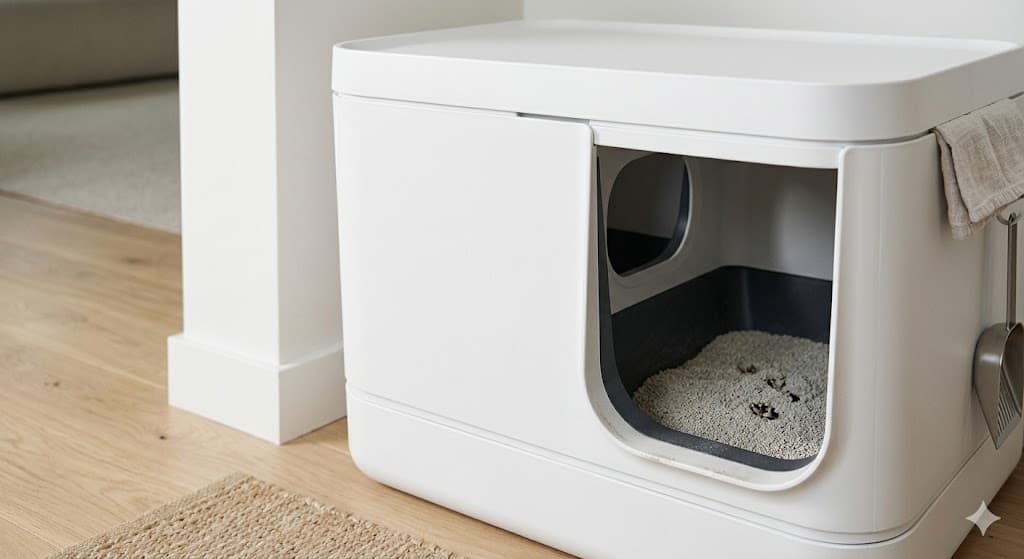
You have three cats, four litter boxes (yes, the n+1 rule), and the distinct impression that your house smells like a cat sanctuary, no matter how often you scoop. Your newest cat has started avoiding the smallest box entirely, leaving passive-aggressive puddles near the laundry room. Your elderly cat is struggling to climb into the hooded box that used to work fine. And somewhere between managing their individual preferences and your own olfactory limits, you’ve started wondering whether better litter boxes could actually solve problems rather than just contain them.
Multi-cat households require different litter box solutions than single-cat setups. The volume of waste is significantly higher, individual cat preferences must be accommodated, territorial dynamics create avoidance patterns that single-box solutions can’t address, and odor control becomes substantially more challenging at scale. The wrong litter box setup creates inappropriate elimination problems that damage floors, destroy furniture, and strain the human-cat relationships that make multi-cat households work in the first place.
We compared the five best multi-cat litter boxes in 2026 across high-volume households, different cat age ranges, varying space constraints, and different levels of owner maintenance involvement. Whether you have two cats or seven, a small apartment or a large home, and whether you’re looking for self-cleaning technology or old-school reliability, there’s a litter box below matched to your specific situation. If you’re also managing cat litter odor at the source, our guide on cat litter odor control covers complementary strategies that pair well with proper box selection. In a household with a dog as well, our enclosure picks cover keeping them out.
Disclosure: HappyPaws is reader-supported. As an Amazon Associate, we earn from qualifying purchases made through links on this page, at no extra cost to you.
Why Multi-Cat Litter Boxes Require Different Thinking
Single-cat litter box advice often fails in multi-cat households. Understanding why requires looking at cat behavior and household dynamics rather than just box features.
The Territory and Avoidance Problem
Cats use litter boxes as territorial markers, and in multi-cat households, dominance hierarchies play out around resource access. Subordinate cats may avoid boxes recently used by dominant cats, creating inappropriate elimination in alternative locations. A box that seems functionally adequate for single-cat use fails when territorial dynamics prevent fair access.
The n+1 rule (one litter box per cat, plus one extra) addresses this by ensuring each cat has options. But box count alone doesn’t solve the problem, box placement matters equally. Placing all boxes in one room creates a single territorial zone rather than distributed access points. Distributing boxes across different rooms provides subordinate cats with spaces they can use without confrontation.
The Volume Math
Two cats produce roughly 2x the waste of one cat (obviously), but the impact on litter box systems is non-linear. Litter that stays relatively clean for a week with one cat requires daily scooping with two cats to maintain the same quality. Three or four cats can overwhelm even aggressive daily scooping. This volume increase affects box choice significantly, high-sided designs that contain kick-out become more important, larger box volumes that handle multiple uses before saturation reduce daily maintenance, and self-cleaning technology becomes more valuable as per-cat maintenance time compounds.
Run the numbers for a specific household below. The box count follows from how many cats share the space and how many floors they use, and the minimum length follows from the largest cat rather than the average one. A household spread across several floors often needs more boxes than the n plus one rule alone suggests.
Individual Cat Preferences
Each cat develops individual preferences for box style, litter type, entry height, and privacy level. In single-cat households, you optimize for one cat’s preferences. In multi-cat households, different cats often prefer different box styles, one cat may love hooded boxes while another refuses them, or one cat may prefer top-entry while another needs low-step access for senior mobility.
Rather than forcing all cats to use identical boxes, offering variety across the household accommodates individual preferences. This pragmatic approach reduces inappropriate elimination caused by cats avoiding boxes that don’t suit their preferences. Our cat litter mats follows similar individualization logic for different stress-management preferences.
The Odor Control Challenge
Multi-cat households generate more concentrated urine odor because multiple cats use the same boxes repeatedly. Ammonia concentrations build up faster than in single-cat households, and the bacterial breakdown that creates the strongest odors happens more quickly in more-used boxes. Litter box design affects odor significantly, covered boxes trap odors that open boxes dissipate, but also concentrate them between uses. Self-cleaning boxes remove waste before significant odor develops. Higher-walled designs contain odor better but may not prevent it.
What to Look for in the Best Multi-Cat Litter Boxes
Specific features matter more for multi-cat households than single-cat situations. These factors directly affect whether a litter box system actually serves your cats or creates problems.
Appropriate Size for Your Largest Cat
Boxes need to accommodate your largest cat comfortably, ideally 1.5x the cat’s length (nose to base of tail) in both dimensions. Small boxes cause kick-out, discomfort, and avoidance. The old “standard” 16×12 inch boxes are undersized for adult cats; appropriate sizing runs 20×16 inches minimum for average cats, 24×20 inches for larger breeds like Maine Coons or Ragdolls. In multi-cat households, the largest cat’s needs set the minimum size for all boxes.
Entry Height for All Ages
Entry thresholds matter enormously for senior cats, arthritic cats, and kittens. Standard boxes with 4-6 inch entry walls work for adult cats with full mobility. Senior cats struggle with entries above 3 inches, and may refuse boxes that require painful jumping. Low-entry boxes or step-stool supplementation maintains accessibility as cats age. Kittens similarly need lower entries until they reach full mobility.
Litter Retention and Kick-Out Control
Kick-out, litter scattered around the box during digging and elimination, compounds in multi-cat households because multiple cats kick out litter from shared boxes. High-sided boxes contain kick-out more effectively than standard-height designs. Top-entry boxes virtually eliminate kick-out entirely. Litter-catching mats supplement containment for boxes with any exposed entry.
Easy Cleaning and Maintenance
Multi-cat households involve significantly more frequent cleaning. Boxes with removable liner trays, smooth interior surfaces, and rounded corners clean faster than complex designs with crevices that trap waste. Dishwasher-safe components speed deep cleaning. For self-cleaning models, waste receptacle design affects how often you need to actually empty versus just monitor.
Odor Control Features
Carbon filters in hooded boxes absorb odors before dispersal, but require replacement every 30-60 days. Antimicrobial surfaces in premium boxes resist bacterial growth that creates stronger odors. Self-cleaning systems prevent odor by removing waste rapidly rather than containing accumulated waste. Consider which odor control mechanism matches your maintenance preferences and budget.
Privacy and Security Balance
Cats want privacy during elimination, but also escape routes if threatened. Fully enclosed boxes provide maximum privacy but create ambush opportunities in multi-cat households where other cats may block exits. Open boxes provide full escape visibility but no privacy. Partial enclosures balance both needs. Box design affects cat comfort significantly in multi-cat contexts where dynamics can create elimination anxiety.
Self-Cleaning Technology Considerations
Self-cleaning boxes (electronic scooping systems) offer major maintenance reduction but introduce reliability concerns, cost considerations, and specific cat acceptance requirements. Not all cats accept self-cleaning boxes, the noise and movement frighten some cats enough to refuse use entirely. Premium self-cleaning boxes work reliably for acceptance-compatible cats; budget self-cleaning boxes often fail mechanically or process litter poorly.
Best Multi-Cat Litter Boxes in 2026: Our Top 5 Picks
1. Modkat Flip Litter Box, Best Overall Multi-Cat Litter Box
Best Overall | Price: ~$170
The Modkat Flip delivers a premium multi-cat litter box design through an innovative front-entry top-flip design that balances privacy, litter containment, and easy cleaning access. The oversized interior accommodates large cats and multiple users, while the hinged lid simplifies daily scooping significantly. For multi-cat households wanting quality design without self-cleaning complexity, the Flip represents category-leading value.
Best for: Most multi-cat households, owners prioritizing design aesthetics, households with cats that reject enclosed boxes, and anyone wanting premium quality without self-cleaning technology.
Why the Modkat Flip Sets the Multi-Cat Standard
The internal dimensions (21×16×16 inches) accommodate cats up to 18 pounds comfortably, with room for multiple uses between servicing. The elevated walls contain kick-out effectively, while the front entry remains accessible to cats of all sizes and mobility levels. Unlike fully enclosed boxes, the partial enclosure provides privacy without creating ambush anxiety.
The hinged lid flips completely open for cleaning, providing full access to interior surfaces. Standard hooded boxes require removing the entire cover for thorough cleaning, a regular hassle that discourages proper deep cleaning frequency. The Flip design encourages better maintenance through easier access.
Construction uses durable polypropylene plastic that resists staining, bacterial growth, and urine scald over multi-year use. The smooth interior surfaces clean easily with standard household cleaners. The base includes an integrated tarp and liner system that supports scooping hygiene between deep cleans.
The included litter scoop clips to the box for convenience, a small detail, but one that reduces the “where’s the scoop” problem that plagues households with multiple boxes. Replacement litter liners are available but not required.
Total cost of ownership: $170 upfront with a 5-7 year expected lifespan. Per-year cost around $25-35, reasonable for a premium multi-cat household quality.
PROS:
- Oversized interior for large cats and multi-use
- Flip-open lid simplifies cleaning
- Partial enclosure balances privacy and escape access
- Attractive design suits home aesthetics
- Durable construction for long-term use
- Integrated scoop storage
- No filter replacements required
CONS:
- Higher upfront price than basic boxes
- Not self-cleaning (daily scooping required)
- Only available in limited color options
- Large footprint requires dedicated space
- Not ideal for extremely small apartments
- Setup requires assembly
2. Litter-Robot 4, Best Self-Cleaning Multi-Cat Litter Box
Best Self-Cleaning | Price: ~$699
For multi-cat households wanting serious maintenance reduction, Litter-Robot 4 represents the premium tier of automatic litter box technology. The rotating globe design automatically separates waste from clean litter after each use, depositing waste in a sealed receptacle below. The app-connected system tracks each cat’s box usage (identified by weight), alerting owners to changes in elimination patterns that can indicate health issues. For households with 2-4 cats where scooping time significantly impacts daily routine, the Litter-Robot delivers genuine life-quality improvement.
Best for: Households with 2-4 cats, maintenance-averse owners, multi-cat health monitoring needs, users who’ve tried cheaper automatic boxes without success.
Why the Litter-Robot 4 Justifies the Premium
The rotating globe mechanism is fundamentally different from scraping or raking self-cleaning boxes that plague cheaper alternatives. Rotation separates waste through gravity as the globe turns, clumped litter falls through a sifter into the waste compartment while clean litter returns to the box. This mechanism handles heavier-use conditions in multi-cat households reliably, unlike scraping systems that jam or miss waste.
Capacity handles multiple cats without requiring constant emptying. The waste drawer holds approximately 7-10 days of waste for a 2-cat household, 4-7 days for 3-4 cats. The large drawer size reduces the frequency of the actual messy task (emptying complete waste) compared to the daily scooping requirements of manual boxes.
App connectivity provides individual cat tracking through weight detection. Each cat’s entries are logged separately, creating patterns that reveal changes before they become noticeable behaviorally. A cat using the box 30% more than baseline may be developing urinary tract issues; a cat using 50% less may have constipation. Early detection through quantified data catches health issues earlier than observation alone.
The premium cost reflects actual manufacturing quality and technology investment. Cheaper self-cleaning alternatives fail within 1-2 years; the Litter-Robot 4 typically reaches 7-10+ years of reliable service. The annualized cost becomes reasonable despite the upfront price when the lifespan is considered.
Total cost of ownership: $699 upfront with a 7-10 year expected lifespan. Per-year cost around $70-100, significant but justified for 24/7 elimination of scooping tasks.
PROS:
- Truly automatic cleaning with each use
- Individual cat tracking through weight detection
- App notifications for maintenance and health
- Handles multi-cat volume reliably
- Long expected lifespan justifies investment
- Quieter than earlier Litter-Robot models
- Dramatic maintenance time reduction
CONS:
- Highest price point in category
- Some cats refuse due to motion/sound
- Requires specific clumping clay litter
- Occasional mechanical issues possible
- Electrical requirement limits placement
- Waste drawer still requires periodic emptying
- Large footprint
3. IRIS USA Top Entry Cat Litter Box, Best Top-Entry Multi-Cat Box
Best Top-Entry | Price: ~$35
For multi-cat households with significant kick-out problems, dogs who eat litter, or strong privacy preferences, the IRIS USA Top Entry Cat Litter Box solves these specific issues more effectively than traditional entry designs. The top-opening entrance requires cats to climb in and out, which shakes litter off their paws on exit, dramatically reducing tracking and kick-out. At budget pricing, this solution is accessible to most households.
Best for: Households with excessive litter tracking, dog-accessible homes, cats wanting maximum privacy, households in smaller spaces where footprint matters.
Why Top-Entry Design Solves Specific Problems
The top-entry design eliminates traditional kick-out almost entirely, cats can’t scatter litter through an open doorway because there’s no open doorway. The exit requires climbing onto the ridged top, which mechanically shakes litter off paws before they contact carpets or hardwood. Tracking reduction in households with top-entry boxes is typically 60-80% compared to standard entry designs.
For dog-accessible households, the top-entry design prevents dogs from accessing litter (both eating clumps, a disgusting and unhealthy behavior, and using the cat box inappropriately). Most dogs can’t climb over the 14-inch sides to access the litter. This physical separation addresses a specific problem that’s common in mixed-pet households.
Privacy is maximum, cats are fully enclosed during elimination with only an overhead opening. Skittish cats often prefer this level of privacy. However, the enclosure creates ambush opportunities in multi-cat households where dominant cats may block the exit. This isn’t ideal for households with aggressive inter-cat dynamics; it works well for peaceful multi-cat households.
Cleaning requires removing the lid entirely, which is less convenient than flip-top designs. The 22×16×15 inch internal dimensions accommodate most cats but may be tight for very large breeds. Some cats refuse top-entry designs because of the climbing requirement, senior cats especially may struggle with the height.
Total cost of ownership: $35 upfront with 4-5 year expected lifespan. Per-year cost around $7-9, excellent value for solving the specific tracking problem.
PROS:
- Dramatically reduces tracking and kick-out
- Prevents dog access in mixed-pet households
- Maximum privacy for skittish cats
- Smaller footprint than hooded alternatives
- Affordable price point
- Simple durable construction
- Good for most adult cats
CONS:
- Senior or arthritic cats may struggle
- Ambush potential in multi-cat households
- Interior cleaning requires full lid removal
- Some cats refuse top-entry designs
- Internal size tight for very large breeds
- No self-cleaning features
4. Petmate Booda Dome, Best Hooded Multi-Cat Litter Box
Best Hooded | Price: ~$60
For multi-cat households wanting enclosed privacy with conventional side-entry access, the Petmate Booda Dome delivers well-designed hooded litter box functionality. The dome design includes a stepped entry that reduces tracking (similar principle to top-entry boxes but through a different mechanism), carbon filter odor control, and an interior large enough to accommodate multiple cat users comfortably. For traditional hooded box preference with multi-cat-appropriate sizing, Booda delivers.
Best for: Traditional hooded box preferences, moderate tracking concerns, cats that reject top-entry designs, households wanting odor containment.
Why the Booda Dome Outperforms Standard Hooded Boxes
The stepped entry design requires cats to climb slightly upward into the box, which shakes litter off paws before exit, achieving tracking reduction similar to top-entry boxes while maintaining side-entry accessibility for senior cats. This design element differentiates the Booda from basic hooded boxes that allow direct litter tracking. Entry style matters more with several cats sharing, and our comparison of top entry against front entry boxes covers both.
The dome shape maximizes interior volume within a given footprint, the curved walls provide more usable space than rectangular hooded boxes. Interior dimensions (21×21×18 inches) accommodate cats comfortably and allow for multiple uses before servicing. The curved shape also eliminates the corner buildup of waste that rectangular boxes develop.
The included carbon filter traps odors before dispersing into the room, delivering meaningful odor reduction compared to open boxes. Filter replacement runs $5-8 every 60-90 days, a small but real ongoing cost. For households where odor control matters significantly, the filter benefit often justifies this recurring expense.
The design accommodates most standard clay, clumping, and natural litters well. The interior slopes slightly toward the entry, which some cats find disorienting initially but most adapt to. Cleaning requires removing the dome entirely (which separates easily from the base), giving full access to interior surfaces for deep cleaning.
Total cost of ownership: $60 upfront plus $20-30/year in filter replacements, 4-5 year expected lifespan. Per-year cost around $30-40, reasonable for the hooded category.
PROS:
- Stepped entry reduces tracking
- Maximum interior volume for footprint
- Carbon filter odor control included
- Traditional side-entry accessibility
- Good for most cat sizes
- Works with most litter types
- Attractive curved design
CONS:
- Requires ongoing filter replacement costs
- Dome removal needed for deep cleaning
- Interior slope takes adjustment
- Not as tracking-effective as top-entry
- Larger footprint than top-entry options
- Limited color options
5. Van Ness Extra Giant Enclosed Cat Pan, Best Budget Multi-Cat Litter Box
Best Budget | Price: ~$28
For multi-cat households on tight budgets or needing multiple boxes to satisfy the n+1 rule without premium costs per box, Van Ness Extra Giant delivers legitimate oversized litter box functionality at genuine budget pricing. The extra-large dimensions and removable hood offer flexibility, and the basic construction lacks premium features but meets functional requirements for most multi-cat situations.
Best for: Budget-constrained households, foster cat situations, secondary/backup litter boxes, homes with 3+ cats needing multiple boxes.
Where Van Ness Compromises and Where It Doesn’t
The interior dimensions (25×19×10 inches) genuinely accommodate large cats and multiple uses between scoops. Size isn’t compromised versus premium alternatives, the savings come from construction material quality and design refinement rather than functional sizing.
Construction uses thinner plastic than premium boxes, which affects durability over time. Expect 3-4 year lifespan versus 5-7 years for premium alternatives. For budget-conscious multi-cat households, buying two Van Ness boxes versus one premium box and accepting shorter lifespan often makes mathematical sense.
The removable hood provides flexibility, use enclosed for privacy-preferring cats or open for cats who reject hooded boxes. This versatility accommodates different cat preferences within a single box purchase. The flexibility is genuine utility beyond cost savings.
Odor control is minimal, no carbon filter, no antimicrobial surfaces, just basic plastic. In multi-cat households, this means more reliance on frequent scooping and litter changes to manage odors. Some households compensate with better litter brands; others find the odor control inadequate regardless of litter choice.
Cleaning is straightforward due to simple construction. The basic design means fewer crevices to trap waste. The hood removes easily for thorough cleaning.
Total cost of ownership: $28 upfront with a 3-4 year expected lifespan. Per-year cost around $7-10, the cheapest genuine multi-cat option.
PROS:
- Legitimate oversized dimensions at a budget price
- Removable hood for versatility
- Simple construction cleans easily
- Widely available at most retailers
- Good for foster/temporary situations
- Allows buying multiple boxes affordably
- No ongoing filter costs
CONS:
- Thinner plastic construction
- Shorter expected lifespan
- No odor control features
- Basic aesthetics
- No tracking-reduction features
- Limited durability for aggressive diggers
- Minimal design refinement
Quick Comparison of the Best Multi-Cat Litter Boxes
For fast reference, here’s how the five options stack up:
- Modkat Flip, Best overall with premium design and large capacity, ~$170
- Litter-Robot 4, Best self-cleaning with individual cat tracking, ~$699
- IRIS USA Top Entry, Best top-entry for tracking control and budget pricing, ~$35
- Petmate Booda Dome, Best traditional hooded with odor control, ~$60
- Van Ness Extra Giant, Best budget option for multiple box purchases, ~$28
How to Choose the Right Multi-Cat Litter Box Setup
Match your litter box choice (or combination) to your household size, cat temperaments, and maintenance preferences.
If you have 2-3 cats in an average household, the Modkat Flip as primary box plus one budget backup (Van Ness or similar) provides the n+1 coverage without premium cost for every box. The Flip handles the majority of use; the backup provides territory dispersion and redundancy.
If you have 3-4 cats and maintenance time is a significant constraint, the Litter-Robot 4 delivers genuine life-quality improvement. The app monitoring also helps track individual cat health in households where observation becomes difficult with more animals. Supplement with 1-2 manual backup boxes for the n+1 rule.
If tracking is a major problem in your household, IRIS USA Top Entry as primary boxes (buy 2 for multi-cat coverage) addresses the tracking issue more effectively than any other design. At $35 per box, buying two still costs less than one premium alternative.
If you prefer traditional hooded boxes and odor control is a priority, Petmate Booda Dome’s carbon filter system manages multi-cat odors better than open boxes. Works well as a primary box with a top-entry or open box supplement for cats that reject hooded designs.
If budget is tight and you have 3+ cats requiring multiple boxes, buying 3-4 Van Ness boxes provides adequate coverage at under $100 total. The shorter lifespan and basic features are acceptable tradeoffs for budget-constrained households where coverage matters more than refinement.
Budget Math Across Multi-Cat Litter Box Options
Annualized costs for a 3-cat household needing 4 boxes (n+1 rule):
- 4 Van Ness Extra Giant: $112 upfront ÷ 3.5 years = $32/year
- 4 IRIS USA Top Entry: $140 upfront ÷ 4.5 years = $31/year
- 1 Modkat + 3 Van Ness: $254 upfront across mixed lifespans = ~$51/year
- 4 Petmate Booda + filters: $240 upfront + $100 filters/year = $148/year over 4.5 year lifespan
- 1 Litter-Robot + 2 Van Ness + 1 Modkat: $897 upfront across mixed lifespans = ~$135/year
For context, inappropriate elimination problems from inadequate litter box setup can cost $200-500 in carpet/flooring damage per incident, plus professional cleaning. The marginal cost of premium multi-cat solutions often pays back within a single prevented incident.
Accessories Most Multi-Cat Households Need
Three additions that optimize multi-cat litter box systems.
Litter-catching mats ($25-45 for quality options) around each box dramatically reduce tracking throughout the house. Honeycomb or grooved designs work better than flat mats. In multi-cat households with multiple boxes, multiple mats matter.
High-quality clumping litter ($20-40 for 40lb bags) affects odor control, clumping performance, and cat acceptance significantly. Premium clay clumping litters generally outperform value options in multi-cat household performance. Match litter type to your boxes (some self-cleaning boxes require specific litter).
Enzymatic cleaner for accidents ($15-25 per bottle) handles inevitable inappropriate elimination without leaving markers that encourage repeat offenses. Regular cleaners often leave odor residues invisible to humans but attractive to cats for re-marking. Nature’s Miracle and Rocco & Roxie are widely recommended options.
When the Best Multi-Cat Litter Box Isn’t Enough
Litter box choice addresses major aspects of multi-cat elimination issues, but some problems require intervention beyond box selection.
Medical issues cause inappropriate elimination surprisingly often. UTIs, crystals, kidney disease, arthritis, cognitive dysfunction, and numerous other conditions affect elimination behavior. If cats suddenly start avoiding previously accepted boxes, veterinary evaluation should happen before assuming it’s a box or behavioral issue. Medical causes are common enough that they should be ruled out first.
Severe inter-cat aggression creates elimination problems that no box setup resolves. Cats unable to access boxes safely due to household dynamics require behavioral intervention, often professional help from a veterinary behaviorist. Gradual reintroduction protocols, pheromone products like Feliway, and sometimes medication address the underlying dynamics.
Territorial marking (spray-marking) is different from inappropriate elimination and requires different interventions. Intact males spray more frequently than neutered males; intact females can also spray. Neutering eliminates most spraying. Residual post-neutering spraying often responds to environmental management and sometimes medication rather than litter box changes.
Our Verdict on the Best Multi-Cat Litter Boxes
Modkat Flip Litter Box is the right choice for most multi-cat households wanting quality design and adequate capacity. The flip-open lid, oversized interior, and attractive aesthetic make daily management easier than basic boxes. At $170 with 5-7 year lifespan, the per-year cost is reasonable for a primary litter box in a multi-cat household.
For maintenance-constrained households with 2-4 cats, Litter-Robot 4 delivers genuine quality-of-life improvement through automatic cleaning and individual cat tracking. The $699 investment is significant, but the maintenance time reduction over 7-10 years of lifespan makes the per-day cost minimal. The app-based health monitoring adds real value in multi-cat health management.
Households struggling with tracking or mixed-pet situations benefit dramatically from IRIS USA Top Entry boxes. At $35 per box, buying multiple for n+1 coverage remains affordable, and the tracking reduction is visible within the first week of use. The accessibility limitations for senior cats make this unsuitable for multi-generational feline households, but excellent for younger adult cat homes.
Traditional hooded box preferences should choose Petmate Booda Dome for its refined design, built-in odor control, and tracking-reduction stepped entry. The ongoing filter costs are a real consideration, but the odor control benefit justifies the expense for households where smell management is a priority.
Budget-constrained households needing multiple boxes for n+1 coverage should start with Van Ness Extra Giant for primary needs. The shorter lifespan and basic features are acceptable trade-offs when the alternative is an inadequate box count, which causes worse problems than basic box quality.
Whichever you choose, the n+1 rule and proper distribution across household rooms matter more than the specific box models. A household with 4 cats and only 2 premium boxes often has worse elimination problems than 4 basic boxes distributed properly. Invest in adequate coverage before upgrading individual box quality, cats using bad boxes still prefer them to nothing when alternatives don’t exist.
Frequently Asked Questions
How many litter boxes do I need for multiple cats?
The standard rule is n+1, one box per cat plus one additional. Two cats need 3 boxes; three cats need 4 boxes; four cats need 5 boxes. This coverage prevents territorial avoidance issues where subordinate cats avoid boxes frequently used by dominant cats. Equally important is distribution across rooms, placing all boxes in one location creates a single territorial zone rather than providing alternative access points. Distribute boxes across different rooms when possible.
What size litter box works best for multi-cat households?
Multi-cat household boxes need to accommodate your largest cat comfortably, so size based on your biggest cat, typically 20×16 inches minimum, 24×20 inches for larger breeds. The “1.5x cat length” rule applies (box length should equal 1.5x your largest cat’s length nose-to-base-of-tail). Undersized boxes cause kick-out, discomfort, and avoidance. In multi-cat households especially, oversized boxes handle multiple uses between servicing better than standard sizes.
Are self-cleaning litter boxes worth it for multi-cat households?
Self-cleaning boxes can significantly reduce maintenance time in multi-cat households, but only premium models (like Litter-Robot 4) reliably handle multi-cat volume. Budget self-cleaning boxes frequently jam, miss waste, or fail mechanically within months. If you’re considering self-cleaning, invest in quality rather than cutting corners, the price difference reflects actual reliability differences. Also confirm your cats accept the motion and sound before committing; some cats refuse self-cleaning boxes entirely.
Should all litter boxes in my multi-cat household be the same style?
No, offering variety actually helps multi-cat households. Different cats often prefer different box styles (hooded vs open, top-entry vs side-entry, low-step vs standard). Having 2-3 different styles across your total box count accommodates individual preferences rather than forcing all cats to use identical boxes. This variety reduces inappropriate elimination caused by cats avoiding boxes that don’t suit their preferences.
How often should I clean multi-cat litter boxes?
Daily scooping minimum for multi-cat households; twice-daily scooping in heavy-use situations (3+ cats). Complete litter changes every 2-4 weeks depending on litter type and box count. Thorough deep cleaning (wash with mild soap, thoroughly dry) monthly. Poor maintenance causes more multi-cat elimination problems than any other single factor, cats have extremely sensitive smell and avoid boxes that humans would consider barely dirty.
What’s the best location for multi-cat litter boxes?
Distribute boxes across different rooms rather than clustering them. In multi-story homes, place boxes on each floor. Avoid isolated spots like basements with limited access, as well as high-traffic areas near food bowls or entrances. Each box should provide multiple escape routes (not dead-end corners where cats can be trapped by dominant cats). Low-traffic but accessible locations work best, near cat resting areas but not right next to food.
Can I use different litter types in different boxes?
Yes, different litters in different boxes can accommodate cats with different preferences. However, most multi-cat households find consistency easier for purchasing and cat acceptance. If you’re testing different litters, offer the same litter in all boxes during testing to isolate which litter cats prefer. Once established, consistent litter across boxes simplifies household management.
What should I do if one cat starts avoiding the litter box?
First, rule out medical causes with a veterinary exam, UTIs, crystals, kidney issues, arthritis, and other conditions cause sudden elimination changes. If medically cleared, examine whether any recent changes occurred (new cat, new furniture near box, box moved, different litter, inadequate cleaning). Try offering additional boxes in different locations and different litter types to restore options. If problems persist despite medical clearance and environmental adjustments, consult a veterinary behaviorist.
Recommended Reading
See also our guides to cat exercise wheels, low entry litter boxes senior cats, and clumping vs non clumping cat litter.
