
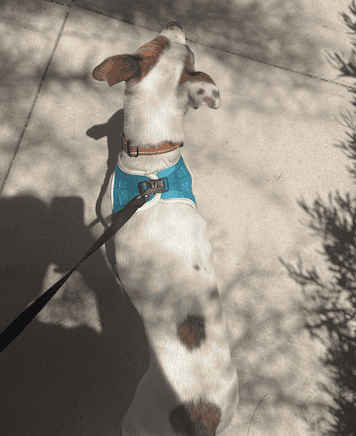
For recommendations, see our best dog harnesses for pulling guide. A dog that pulls on the leash turns a calm walk into a workout and limits where you can go without straining your arm or the dog’s neck. The instinct most people have is to pull back harder, which makes it worse, because dogs have an opposition reflex and instinctively push against pressure. To stop leash pulling, the dog has to learn that pulling earns no forward progress and that a loose leash is what keeps the walk moving. The right gear, like a front-clip no-pull harness, makes that lesson far easier to teach. For more, see why dogs pull on the leash.
Quick Verdict
Stop leash pulling by switching to a front-clip no-pull harness and a fixed leash, then halting every time the leash goes tight so pulling never earns forward progress. Reward loose-leash walking, add distractions slowly, and stay consistent across a few weeks for the new habit to replace the old one.
Key Takeaways
- A front-clip no-pull harness redirects a pulling dog sideways, removing the reward of forward motion.
- The stop-and-reset method, halting every time the leash tightens, is the single most effective technique once the gear is right.
- Pulling is self-rewarding, so the retraining has to make pulling consistently fail.
- Consistency across every walk matters more than the specific method; mixed messages slow progress.
Why Dogs Pull
Dogs pull because pulling works. When a dog pulls forward and you take a step that way, even reluctantly while telling them to stop, the pull just got rewarded. Repeat that over enough walks and pulling becomes the default walking style.
The other piece is the opposition reflex. When you hold a dog back, they instinctively push against the pressure, a response hardwired in many working and herding breeds. A flat collar with a tight leash actively triggers the reflex you are trying to suppress, so the dog learns to pull and the gear amplifies it. Changing both at once produces the fastest results.
What You Need Before You Start
A Front-Clip No-Pull Harness
Front-clip harnesses attach the leash at the dog’s chest rather than between the shoulders, so a pull redirects the dog sideways instead of letting them lean their full weight into it. That removes most of the mechanical advantage and most of the opposition-reflex trigger. I use a front-clip harness on my own dog, and the difference compared to a flat collar was immediate.
A Standard Fixed-Length Leash
Use a standard fixed-length leash, roughly four to six feet, and avoid retractable leashes during training. A retractable’s variable length sends mixed signals about how close the dog should stay, and its constant light tension actively rewards pulling. A fixed leash gives clear, consistent feedback.
High-Value Treats and a Pouch
Use small, soft treats the dog finds extra special, since they have to compete with squirrels, smells, and other dogs. Freeze-dried meat, cooked chicken, or a favorite training treat all work. A treat pouch on your belt keeps rewards fast to reach, and speed of reward is what makes the lesson clear.
Time and Patience
Reliable loose-leash walking usually takes a few weeks of consistent practice on shorter, slower walks. Treat the training period as training rather than exercise, and meet the dog’s physical needs through yard play, mental enrichment, or controlled off-leash time in safe areas while the lessons take hold.
Step 1: Start in a Low-Distraction Environment
Begin inside the house or a quiet backyard rather than the busy street where the dog usually walks, since a dog cannot learn a new behavior while overwhelmed by stimulation. Walk a few steps on the front-clip harness and reward generously whenever the dog is near you with a loose leash, marking the moment with a word like “yes” or a clicker before you deliver the treat.
Practice in short sessions of a few minutes, a couple of times a day, and end each one before the dog gets bored. Frequent short sessions build the skill faster than occasional long ones.
Step 2: Apply the Stop-and-Reset Method
The core technique is simple. The moment the leash goes tight, stop walking. Do not yank or correct, just stand still and wait. The dog eventually turns back or steps toward you, which loosens the leash, and that is when you mark with “yes,” reward, and move on.
Repeat this every single time the leash tightens. On an early walk you may stop dozens of times, and within a few days far fewer, until by the second week or so the dog starts checking in with you to keep the walk moving. Consistency is the variable that makes it work, because stopping sometimes and letting them pull other times teaches the dog that pulling occasionally pays off, which keeps the habit alive.
Step 3: Add the U-Turn for Persistent Pullers
Some high-drive dogs ignore the stop and simply stand there pulling, expecting the walk to resume. The U-turn breaks that pattern. When the leash tightens, turn and walk the other way without a word, so the dog loses ground rather than just stalling.
After several U-turns, the dog starts paying attention to where you are going instead of dragging you where they want to go. It works because it removes the reward of pulling getting them there eventually.
Step 4: Reward Loose-Leash Walking Generously
Catching the dog walking well matters more than correcting the pull. Stop often to mark and reward a loose leash and a dog near your side, so they learn that staying close produces good things while pulling produces nothing useful.
Reward generously through the first couple of weeks, then space the treats out as the behavior holds. Eventually the walk itself becomes the reward, continuing only while the leash stays loose, and treats fade to occasional reinforcement.
Step 5: Gradually Increase Distractions
Once the dog walks on a loose leash in quiet settings, add challenge slowly. Quiet sidewalks first, then occasional pedestrians, then other dogs at a distance, then closer encounters as the dog stays focused.
Manage distance from triggers through this phase. If another dog appears and yours starts straining, cross the street to add space rather than testing whether the training holds at that intensity. Working below threshold, the distance at which your dog can still focus on you, protects the training, while pushing over threshold sets it back. Expect a dog who walks beautifully on a quiet trail to pull the first time they pass a dog park, since the skill transfers across settings gradually.
Step 6: Phase Out the Heavy Reward Schedule
After a few weeks of consistent training, most dogs walk on a loose leash with much less reinforcement. Keep rewarding occasionally to maintain the habit, especially in new places or when the dog is doing well, and let the walk itself carry the rest.
Keep the front-clip harness even after the dog walks well, since it is a tool rather than a corrective device and using it long term does not undermine the training. Once my own dog learned to walk without pulling, I moved to a retractable leash for relaxed walks, which works precisely because the loose-leash habit was solid first. That order matters: train on a fixed leash, then a trained dog can enjoy the extra room.
When Your Dog Is Anxious or Reactive
A fearful or traumatized dog pulls for a different reason than a high-drive one, and the fix leans more on calm than on technique. With my own rescue, who carries PTSD from before I adopted her, I have learned that the best move is often to stop where I am and wait, letting her settle before we go on.
When she tips over threshold and cannot refocus, a brief reset helps more than any cue. Because she is small, that sometimes means picking her up for a few seconds, just long enough to lower her arousal, then setting her down to continue the walk. This is an emotional reset for an anxious dog rather than a method for ordinary pulling, and it works because it gets her back below the threshold where she can think again. A dog who lunges or panics at any distance is worth working through with a certified positive-reinforcement trainer.
Common Mistakes and How to Avoid Them
A few habits send people back to square one.
Inconsistency Between Walkers
If one person stops for a loose leash while another lets the dog pull, the training will not stick. Everyone who walks the dog needs the same method, so agree on the approach as a household and hold to it.
Using a Flat Collar or Back-Clip Harness
Both work against you. Flat collars trigger the opposition reflex and can strain the trachea on a persistent puller, and back-clip harnesses are built for traction, which helps a dog pull more efficiently. A front-clip harness changes the mechanics in your favor.
Mixing in Aversive Corrections
Prong collars, slip collars, or leash jerks add discomfort to the walk, and the evidence points to aversive methods producing worse welfare outcomes without outperforming reward-based training for most goals1. The dog also starts linking walks, or the person walking them, with discomfort, which creates new problems.
Training and Exercising at the Same Time
The early weeks produce short, slow, stop-heavy walks, which are not exercise. Burn off energy with yard play or safe off-leash time, rather than trying to tire the dog on a fast walk while also teaching leash manners, since that usually means neither happens well.
Letting Pulling Work Intermittently
The fastest way to end a behavior is to make sure it never earns its reward. If you stop sometimes but other times let the dog pull you toward the interesting smell, the dog learns that persistence pays, and intermittent rewards keep a habit alive indefinitely.
Recommended Reading
- walking fundamentals worth revisiting
- Best no-pull dog harnesses
- How to leash train a small dog
- Retractable vs standard dog leash
Frequently Asked Questions
How long does it take to stop leash pulling?
Most dogs show meaningful improvement in the first week or two of consistent training, with full reliability often arriving within about a month. Dogs with long pulling histories, high-drive breeds, older dogs, and rescues with unknown backgrounds can take several months for the new habit to fully replace the old one.
Is a head halter a good alternative to a front-clip harness?
Head halters like the Gentle Leader or Halti work well for some dogs and can outperform a front-clip harness on very strong pullers. The trade-off is that some dogs find them uncomfortable and need a slow introduction, so most owners find the front-clip harness easier to start with and enough for everyday use.
What about a prong collar or shock collar?
Aversive tools work in the short term by adding discomfort, but the welfare and behavioral side effects make them poor choices. The American Veterinary Society of Animal Behavior and other professional groups recommend against aversive training tools, citing risks of fear, anxiety, and escalating aggression2. Reward-based methods produce comparable or better results without those risks.
My dog pulls toward other dogs specifically. Is that different?
Leash reactivity is a related but distinct problem. The core method still applies, but you work below threshold more carefully, adding distance before your dog tips over. If your dog lunges or barks at other dogs at any distance, a certified positive-reinforcement trainer who specializes in reactivity is worth the investment.
Can I train an older dog not to pull?
Yes. Older dogs learn new behaviors well, though established habits take longer to replace than fresh ones. Expect a longer timeline than with a puppy, lean on particularly high-value rewards, and keep consistency tight, since the old pattern has more momentum behind it.
Related Reading
Explore more: stop cat scratching furniture, dog doggles and sunglasses, dog gates, dog muzzles, dog jackets cold weather, how to choose dog gear, how to teach dog come called, and dog tents camping shelters.
Recommended Reading
See also our guides to how to stop a dog from eating poop, how to stop a puppy from biting, and why is my dog shaking.
Sources
- Vieira de Castro AC, Fuchs D, Morello GM, Pastur S, de Sousa L, Olsson IAS. Does training method matter? Evidence on aversive-based methods and companion dog welfare. PLOS One, 2020. https://journals.plos.org/plosone/article?id=10.1371/journal.pone.0225023
- American Veterinary Society of Animal Behavior. Position Statement on Humane Dog Training, 2021. https://avsab.org/resources/position-statements/
