
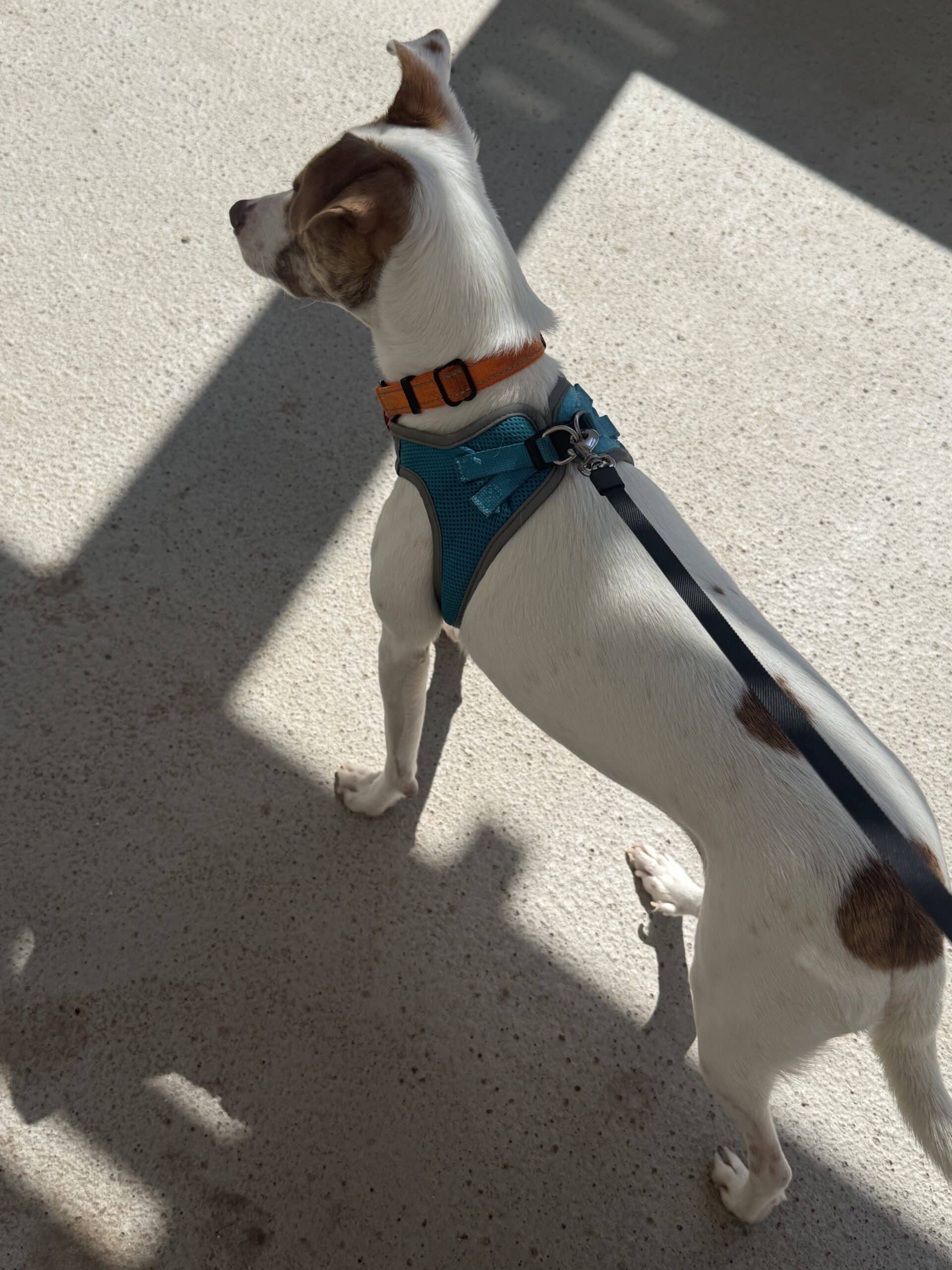
Measure your dog rather than trusting the weight bracket on the label. Most gear is sized by weight, but the dimension that determines fit is chest girth for harnesses, neck circumference for collars, and length nose to tail base for beds and crates. A dog sitting between categories fits by measurement even when no weight bracket claims them.
The categories themselves are not standardised. One brand’s medium is another’s large, and a dog at the boundary lands differently across manufacturers, which is why the same dog wears a medium harness and sleeps in a large bed.
Quick Answer
Take three measurements: chest girth behind the front legs, neck circumference, and length from nose to base of tail. Compare those against each brand’s own chart rather than the size name. Where you fall between, size up for beds and crates and stay exact for harnesses and collars.
Key Points
- Weight brackets are a rough proxy for the measurement that matters
- Size names are not standardised between brands
- Chest girth decides harness fit, not weight
- Size up on beds and crates, stay exact on anything worn
- Build matters as much as weight for the same number on the scale
- Food portions follow weight and condition, and a vet should set them
What to Measure
| Item | Measurement that decides fit | If between sizes |
|---|---|---|
| Harness | Chest girth behind front legs | Choose the size where you sit mid-range |
| Collar | Neck circumference plus two fingers | Size up, adjust down |
| Bed | Nose to base of tail, plus sleeping style | Size up |
| Crate | Length and height standing | Size up |
| Coat | Back length, neck to tail base | Match back length, check girth separately |
| Bowl | Volume by daily portion | Either works |
Why the Categories Fail at the Boundary
Small, medium, and large mean whatever each manufacturer decided. One brand puts the small ceiling at twenty pounds, another at thirty, and a dog at twenty-five lands in different categories depending on whose chart you are reading.
Weight is also a poor proxy for shape. Two dogs at the same weight can have very different chest depths and neck thicknesses, which is why a deep-chested dog and a stocky one need different harnesses despite matching on the scale.
The practical response is to stop reading size names and read the numbers underneath them. Every reputable brand publishes a measurement chart, and that chart is the actual product specification.
Where My Dog Lands
She is around twenty-five pounds, which technically puts her in medium, and she sits close enough to the boundary that I expected sizing to be a running problem. It has not been.
The harness I got lucky on. I picked a size and it fit, without measuring first, and I would not recommend that as a method. The collar fits too, and those are the only two things she wears, so the clothing side of this has been easier than I anticipated.
The crate was not an issue because I bought a collapsible one and deliberately went for space rather than a snug fit. That removed the sizing question entirely, which is worth knowing if you are hesitating between two crate sizes at the boundary.
The one thing I do have to guess at is food portions. Feeding charts run by weight bracket, and at the edge of a bracket the recommended amounts jump in a way that does not feel precise. That is the piece I have never felt confident about, and it is the one where guessing has real consequences rather than just an awkward fit.
I have never bought anything in the wrong size, which surprises me given how much is written about boundary dogs. My experience covers one twenty-five pound adult dog, and it does not cover growing puppies, where sizing is a moving target, or large breeds, where the stakes on a wrong harness are higher.
Taking the Measurements
Chest girth
Wrap a soft tape around the widest part of the ribcage, just behind the front legs. This is the number that decides harness fit and the one most people never take.
Neck
Measure where a collar sits, then add enough room for two fingers between collar and neck. Too tight is a safety issue and too loose lets a dog back out of it.
Length
Nose to the base of the tail, not including the tail itself, with the dog standing. This drives bed and crate sizing.
Height
Floor to the top of the shoulders standing, and floor to the top of the head for crate clearance. A dog should stand fully upright in a crate without ducking.
When to Size Up and When Not To
Size up on anything the dog rests in. A bed slightly too big is comfortable and one slightly too small gets used with limbs hanging off. Same for crates, where a dog needs to stand, turn, and lie fully stretched, covered in choosing a dog crate.
Stay exact on anything worn. A harness that is too large lets a dog slip out, and one too small restricts the shoulder. Fit is a safety question rather than a comfort one, and fitting a dog harness covers the checks.
Collars split the difference. Size up and adjust down, since the adjustment range is what you are buying.
The Food Portion Problem
Feeding guidance is printed by weight bracket, and brackets step rather than slide. A dog at the top of one bracket and a dog at the bottom of the next get noticeably different recommendations despite weighing almost the same.
Those charts are also generic. Activity level, age, neutering status, and metabolism all shift what an individual dog needs, and the bag cannot account for any of it.
This is the one sizing question worth taking to a vet rather than solving with a tape measure. They can assess body condition and give a figure suited to your dog, and body condition matters more than weight alone, covered in signs a dog is overweight.
Buying Around the Problem
Adjustable gear removes the boundary question. Harnesses with four adjustment points fit a wider range than two-point designs, and collapsible crates let you buy for space rather than precision.
Generous sizing works for anything the dog rests in, since extra room costs nothing except floor space. This is why buying the larger crate at a boundary rarely goes wrong.
Return policies matter more for boundary dogs than for anyone else. Buying from somewhere that accepts returns on worn items removes most of the risk, and options for smaller dogs sit in choosing a harness for small dogs.
What Fit Looks Like
A harness fits when two fingers slide flat under any strap, the dog moves freely at the shoulder, and nothing shifts when they pull. A collar fits at two fingers with no risk of slipping over the head.
A bed fits when the dog can lie fully stretched without a limb hanging off, allowing for the fact that most dogs curl. A crate fits when the dog stands without ducking, turns without contorting, and lies out flat.
Related Reading
- checking a harness fits properly
- bed sizing by sleeping style
- crate dimensions that work
- which to use for walks
- bowl volume by portion
- beds at the medium end
Frequently Asked Questions
Should I size up or down for a dog between sizes?
Up for anything they rest in, such as beds and crates, where extra room costs nothing. Exact for anything worn, since a loose harness lets a dog slip out and a tight one restricts movement.
Why do brands size differently?
Size names are not standardised, so one manufacturer’s medium ends where another’s begins. Read the measurement chart underneath the size name, since that is the actual specification.
What measurement matters most for a harness?
Chest girth, measured around the widest part of the ribcage just behind the front legs. Weight is only a rough proxy, and two dogs at the same weight can need different sizes depending on build.
Is a 25 pound dog small or medium?
It depends whose chart you read. Twenty-five pounds sits at the boundary, landing in small for some brands and medium for others, which is why measuring beats reading the category name.
How do I know how much to feed a boundary dog?
Feeding charts step by weight bracket and cannot account for activity, age, or metabolism. This is worth asking a vet about rather than estimating, since they can assess body condition and give a figure for your dog.
Can I use a puppy’s measurements to buy ahead?
For beds and crates, yes, with crate dividers to adjust the space. For harnesses and collars, no, since a growing dog needs correct fit now and adjustable gear or replacements as they grow.
When should I ask a vet?
For feeding amounts, weight management, and any gear question tied to a health condition such as joint problems or breathing difficulty. Fit questions can be measured, and nutrition and health need individual assessment.
Measurement beats weight brackets throughout. the wider gear guide covers each category.
