
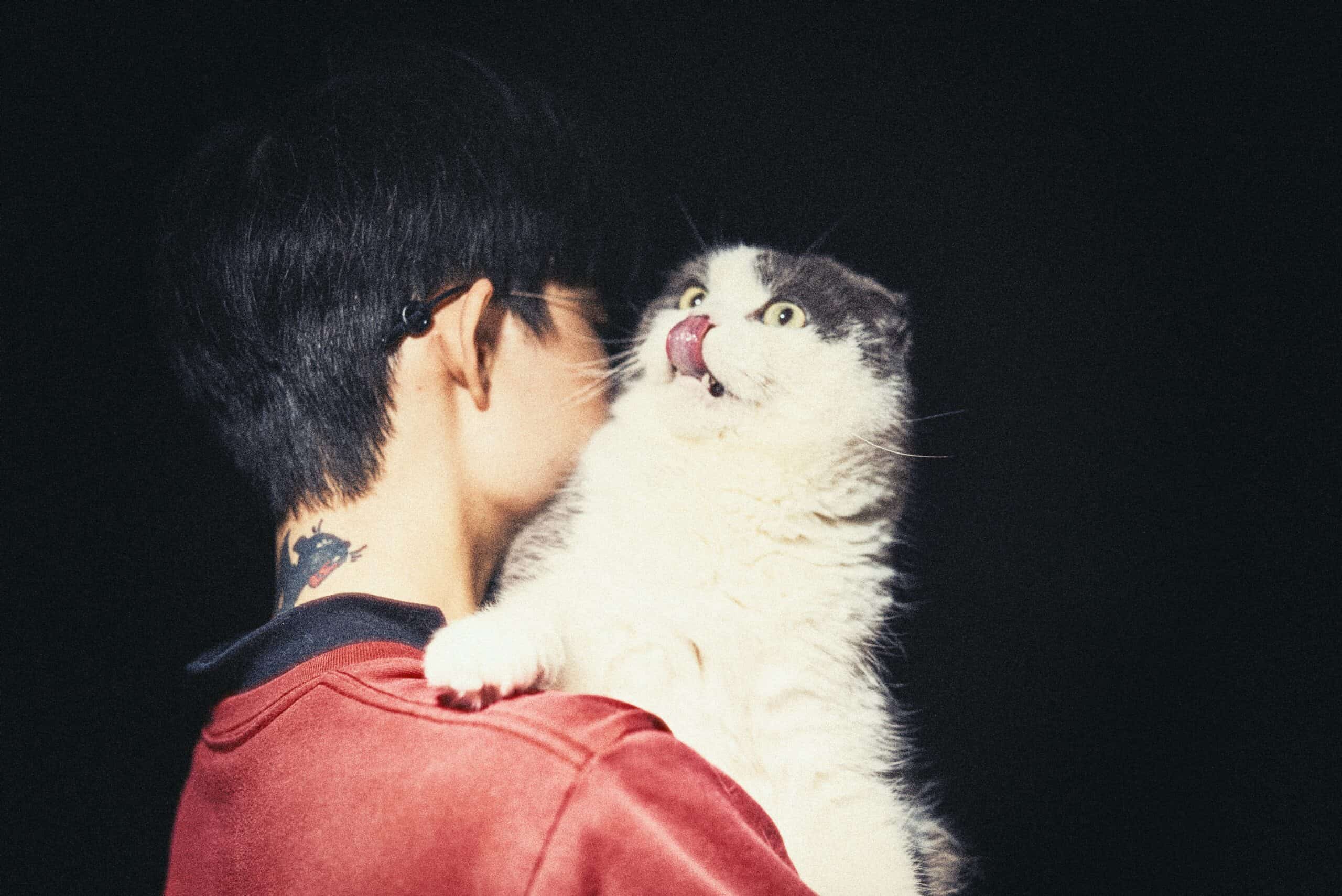
Because licking is how cats groom the members of their group, and being licked means you have been included in it. When your cat licks you, the behavior is usually allogrooming, the mutual grooming cats do with family members, and it also serves to mark you with scent and to ask for attention.
It sits in the same family of behaviors as head rubbing. Our guide to why cats rub against you covers the scent side of the same instinct.
Quick Answer
Cats lick people the way they lick each other: to groom, to exchange scent, and to reinforce a social bond. Add attention seeking, taste on your skin, and occasionally stress. Licking that becomes obsessive, or targets one spot repeatedly, is worth mentioning to a vet.
Key Takeaways
- Licking is social grooming, and you are being groomed as family.
- Scent exchange is part of the point.
- The rough tongue is built for pulling fur, not for softness.
- Salt, lotion, and food residue on skin invite it too.
- Lick-then-bite is usually overstimulation rather than aggression.
- Sudden excessive licking is a reason to check in with a vet.
| What you see | Most likely reason |
|---|---|
| Licking your hand or arm while relaxed | Allogrooming, bonding |
| Licking your hair or face | Grooming the parts a cat would groom |
| Licking then nibbling | Overstimulation, time to stop |
| Licking right after you apply lotion | Taste and smell |
| Licking while kneading and purring | Deep comfort behavior |
| Frantic or constant licking | Stress or a medical issue, see a vet |
Allogrooming, the Main Explanation
Cats that live together groom each other. It happens most between cats who are socially bonded, and it concentrates on the head and neck, the areas a cat cannot easily reach alone.
Licking a person is that behavior pointed at you. It is not a mistake about what species you are; it is a cat treating you as part of the social group it grooms.
That is why it so often lands on hands, arms, and hair. Those are the parts of you within reach of a cat sitting on or beside you.
It also explains the timing. Grooming happens during calm, settled moments rather than during play, which is why licking usually arrives when the cat is relaxed against you.
Scent, and Why It Matters to a Cat
Cats organize their world by smell. Group members share a scent profile, and grooming is one of the ways that profile gets maintained.
Licking you deposits the cat’s scent on your skin and picks up yours. In cat terms that is housekeeping rather than affection alone.
Head rubbing does the same job through glands on the face. Our guide to reading cat body language covers how these signals fit together.
It is also why a freshly washed person sometimes gets extra attention. You came back smelling wrong and are being restored.
Why the Tongue Feels Like Sandpaper
A cat’s tongue is covered in backward-facing keratin spines called papillae. They work like a comb, pulling loose fur and debris out of a coat.
On human skin, which has no fur to comb, those same spines scrape. The sensation is not the cat being rough; it is a grooming tool used on the wrong surface.
The spines are also why cats can strip meat from a bone and why hairballs happen, since everything the tongue catches goes one way.
Our guide to grooming a cat covers helping with the job the tongue is doing, and our guide to cats who hate being brushed covers the cats who would rather do it themselves.
The Other Reasons Worth Knowing
Attention seeking
If licking has previously produced petting, conversation, or food, it has been trained into a request. Cats are efficient about repeating what works.
Taste on your skin
Salt from sweat, lotion, sunscreen, and food residue all make skin worth investigating. This kind of licking is usually brief and targeted.
Comfort and self-soothing
Licking is calming for cats, which is part of why it comes bundled with kneading and purring. Our guide to why cats knead covers the companion behavior.
Kittenhood carryover
Cats separated from their mothers early sometimes retain more intense grooming and suckling behaviors into adulthood.
Lick Then Bite, Explained
The pattern of a few licks followed by a nibble is common and it is rarely aggression. It usually means the interaction has gone past what the cat wanted.
Grooming is arousing in the low-grade sense. Cats can tip from settled into overstimulated, and the bite is the signal that the tipping point arrived.
Reading the body helps. Tail flicking, skin rippling along the back, ears rotating back, and pupils widening all precede it.
The response that works is stopping the petting and staying still rather than pulling away sharply. Our guide to mentally stimulating a cat covers redirecting that energy into play instead.
Whether to Allow It
- Decide based on where. Hands and arms are low risk; open cuts and faces are worth discouraging.
- Wash off products first. Lotions, sunscreens, and topical medications are not meant to be ingested.
- Redirect rather than scold. Offer a toy or move your hand; punishment damages the bond the licking is building.
- Keep sessions short. Ending before the nibble teaches you both where the line is.
- Do not pull away fast. Sudden movement reads as prey and invites a grab.
- Give an alternative outlet. A blanket or a soft toy can absorb the grooming urge.
Our roundup of cat wand toys covers the redirection option, and our roundup of cat blankets and throws covers giving the behavior somewhere else to go.
When Licking Is a Signal Rather Than Affection
Frequency is the thing to watch. Licking that becomes constant, frantic, or hard to interrupt is different from a calm grooming session.
Self-directed overgrooming matters too. Bald patches, broken fur, or licking one spot on the body repeatedly can point to pain, skin problems, parasites, or stress.
A sudden change in the behavior is worth attention even when nothing else looks wrong, since cats show discomfort through behavior before anything else.
Talk to a veterinarian about any of those. Our guide to caring for an indoor cat covers the routine side, and our roundup of cat calming products covers the stress angle once a vet has ruled out a medical cause.
Recommended Reading
Frequently Asked Questions
Why does my cat lick me?
Mostly because grooming is what cats do with members of their social group, so licking you means you have been included. It also exchanges scent, which is how cats keep track of who belongs together, and it frequently doubles as a request for attention.
Does licking mean my cat loves me?
It means you are treated as family in the way cats express that, which is close enough. Cats reserve social grooming for companions they are bonded to, so it is a genuine signal rather than a random habit.
Why is my cat’s tongue so rough?
It is covered in backward-facing keratin spines that act like a comb for pulling loose fur out of a coat. On skin with no fur to catch, those same spines simply scrape. It is a grooming tool meeting the wrong surface.
Why does my cat lick then bite me?
Usually overstimulation rather than aggression. Grooming and petting are mildly arousing, and the nibble marks the point where the cat has had enough. Watch for tail flicking and rippling skin, and stop before that point.
Is it safe to let a cat lick you?
Generally yes on intact skin. Avoid letting a cat lick open wounds, your face, or skin with lotion, sunscreen, or topical medication on it, since those are not meant to be swallowed. Wash products off before a cuddle.
Why does my cat lick my hair?
Because heads and necks are what cats groom on each other, and your hair is the closest equivalent. Shampoo and product scent make it more interesting still, which is why it often happens after you wash.
How do I stop my cat licking me?
Redirect rather than punish. Move your hand, offer a toy, or provide a blanket the cat can groom instead. Keeping sessions short and ending them before the cat tips into nibbling teaches the boundary without damaging the bond.
When should I talk to a vet about licking?
If it becomes constant, frantic, or impossible to interrupt, or if your cat is overgrooming itself to the point of thin fur or bald patches. Any sudden change in grooming behavior is worth raising, since cats signal pain and stress through behavior first.
