
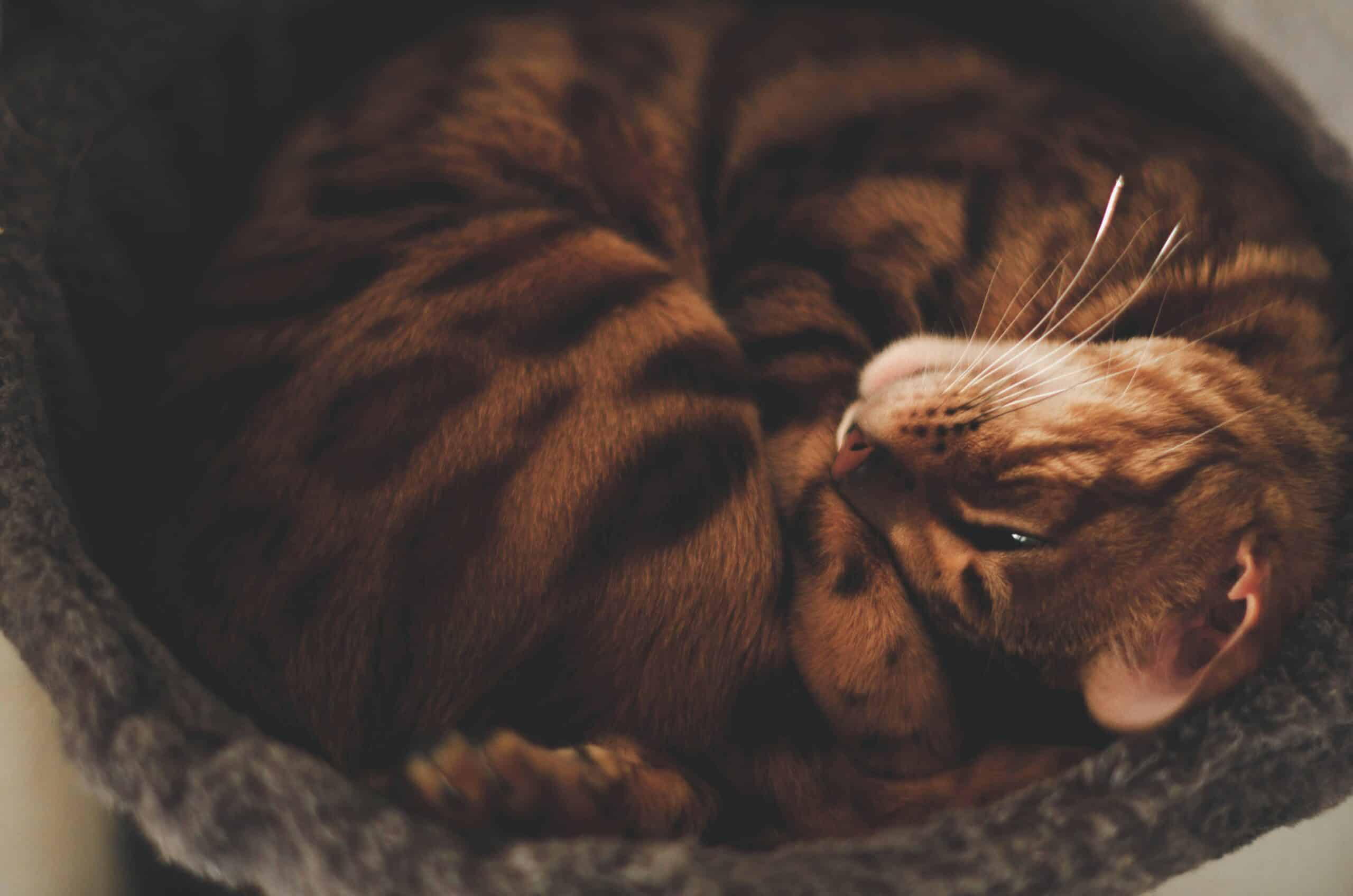
A bed for an anxious cat works by letting the cat hide, because concealment is the primary way cats cope with stress rather than a sign that something is wrong. Covered and enclosed beds give a cat somewhere to retreat without leaving the room, and the research on shelter cats supports the effect directly. The AAFP and ISFM Feline Environmental Needs Guidelines put a safe place first among five pillars of a healthy feline environment, describing it as a private, secure spot that is often raised1. Our roundup of calming products for cats covers the pheromone and supplement side.
A Quick Note
This covers comfort and environment rather than medical care. Sudden anxiety, hiding that starts abruptly, or a cat who stops eating or using the litter box needs a veterinary exam first, since pain and illness present as behavior change in cats.
Quick Verdict
A covered or hooded bed suits most anxious cats, since enclosure is the feature doing the work. Add height if your cat retreats upward, and place any bed against a wall with a clear view of the door rather than in the middle of a room.
Key Takeaways
- Hiding is a coping strategy, not a problem to solve.
- Enclosure matters more than padding or material.
- Height suits cats that retreat upward instead of under.
- Two exits stop a cat feeling trapped in multi-cat homes.
- Placement changes results as much as the bed does.
How We Picked
Beds are grouped by how much cover and elevation they provide, since those are the features that map onto how cats actually cope with stress. Washability and material follow after that.
Descriptions come from how each design works environmentally rather than from use with a particular cat.
1. A Covered or Hooded Bed, Best Overall
Why It Stands Out
A hood turns a bed into a hiding place, which is the specific thing an anxious cat is looking for. Research on newly arrived shelter cats found that those given a hiding box showed lower stress scores and settled into a new environment faster than cats without one2.
A home is not a shelter, but the mechanism is the same. A cat with somewhere to withdraw copes better than a cat with nowhere.
Worth Knowing
Enclosed beds trap hair and are harder to clean than open ones. Look for a removable cover or a design that collapses flat for washing, since a bed that never gets cleaned stops being used.
This suits most anxious cats. Skip it if your cat consistently chooses open high spots instead.
2. A Cave or Igloo Bed, Best for Deep Cover
Why It Stands Out
Cave beds enclose on all sides with a single opening, which gives more cover than a hood and suits cats that want to disappear entirely. Felted wool and molded designs hold their shape rather than collapsing around the cat.
The single entrance also concentrates the cat’s own scent, which makes the space feel established after a few days.
Worth Knowing
One entrance becomes a problem in a multi-cat house, where a second cat sitting at the opening leaves the first with no way out. The environmental guidelines specifically recommend safe spaces with more than one entry point where cats share a home1.
This suits single-cat households. Skip it where cats block each other.
3. A Window Perch or Elevated Bed, Best for Upward Retreaters
Why It Stands Out
Not every cat hides downward. Many prefer height, where they can watch the room and see anything coming. The guidelines note that safe places are often in a raised location for exactly this reason1.
Elevation also removes a cat from floor-level traffic, which matters in a busy household or one with a dog.
Worth Knowing
Suction-mounted perches fail if the window is cold, dusty, or textured. Check the mount periodically rather than assuming it holds. Our roundup of window perches covers mounting in more depth.
This suits cats that climb when stressed. Skip it for older cats who cannot jump comfortably.
4. A Bolster or Donut Bed, Best Middle Ground
Why It Stands Out
A raised rim gives contact on several sides without fully enclosing, which suits cats that want security but dislike being shut in. The bolster also supports the head, which is why cats curl against it.
These are easier to clean than covered beds and less visually intrusive in a living room.
Worth Knowing
Partial cover is a compromise, and a genuinely fearful cat will usually pick something more enclosed. Treat this as a step rather than a solution if your cat is actively hiding elsewhere.
This suits mildly anxious or transitional cats. Skip it if your cat spends the day under the bed.
5. A Self-Warming Bed, Best for Comfort-Seekers
Why It Stands Out
Self-warming beds use a reflective layer to return the cat’s own body heat, with no power and nothing to switch on. Warmth draws cats to a spot and helps them settle once there.
For a cat that will not commit to a new bed, warmth is often what changes their mind.
Worth Knowing
The reflective layer works best when the bed is somewhere draft-free, and it does very little in a cold hallway. Our roundup of heated cat beds covers the powered versions.
You can understand what hiding is telling you before deciding.
This suits cats that seek warm spots. Skip it in a warm climate or a heated room.
6. A Two-Entrance Tunnel Bed, Best for Multi-Cat Homes
Why It Stands Out
A tunnel or a bed with openings at both ends gives cover without the trap risk. A cat inside can always leave, which is what makes the space feel safe rather than cornering.
In households where one cat guards resources, this single design detail decides whether the bed gets used.
Worth Knowing
Soft-sided tunnels collapse and need reshaping, and they take up more floor area than a compact cave. Our guide to introducing two cats covers the wider dynamic these beds sit inside.
This suits homes with more than one cat. Skip it if space is tight and your cat lives alone.
Cat Beds for Anxiety at a Glance
| Type | Cover | Height | Best for |
|---|---|---|---|
| Covered or hooded | Partial to full | Floor | Most anxious cats |
| Cave or igloo | Full, one entrance | Floor | Single-cat homes |
| Window perch | Open | Raised | Cats that climb when stressed |
| Bolster or donut | Partial rim | Floor | Mild anxiety |
| Self-warming | Varies | Floor | Cats drawn to warmth |
| Two-entrance tunnel | Full, two exits | Floor | Multi-cat households |
What to Look For in a Bed for an Anxious Cat
Does your cat hide up or down?
Watch where they go when the doorbell rings. Cats that head under furniture want an enclosed floor-level bed; cats that head for the top of a wardrobe want height. Buying against that preference wastes the purchase.
How many ways out does it have?
One opening is fine for a single cat and a liability where cats compete. A second exit removes the risk of one cat cornering another, which the environmental guidelines flag directly1.
Can you wash it?
Enclosed beds collect hair and hold odor, and a cat will abandon a bed that smells wrong. A removable washable cover matters more here than on an open bed.
Where will it go?
Placement does as much work as the bed. Against a wall, out of through-traffic, with a view of the doorway is the combination most cats settle into.
Enclosed vs Elevated
The case for enclosed
Concealment is the coping mechanism most cats reach for, and the shelter research on hiding boxes measured faster stress recovery in cats given the option2. A later randomized trial found the same direction of effect on stress scores3.
The case for elevated
Some cats manage stress by watching rather than hiding, and height gives them sightlines plus distance from foot traffic. For a cat that heads upward under pressure, a cave on the floor will simply sit empty. Our roundup of climbing shelves covers building that vertical route.
Common Misconceptions
That hiding is a problem to stop
It is how cats cope, and removing the option raises stress rather than lowering it. The aim is giving them a good place to hide, not discouraging the behavior.
That a nervous cat needs a softer bed
Padding is comfort; enclosure is security. A thin covered bed will usually beat a plush open one for a cat that is genuinely anxious.
That the cat will use it because you bought it
Cats choose their own spots. Put the bed where they already retreat to rather than where you would like them to sleep, and give it a week before deciding it failed.
That anxiety is always behavioral
Cats mask pain, and a change in hiding, appetite, or litter box use can be the first visible sign of illness. Our guide to caring for an aging cat covers what changes with age.
Recommended Reading
See our picks for indoor cat beds, notes on mental stimulation, our cat tree roundup, and a guide to introducing a new cat, and caring for an indoor cat.
Anxious Cat Bed FAQ
Do covered beds actually help anxious cats?
The evidence points that way. Studies on newly arrived shelter cats found that those given a hiding box had lower behavioral stress scores and settled faster than cats without one. A home differs from a shelter, but the underlying coping mechanism is the same, and giving a cat somewhere to withdraw is well supported.
Where should I put the bed?
Against a wall, out of the main walking route, with a view of the doorway. Cats settle where they can see what is coming and cannot be approached from behind. Placing a bed in the middle of a busy room is the most common reason one goes unused.
My cat hides under the bed instead. Should I stop that?
No. Hiding is how cats cope with stress, and blocking access to a retreat generally makes anxiety worse. Provide a better option nearby rather than removing the one they chose, and let them move across on their own terms.
How long before a cat uses a new bed?
Give it a week or two before judging. Cats accept new objects gradually, and a bed that smells of the shop rather than of them is unfamiliar. Placing a blanket they already sleep on inside it speeds that up considerably.
Should each cat have their own bed?
Yes, and ideally more beds than cats, placed apart. The feline environmental guidelines emphasize multiple separated resources so no cat has to compete or pass another to reach somewhere safe.
Is a cave bed safe for two cats?
A single-entrance cave can be, though it carries a risk of one cat blocking the other in. Where cats compete, choose a design with two openings so the cat inside always has a way out.
When should I see a vet about my cat’s anxiety?
If hiding starts suddenly, if it comes with changes in appetite, grooming, or litter box use, or if your cat seems painful or withdrawn. Cats conceal illness well, and behavior change is often the first sign. A veterinary exam should come before assuming a problem is behavioral.
Do heated beds help with anxiety?
Warmth encourages a cat to settle and commit to a spot, which helps indirectly. It does not address the underlying anxiety the way enclosure does, so treat it as an addition to a covered or elevated option rather than a replacement.
Sources
- Ellis SLH, Rodan I, Carney HC, et al. AAFP and ISFM Feline Environmental Needs Guidelines. Journal of Feline Medicine and Surgery 2013;15(3):219-230. Pillar one is a safe place: a private, secure retreat, often in a raised location, with multiple entry points recommended in multi-cat homes. View source
- Vinke CM, Godijn LM, van der Leij WJR. Will a hiding box provide stress reduction for shelter cats? Appl Anim Behav Sci 2014;160:86-93. Cats provided with a hiding box showed lower Cat-Stress-Scores and recovered in their new environment faster than cats without one. View source
- van der Leij WJR, Selman LDAM, Vernooij JCM, Vinke CM. The effect of a hiding box on stress levels and body weight in Dutch shelter cats; a randomized controlled trial. PLOS One 2019;14(10):e0223492. View source
