
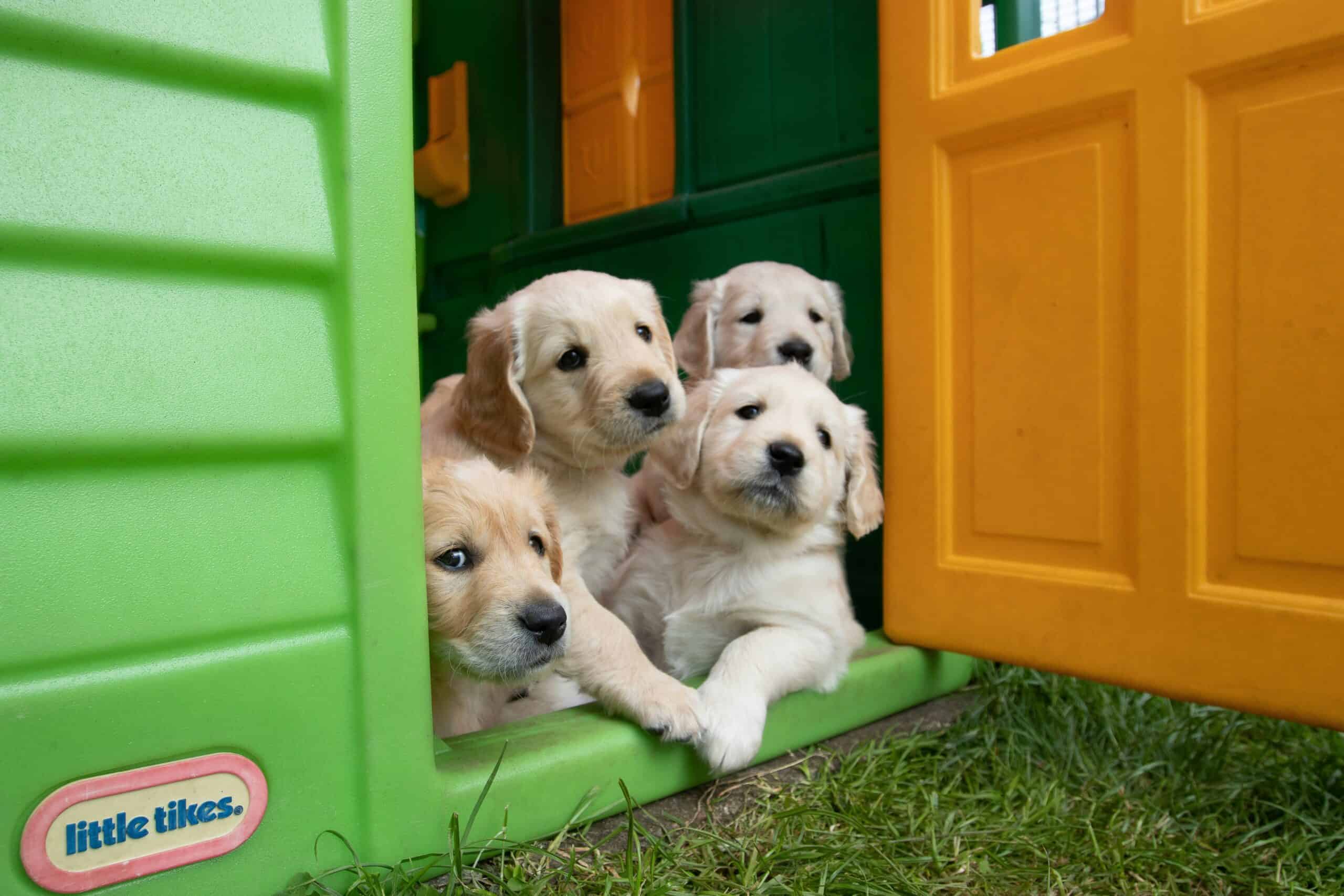
Puppy socialization is the structured process of exposing a young dog to people, animals, environments, sounds, and experiences during a critical developmental window so they grow into a confident adult dog. Done well, it produces a dog who handles novelty without fear, recovers quickly from minor stresses, and behaves predictably across varied situations. Done poorly or not at all, fear-based behaviors and reactivity can emerge that take years of professional work to address later in life. Comparing options? See our best puppy training pads roundup.
This guide covers what the socialization window actually is, how to balance socialization against vaccination timing concerns, what to expose your puppy to and how, and what to avoid. The framework follows current veterinary guidance from major animal health organizations.
Last updated: June 8, 2026 | By Austin Murphy
This article is informational only and does not constitute veterinary advice. Specific socialization plans, particularly during the vaccination window, should be discussed with your puppy’s veterinarian.
Key Takeaways
- The primary socialization window for puppies runs through roughly the first three to four months of life.
- Vaccination guidance recommends balancing socialization needs against full immunity through controlled environment exposure during the window.
- Reward-based training methods produce better welfare outcomes than aversive methods in controlled research.
- See a veterinarian or veterinary behaviorist if your puppy shows persistent fear responses, aggression, or extreme reactivity that doesn’t improve with appropriate socialization.
What the Socialization Window Actually Is
The primary socialization window in puppies spans the early weeks of life through approximately three to four months, though exact boundaries vary by individual and breed. During this period, the puppy’s brain is especially receptive to forming positive associations with new experiences. Exposures during this window shape the adult dog’s behavioral baseline; missed exposures often emerge as fear responses to those same categories later.
The window doesn’t slam shut at week 14, but the gains from new experiences gradually become smaller, and the work required to overcome a fearful adult dog’s avoidance becomes much larger. Most behaviorists describe the post-14-week period as continued socialization that builds on (rather than replaces) the foundation laid in the primary window.
The Vaccination Window Tension and How to Resolve It
Puppies receive their initial core vaccine series beginning around 6-8 weeks of age, with boosters every 3-4 weeks until at least 16 weeks of age[1]. Until the series is complete, puppies have limited immunity to environmental pathogens, particularly parvovirus, distemper, and adenovirus.
This creates apparent tension: the socialization window is largely closing by the time vaccinations are complete. The AAHA 2022 Canine Vaccination Guidelines specifically address this conflict, recommending balancing socialization needs against full immunity through carefully managed controlled exposure during the protected window rather than full isolation[1].
In practice, this means socializing in environments where the puppy is exposed to people, sounds, and surfaces, but where exposure to potentially infected dogs or contaminated outdoor surfaces is controlled. Examples that work include puppy classes (where all attendees are required to be vaccination-appropriate), supervised visits with healthy adult dogs in private homes, walks where the puppy is carried over potentially contaminated public surfaces, and indoor environments at low risk of pathogen exposure.
What to avoid: dog parks, common public walking paths in dog-dense areas, sniffing where unknown dogs have urinated or defecated, and contact with sick or unknown dogs.
What to Expose Your Puppy To
Socialization is broader than meeting people and other dogs. Aim for variety across several categories.
People
People of different ages (children, adults, elderly), genders, sizes, ethnicities, and appearance (people with beards, hats, sunglasses, mobility aids, uniforms). The goal is for your puppy to encounter human variety in non-threatening ways before forming a generalized fear of unfamiliar humans.
Other animals
Other healthy, vaccinated dogs of varied sizes and temperaments in controlled settings. Cats, if your home has them or might. Calm exposure to livestock if relevant to your environment. The goal isn’t to make your puppy a social butterfly but to normalize the presence of other animals.
Surfaces and environments
Different floor surfaces (carpet, hardwood, tile, metal grates, sand, grass, gravel). Indoor and outdoor environments. Stairs. Car rides. The car ride exposure matters especially because car rides are otherwise associated only with vet visits in many puppies.
Sounds
Household sounds (vacuum, doorbell, washing machine, kitchen appliances). Outdoor sounds (traffic, sirens, construction, lawn equipment). Thunder, fireworks, and similar startle-prone sounds at low volume and gradually increasing. Sound desensitization recordings are useful, though real environmental exposure is irreplaceable.
Handling
Touch the ears, paws, mouth, tail, and belly. Brushing. Nail trim practice (even before nails actually need trimming). Bathing. Having strangers (with permission) touch the puppy. These build tolerance for the handling required during veterinary care, grooming, and home maintenance throughout the dog’s life.
For background on the broader puppy raising context, our complete guide on how to train a dog covers the training framework that socialization slots into.
The Method: Positive Exposure, Not Just Exposure
Exposure alone isn’t socialization. The puppy needs to form positive associations with new experiences, not just see them. This requires three things working together.
Calm, controlled exposure
The puppy needs to be in a state where they can observe and engage with novelty, not overwhelmed by it. A puppy who’s scared during exposure forms fearful associations, the opposite of what socialization should produce. Watch the puppy’s body language; if they’re shrinking back, tail tucked, or trying to escape, the exposure is too intense.
Pairing with positive things
Food rewards, gentle play, calm praise, and physical comfort paired with new experiences build the positive association. The puppy sees a stranger and gets a treat from you; the puppy hears a vacuum and gets play time; the puppy walks on a new surface and gets a piece of kibble.
Stopping before overwhelm
Short positive exposures repeated over time produce better outcomes than long exposures that exhaust the puppy. Five minutes of positive exposure followed by a rest is better than 30 minutes that ends in stress. End sessions while the puppy is still engaged, not after they’ve reached their threshold.
Why Aversive Methods Hurt More Than They Help
Some older training approaches recommended physical corrections, intimidation, or aversive tools as part of puppy raising. Current evidence consistently finds that these approaches produce worse welfare outcomes than reward-based training. In a controlled comparison of companion dogs across training schools, dogs trained with aversive methods (prong collars, choke chains, e-collars, intimidation) showed higher cortisol response and more stress-related behaviors than reward-trained dogs[2].
The American Veterinary Society of Animal Behavior position statement on humane dog training similarly endorses reward-based training methods over aversive approaches[3]. The position reflects accumulated research and clinical experience that fear and pain-based training methods damage the human-dog relationship and produce behavioral problems they’re meant to prevent.
Practical takeaway: For puppies specifically, reward-based methods work better in early development and produce a more resilient adult dog. The training tools you’d see in a modern positive-reinforcement puppy class (treats, toys, clickers, marker words, harnesses) are the appropriate equipment.
📑 Recommended Read: Socialization is one piece of comprehensive puppy raising. Check out our complete breakdown of how to potty train a puppy for the housebreaking work that runs in parallel with socialization during the same developmental window.
Puppy Classes: Why They’re Worth It
For training equipment that supports reward-based socialization, our roundup of best dog treats for training covers the high-value rewards that make socialization sessions effective.
A well-run puppy class accomplishes several socialization goals in one structured environment:
Exposure to other vaccinated puppies of varied breeds and sizes. Exposure to multiple strangers (other puppy parents, the instructor). New environment outside the home. Structured handling practice. Foundation training (sit, name recognition, come). Guided socialization with a trainer who can intervene if exposures aren’t going well.
Look for classes that:
- Require all puppies to be in the vaccination process (specific requirements vary by area)
- Limit class size to allow individual attention
- Use reward-based training methods
- Run on clean, indoor surfaces
- Have instructors with credentials (CPDT-KA, KPA-CTP, or similar)
Avoid classes that:
- Use aversive equipment or methods
- Run in outdoor public spaces with high dog traffic
- Allow free-for-all play without supervision
- Have instructors who can’t articulate their training philosophy
What If You’re Adopting Past the Window
Many dogs come home past the critical socialization window: rescue dogs of unknown history, dogs adopted from shelter or foster situations at 4+ months. The work is harder but not impossible.
The post-window approach uses the same principles (positive exposure, calm controlled environment, reward-based associations) but moves more slowly and accepts smaller increments of progress. Some adult dogs adopted with significant fear histories never become fully social, and that’s an acceptable outcome; the goal becomes a dog who copes with daily life rather than one who enjoys novelty.
Professional support helps significantly here. A veterinary behaviorist (a veterinarian board-certified in behavior) or a certified animal behaviorist can structure desensitization programs that aren’t realistic to design without specific expertise.
Common Mistakes and How to Avoid Them
Waiting until vaccinations are complete to socialize. By that point, the primary window is largely closing. AAHA explicitly recommends managed socialization during the vaccination window rather than full isolation[1].
Treating socialization as just meeting other dogs. Other dogs are one category of many. Skipping the others (varied humans, surfaces, sounds, environments) leaves substantial gaps.
Forcing exposures that overwhelm the puppy. If the puppy is scared, the experience is producing the wrong association. Back off, reduce intensity, try smaller doses.
Using aversive methods that produce stress rather than learning. The research is consistent that reward-based methods produce better welfare outcomes[2].
Going to high-risk environments during the vaccination window. Dog parks, common walking paths, and similar high-traffic dog spaces present real parvovirus and distemper risk before vaccinations are complete.
Skipping the handling work. A dog who hates having its paws touched is a hassle for life. Handling practice during the socialization window is a small effort with a large lifelong return.
Letting the puppy fail too many times. Frequent failed exposures (where the puppy ends up scared) accumulate into a fearful adult. Set up exposures to succeed.
Stopping socialization at the end of the window. The primary window closes around 14 weeks, but continued socialization through the first year is valuable. Stopping cold at week 14 can lead to regression in skills built earlier.
When to See a Veterinarian or Behaviorist
Some puppy behaviors warrant professional evaluation rather than continuing standard socialization:
- Persistent fearfulness that doesn’t improve with appropriate exposure
- Aggression: growling, snapping, or biting in response to handling or proximity
- Extreme reactivity to specific stimuli (cars, certain people, specific sounds)
- Body language suggesting consistent stress (tucked tail, ears pinned, dilated pupils, panting in non-warm conditions)
- Failure to thrive socially (avoids people, hides constantly, no interest in interaction)
- Hard mouthing or biting that doesn’t respond to standard puppy bite redirection
- Resource guarding (food, toys, sleeping area) that escalates rather than softens
- Crying or distress in confinement that doesn’t improve with appropriate crate training
- Health concerns potentially affecting behavior (pain, gastrointestinal issues, vision or hearing problems)
- Failure to progress on basic training despite consistent, appropriate effort
A primary care veterinarian is a reasonable first stop. A veterinary behaviorist (board-certified through ACVB) is the appropriate referral for complex behavior cases.
Frequently Asked Questions
When should I start socializing my puppy? As soon as the puppy is at home, with appropriate caution about disease exposure. Most puppies come home around 8 weeks old, which is in the middle of the primary socialization window.
Is it safe to take my puppy outside before vaccinations are complete? Controlled exposures are recommended by AAHA[1]. Carrying a puppy on a walk so they see and hear the environment is different from letting them sniff public dog-traffic areas.
How many new experiences should I aim for per week? Multiple positive exposures per day during the primary window. Quality matters more than quantity; one excellent positive exposure beats five overwhelming ones.
Can I socialize my puppy too much? Quality and intensity matter more than quantity. A puppy who’s exhausted from over-exposure may form negative associations. Aim for engaged interest, not overwhelm.
What if my puppy doesn’t like other dogs? Some dogs are temperamentally less social. The goal isn’t to force friendship but to build tolerance and reduce reactivity. A dog who can ignore other dogs calmly is well-socialized; they don’t need to enjoy other dogs.
Should I let strangers pet my puppy? Generally, yes, when the puppy is comfortable with it, since stranger exposure is a core socialization category. Ask people to wait until you’re ready, and skip if the puppy is showing stress.
How do I know if a socialization experience went well? The puppy’s body language at the time and behavior afterward. Loose body, soft eyes, willing engagement during the experience, and normal behavior afterward suggest success. Stress signs during, or unusual withdrawal after, suggest the experience was too much.
Is puppy day care good for socialization? Sometimes. Well-run programs with size-matched playgroups, supervised play, and clean facilities can support socialization. Poorly-run programs (overcrowded, unsupervised, mixed temperaments) can produce fear or aggression. Visit and evaluate before committing.
This article is for general education and does not replace veterinary advice. Specific socialization plans during the vaccination window should be developed with your puppy’s veterinarian.
Related Reading
Explore more: puppy toys teething relief, puppy toys, how to stop a puppy from biting, puppy food for large breeds, and puppy playpens.
Recommended Reading
See also our guides to puppy toys, and puppy toys teething relief.
Sources
- Ellis J, Marziani E, Aziz C, et al. 2022 AAHA Canine Vaccination Guidelines. J Am Anim Hosp Assoc. 2022;58(5):213-230. View source
- Vieira de Castro AC, Fuchs D, Morello GM, Pastur S, de Sousa L, Olsson IAS. Does training method matter? Evidence for the negative impact of aversive-based methods on companion dogs’ welfare. PLOS One. 2020;15(12):e0225023. View source
- American Veterinary Society of Animal Behavior. Position Statement on Humane Dog Training. 2021. View source
