
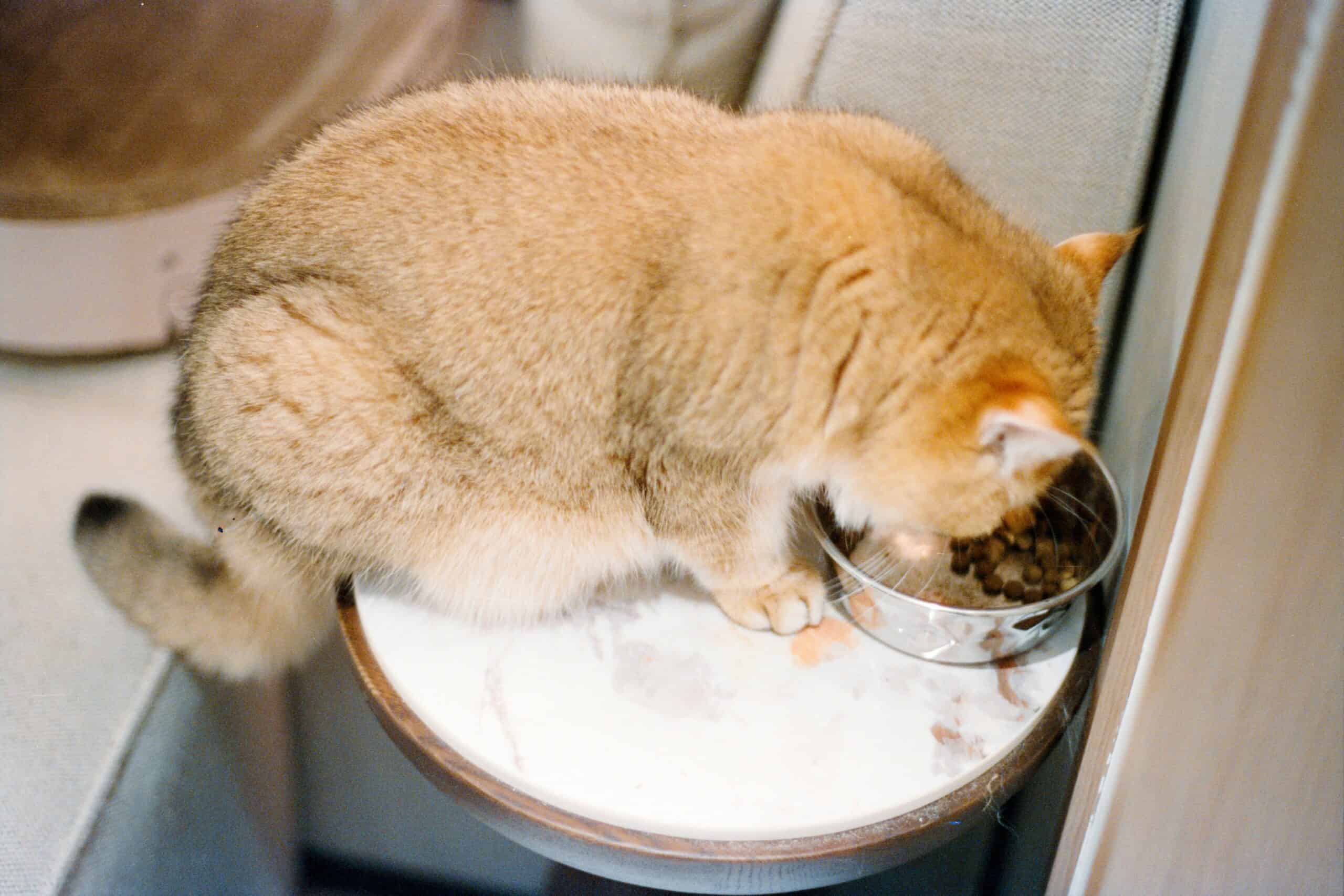
Most adult indoor cats need somewhere in the range of 20 calories per pound of body weight per day, which usually works out well below what the feeding chart on the bag suggests. How much should I feed my cat? Two numbers answer it: the cat’s current weight and the calories in a cup or can of the food.
The bag rarely presents it that way. Feeding charts print wide weight bands and generous ranges, so the printed portion often lands above what a quiet indoor cat burns. Portion control sits alongside enrichment and litter habits in daily indoor cat care, and it is the piece owners most often get wrong by accident.
Quick Answer
Take the cat’s weight in pounds and multiply by roughly 20 to get a typical daily calorie target. Then check the calories per cup or per can on the label and divide. That portion, split into two meals, is a starting point a veterinarian can adjust.
A Quick Note
This article offers general guidance only. Cats vary widely in metabolism, activity, and health history, so no single formula fits every animal. A veterinarian should guide any decision tied to weight, appetite, or a medical condition.
Key Points
- Body weight gives a better starting portion than the weight band printed on the bag.
- Calories matter, not cups. Two dry foods can differ a lot at the same cup measure.
- A heavy cat should usually be fed toward a target weight, not the current one.
- Treats belong inside the daily total rather than on top of it.
- Body condition tells more about portion size than the scale alone.
- A cat gaining or losing weight on a correct-looking portion needs a vet visit.
| Cat’s weight | Typical daily calorie range | Roughly what that looks like |
|---|---|---|
| Kitten, still growing | Much higher per pound than an adult | Several small meals daily, usually fed to appetite rather than a fixed portion. |
| 6 pounds, small adult | About 120 to 140 calories | Often near a third of a standard cup of dry, or roughly two small wet cans. |
| 8 pounds, average adult | About 160 to 180 calories | Often close to half a cup of dry, or two to three small wet cans. |
| 10 pounds, average adult | About 190 to 220 calories | Frequently a little over half a cup of dry, or three small wet cans. |
| 12 pounds, larger adult | About 230 to 260 calories | Often near two thirds of a cup of dry, or three to four small wet cans. |
| 15 pounds, large adult | About 280 to 320 calories | Often close to three quarters of a cup of dry, or four small wet cans. |
| Senior adult | Varies, sometimes lower and sometimes higher | Depends on muscle loss, dental comfort, and health conditions. A veterinarian should set this one. |
Typical guidance only, not measurements. Calorie content differs between foods, so divide by the label figure rather than copying a volume.
Why Body Weight Beats the Feeding Chart on the Bag
A portion built from the cat’s own weight fits the animal in front of you, while the chart on the bag fits a population. Those charts group cats into broad bands, so a 9 pound cat and a 12 pound cat can share a row.
Bag charts also assume a fairly active cat. Many indoor cats sleep most of the day, climb little, and hunt nothing. Ranges skew generous too, since a chart that leaves cats hungry draws complaints.
Calories Versus Volume: Why Two Cups Can Differ
A cup measures space, not energy, so the same scoop of two dry foods can deliver very different calories. Kibble density shifts with fat content, protein source, and piece shape. Airy kibble fills a cup with less food than small dense pellets do.
This is why copying a friend’s portion rarely works. Half a cup of one recipe might cover a small cat’s whole day. Half a cup of another falls well short.
The label figure, usually printed as calories per cup, settles it. Reading it is also the fastest way to compare food built for indoor cats. Lower calorie recipes let a cat eat a satisfying volume without going over.
Feeding for Current Weight Versus Feeding for Target Weight
When a cat carries extra weight, feeding for the current number simply maintains it. The usual approach calculates from the weight the cat should be, which a veterinarian can name. That produces a smaller portion and a slow, steady change.
Slow is the important word. Cats should not drop weight quickly, because rapid loss creates serious problems of its own. The same logic runs the other way for a thin cat, and either direction deserves professional input.
Wet Food, Dry Food, and How Water Changes the Volume
Wet food is mostly water, so it carries far fewer calories per ounce than kibble. That is why a wet portion looks enormous next to a dry one of the same energy.
Many owners feed both, which is where portions get muddled. The clean method sets the daily calorie total first, then splits it between the two formats.
The differences between wet and dry feeding reach past calories into hydration and dental habits. Cats on dry food alone often drink more from the bowl. Either way, the portion should come from a label rather than a habit.
Free Feeding, Multi-Cat Homes, and Calories You Cannot See
Leaving a full bowl out all day makes portions invisible, because nobody knows how much went in or how fast it left. Free feeding suits grazers who self-regulate, and it fails badly for cats who eat whenever food exists. Measured meals turn intake into something you can see.
Multi-cat households add a layer. A confident cat often finishes its own bowl and then starts on a slower housemate’s. Separate rooms, staggered timing, or spaced feeding stations and mats keep portions where they belong.
Treats deserve the same honesty. Every dental chew, lick of gravy, and sliver from a plate belongs inside the daily total.
Adjusting for Kittens, Seniors, and Cats After Spay or Neuter
Life stage changes the math more than almost anything else. Kittens need far more calories per pound than adults, and they usually eat several small meals rather than two. Guidance on kitten feeding frequency matters as much as the amount at that age.
Spaying and neutering typically lower a cat’s energy needs. Many cats gain weight afterward on exactly the portion that suited them before. Reviewing the amount at that point prevents a slow creep.
Seniors go both ways. Some slow down and need less, while others lose muscle and need richer food. Dental comfort and health conditions both shape the answer, so a vet should set a senior portion.
How to Tell Whether the Portion Is Working, and What It Cannot Tell You
Body condition answers the portion question better than a single weight reading. Run your hands along the cat’s sides, where the ribs should feel easy to find under a thin layer. From above a gentle waist should show, and from the side the belly should tuck up.
Weigh at the same time of day, on the same scale, every few weeks. Trends matter far more than any single figure. A portion that holds good body condition steady is doing its job.
No calculation can tell you everything. It cannot detect an undiagnosed thyroid, kidney, or digestive condition. It also cannot know that one cat climbs all evening while another naps through it.
So a cat losing or gaining weight on a portion that looks correct is telling you something the arithmetic missed. That is a reason to call a veterinarian rather than adjust the scoop again.
What Trips People Up
Using the scoop that came in the bag
Those scoops are rarely a standard measuring cup, and some hold far more. Measure with a proper cup or a kitchen scale instead.
Switching foods but keeping the old portion
Calories per cup change with the recipe, so the same volume can become a bigger meal overnight. Recalculate from the new label whenever the food changes.
Counting meals but not treats
Treats, toppers, and table scraps add up faster than most people expect. Fold them into the daily total and trim the meal to match.
Chasing the scale week to week
Small fluctuations are normal and mean little alone. Watch the trend across a month, and check body condition by hand alongside it.
Recommended Reading
For homes where meals need to happen on schedule, a look at the best automatic cat feeders shows how portion control can run without anyone standing over the bowl. Older cats have their own requirements, covered in this guide to food formulated for senior cats. For fussy eaters or cats who need extra moisture, toppers and broths can raise interest without wrecking the total.
Frequently Asked Questions
How much should I feed my cat each day in cups?
There is no single cup answer, because calories per cup differ widely between foods. Start from roughly 20 calories per pound of body weight, then divide that total by the calories per cup on the label. For many average adult cats the result lands near half a cup to two thirds of a cup daily, split across two meals.
Is twice a day enough for an adult cat?
Two measured meals a day suit most healthy adult cats and make portions easy to track. Some cats do better with three smaller servings, especially if they vomit on an empty stomach or beg heavily between meals. The daily total matters more than how many times the bowl gets filled.
Why does the bag say to feed so much more than that?
Feeding charts cover broad weight bands and generally assume an active cat, so the printed amount suits a wide population rather than one animal. Ranges also skew generous, since a chart that underfeeds draws complaints. Treat the bag as a rough ceiling and the calorie calculation as the real starting point.
What works when one cat steals the other cat’s food?
Separate the cats at mealtimes, either in different rooms or behind a closed door, and pick up bowls once eating stops. Spacing feeding stations apart and feeding at set times both help more than free feeding does. Microchip-activated bowls exist for households where separation is not practical.
Should treats count toward the daily portion?
Treats carry real calories, and a handful across a day can quietly undo a carefully measured meal. Keep them to a small share of the daily total, then reduce the meal slightly on days when more treats go out. Using part of the regular kibble as a reward works well too.
How long before a portion change shows up?
Give any change three to four weeks before judging it, since cats shift weight slowly and daily readings bounce around. Weigh at the same time of day on the same scale, and note the trend rather than the number. Check body condition by hand at the same time, because muscle and fat feel different.
When should you talk to a veterinarian about portions?
Bring it up at any routine visit, and sooner if something changes. A cat losing or gaining weight on a correct-looking portion deserves a call rather than a bigger scoop, and so does sudden constant begging or refused food. A veterinarian can set a target weight, rule out underlying conditions, and adjust the plan safely.
