
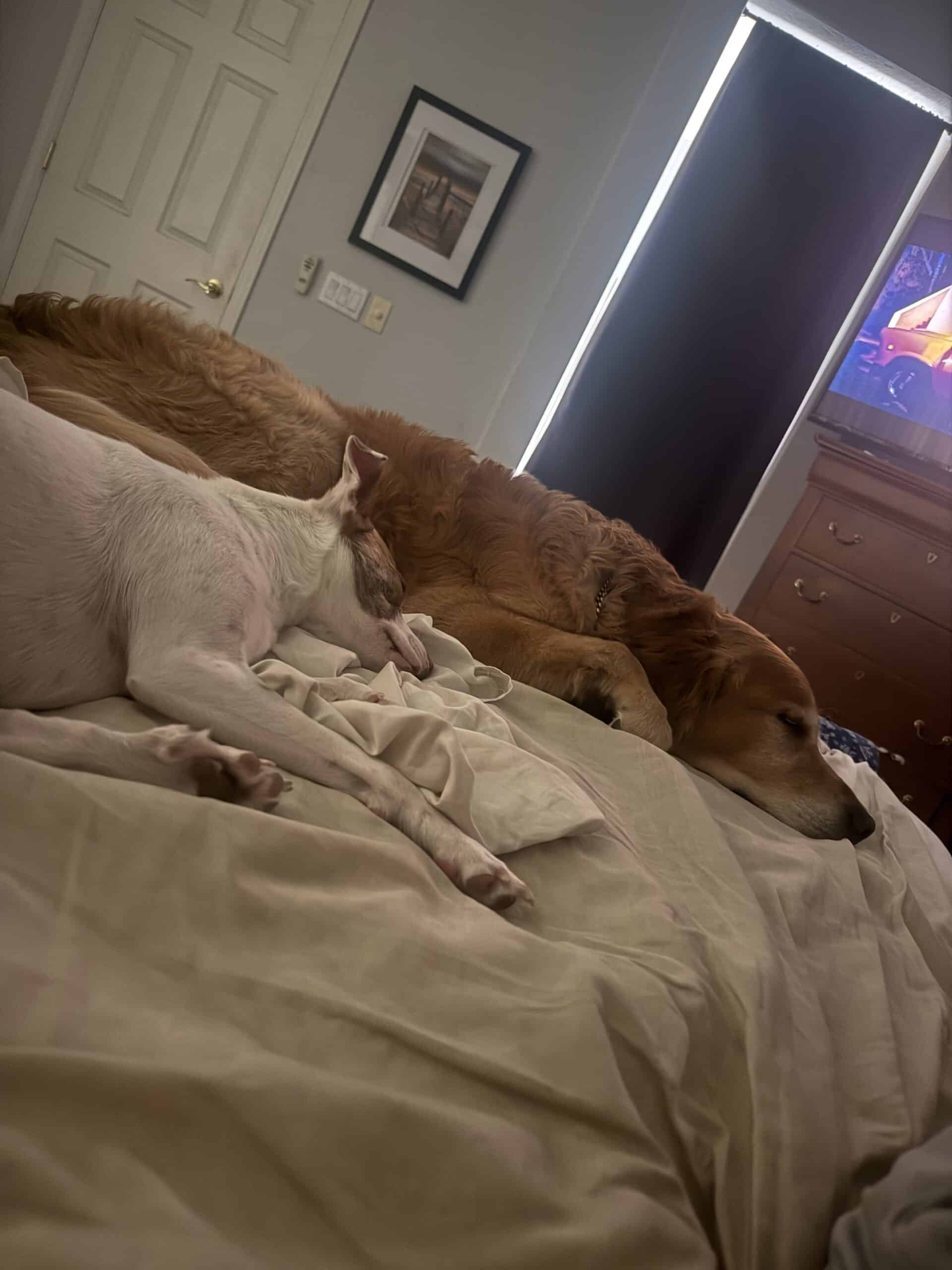
Separate the resources and let the dogs work out the rest. Food bowls apart, beds apart, and supervision at mealtimes covers most of what goes wrong when two dogs share a house temporarily. Water is usually the exception, since dogs share it without much fuss.
The mistake is over-managing the social side. Dogs sort out their own arrangement faster than people expect when the things worth competing over are out of the equation.
Quick Answer
Feed them in separate spots with supervision, give each dog their own bed and sleeping area, and keep high-value toys and chews put away. Let them meet on neutral ground if they do not know each other. Attention is the resource most likely to cause friction.
Key Points
- Feeding is the highest-risk moment and needs supervision
- Separate beds matter more than separate rooms
- Water bowls are usually shared without incident
- Attention causes more tension than food or toys
- Dogs who know each other settle faster than first meetings
- Give each dog somewhere to be away from the other
Setting Up Before They Arrive
| Resource | Arrangement | Why |
|---|---|---|
| Food bowls | Separate spots, supervised | Highest-risk moment for conflict |
| Water bowls | Separate or shared | Rarely a source of tension |
| Beds | One each, in different spots | Somewhere that belongs to each dog |
| High-value chews | Put away or given separately | The most guarded item type |
| Ordinary toys | Usually fine out | Lower value, less guarded |
| Sleeping areas | Separate rooms if that suits | Overnight is unsupervised |
Feeding Is Where It Goes Wrong
Food is the resource dogs are most likely to guard, and mealtimes concentrate that into a few minutes with both dogs in the same state of anticipation.
Separate bowls in separate places is the baseline. Different rooms, or opposite ends of one room, so neither dog is eating within reach of the other.
Supervision matters as much as separation. A dog who finishes first will investigate the other bowl, and that is the moment where a tolerant pair becomes a tense one. Staying present until both have finished and picking the bowls up afterwards removes it.
How It Works With Finn
Finn is my sister’s golden retriever, six years old, and my dog has known him since I got her. They get along, and it took time to get there rather than being immediate.
What actually happened surprised me: it took quicker than I thought it would. I expected a long adjustment given her history and it was shorter than that.
They play, and sometimes she follows him around, which is a version of the following behavior she does with me applied to another dog. She is pretty calm around him now, and sometimes she still roams rather than settling.
The one point of friction is attention. There is some tension over that specifically, which is not about food or toys or space, and it is the thing that has not resolved with familiarity the way everything else has.
Separate bowls for food, and the same for water. We have to guard her at meals, which is the supervision this article recommends, and it is not optional in our case.
She sleeps with me and he sleeps in my parents’ room. That separation has worked without any adjustment period, and I suspect it removes a whole category of overnight problems we never had to solve.
My experience covers a small dog and a large one who see each other periodically at a family home. It does not cover permanent multi-dog households, dogs meeting for the first time, or unsupervised introductions.
Attention Is the Overlooked Resource
People plan for food and toys and forget that human attention is competed over more than either. A dog who is used to being the only one gets less of it when another dog is present, and that registers.
Signs are subtle rather than dramatic. Pushing between you and the other dog, leaning harder, or reappearing every time you interact with the visitor.
Managing it means giving attention deliberately rather than reactively. A dog rewarded for pushing in learns to push in, and a dog who gets attention when settled learns something different. Related behavior sits in why dogs follow people everywhere.
Sleeping Arrangements
Overnight is the longest unsupervised stretch, which makes it the period worth arranging deliberately rather than seeing how it goes.
Separate rooms remove the question entirely. Each dog sleeps where they normally would, and nothing needs negotiating in the dark.
Where separate rooms are not available, separate beds at a distance work, ideally with each dog’s own bedding so the scent is familiar. Placement guidance sits in where to put a dog bed.
A crate suits dogs already comfortable in one, since it gives a defined space nobody else enters. Detail sits in choosing a dog crate.
Water Is Usually Fine
Water is rarely guarded the way food is. Most dogs drink from whichever bowl is nearest without either taking issue.
Separate bowls are still worth having, mainly so neither dog runs out and to reduce the traffic at one spot. Options sit in choosing a dog bowl.
Watch it anyway on the first day. A dog who guards water is unusual and it is worth knowing early rather than discovering it under pressure.
First Meetings Against Familiar Dogs
Dogs who already know each other
Straight into the house is usually fine. They have an established arrangement and it resumes rather than needing rebuilding.
Dogs meeting for the first time
Neutral ground first, ideally a walk together before either enters a house. Territory is what makes indoor first meetings harder than outdoor ones. The process sits in introducing a new dog to your home.
Size differences
A small dog and a large one can play well and the size gap means accidental injury is possible during rough play. Supervision matters more than with matched sizes.
Energy differences
A high-energy dog pestering a calmer one causes friction that looks like dislike and is really mismatch. Separate spaces let the calmer dog opt out.
Giving Each Dog an Exit
Both dogs need somewhere they can go to be away from the other, and that matters more than any amount of supervised together-time.
A bed in a quiet room, a crate, or simply a closed door for part of the day gives a dog the option of disengaging. Dogs who cannot get away from each other build tension that dogs with an exit do not.
This applies to the resident dog as much as the visitor. Having their home occupied is its own adjustment, covered in creating a safe space for your dog.
Going Well Against Worth Intervening
Going well looks like play with breaks in it, both dogs able to settle, eating without incident when separated, and some mutual ignoring. Following each other around and occasional squabbles over attention are normal.
Worth intervening looks like stiffening, freezing over a resource, growling that escalates rather than resolving, one dog unable to disengage from the other, or either dog unable to settle at all. Persistent tension needs a behaviorist rather than more exposure, and body language reading sits in telling if two dogs are getting along.
Related Reading
- gear for a visiting dog
- first introductions
- giving each dog an exit
- sleeping arrangements
- crates as separate space
- bowls for two dogs
Frequently Asked Questions
How do I prepare for a dog visiting for the weekend?
Separate food bowls and beds, put high-value chews away, and plan where each dog sleeps. Supervision at mealtimes matters more than anything else you can arrange in advance.
Should visiting dogs share water bowls?
Most dogs share water without any issue, since it is rarely guarded the way food is. Separate bowls are still worth having so neither runs out and traffic is spread.
Where should a visiting dog sleep?
Separate rooms if that is available, since overnight is the longest unsupervised stretch. Otherwise separate beds at a distance, each with the dog’s own familiar bedding.
What causes the most tension between two dogs?
Food during meals, and human attention throughout the day. Attention is the one people plan for least, and it is often the friction that persists after everything else settles.
How long does it take two dogs to get along?
It varies widely. Dogs who have met before pick up where they left off, and first meetings can take days to weeks. Some pairs settle considerably faster than owners expect.
Do I need to supervise them constantly?
At mealtimes, yes. Otherwise supervision can relax as they settle, provided both dogs can get away from each other and neither shows guarding behavior.
When should I get professional help?
If either dog stiffens or freezes over resources, if growling escalates rather than resolving, if one cannot disengage from the other, or if either cannot settle at all. Persistent tension needs a behaviorist rather than more exposure.
A second dog needs their own bed. picking a dog bed covers sizing and placement.
