
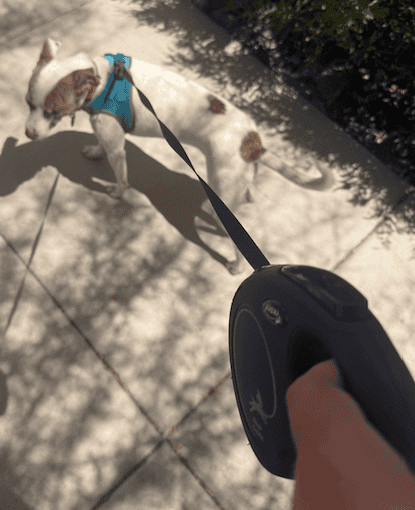
Comparing options? See our best retractable dog leashes roundup. Is that extra roaming room worth giving up some control on walks? The retractable vs standard dog leash choice trades freedom for steady handling, and the right one depends on your dog’s training, your surroundings, and how much control you want. A retractable leash extends to let a dog explore, while a standard fixed-length leash keeps the dog at a consistent, controllable distance. I walk a small Jack Russell mix on a retractable and like what it gives her, so this guide weighs both honestly rather than crowning one winner. If your dog pulls, our guide on how to stop leash pulling helps before you pick a leash at all.
Quick Verdict
Choose a standard leash for everyday walks, training, busy areas, and reliable control, since a fixed length gives the most steady handling. Choose a retractable only to give a well-behaved dog extra room to sniff and roam in open, low-traffic spaces. For training and crowds, standard wins; for open-space freedom with a trained dog, a retractable earns its place. For more on this, see our guide to leashes for apartment walks.
Key Takeaways
- A standard fixed-length leash gives stronger, faster control for training and busy settings.
- A retractable suits a calm, trained dog in open, low-traffic spaces where roaming room is the goal.
- Retractable cords are slow to reel in near roads or crowds and can injure if they snap taut.
- Retractable leashes can teach pulling, since straining extends the cord.
- Many owners keep both and switch based on where they are walking.
Disclosure: HappyPaws is reader-supported. As an Amazon Associate, we earn from qualifying purchases made through links on this page, at no extra cost to you.
How We Compared Retractable vs Standard Dog Leash
We weighed control, freedom to roam, training value, safety across settings, and durability. The American Kennel Club notes that a standard fixed-length leash gives the most control and is the general pick for training and busy environments1. The goal is to match the leash to your dog and where you walk, not to declare a single best.
Retractable Leash: Strengths and Trade-offs
A retractable leash has a thin cord that extends and retracts from a handle, letting a dog range out and come back. It hands a well-behaved dog freedom to sniff and explore on open paths, and it asks for less control and slower reaction in return.
Where a Retractable Wins
It gives a dog room to roam, sniff, and stretch on open, quiet paths. I use one with my small Jack Russell mix, and the extra leeway lets her range ahead and explore on our calm sidewalks while I keep slack in reserve. The cord has never tangled or caught on her, and the handle has held up well, so for a calm small dog in low-traffic spots the freedom is the whole appeal. You can compare options in our retractable leash picks.
Where a Retractable Struggles
The long cord makes it slow to reel a dog in fast, which turns risky near roads, people, or other dogs. The thin cord can also cause cuts or burns if it wraps or snaps taut, so it belongs in open space rather than a crowd.
Check Price on AmazonStandard Leash: Strengths and Trade-offs
A standard leash is a fixed-length strap, usually four to six feet, that keeps a dog at a steady, controllable distance. It is the default for control, safety, and predictability, and it gives up some roaming room in exchange.
Where a Standard Wins
It delivers strong, immediate control, which matters for training, busy streets, and reactive dogs. Its predictable length keeps a dog close and safe, with sized options in our small-dog leash picks and large-dog leash picks.
Where a Standard Struggles
It limits how far a dog can roam, which some dogs find restrictive on open trails. That is a fair trade for control, though it offers less freedom than a retractable in wide-open spaces.
Check Price on AmazonControl and Safety Compared
Control
A standard leash wins on control, keeping a dog close with instant, reliable handling. A retractable’s long cord slows your reaction and gives a dog more chance to reach trouble before you can stop it.
Safety in Different Settings
A standard leash wins for safety near roads, in busy areas, and around other dogs. A retractable is safer only in open, quiet spaces, where the extra cord cannot put a dog in harm’s way.
Training and Durability Compared
Training Value
A standard leash wins for training, since a consistent length teaches a dog to walk politely at your side. A retractable can encourage pulling, because the dog learns that straining extends the cord, which works against the lessons in our leash training guide.
Durability and Handling
A standard leash is simple and rugged, with little to break. A retractable adds a spring mechanism and thin cord that can wear or fail, and the handle can be awkward to grip securely if a dog lunges.
Comfort and Handling Compared
Grip and Comfort
A standard leash uses a simple loop handle that is easy to hold, double up, or shorten by hand. A retractable has a bulky plastic handle that some find awkward, especially when a dog lunges and the brake has to be pressed fast.
Handling on the Walk
A standard leash lets you feel and guide your dog directly through the strap, which aids communication. A retractable keeps constant light tension that can dull that feedback and makes quick corrections harder at full extension.
Retractable vs Standard Leash Comparison
| Factor | Retractable Leash | Standard Leash |
|---|---|---|
| Control | Less | Strong |
| Freedom to roam | High | Limited |
| Training use | Poor | Excellent |
| Busy areas | Risky | Safe |
| Best setting | Open, quiet space | Anywhere |
| Reaction speed | Slower | Quick |
Which Should You Choose
Choose a Standard Leash If
Pick a standard leash for everyday walks, training, busy or urban areas, reactive dogs, or anytime control matters most. It is the safe default, and it pairs well with a harness from our small-dog harness picks.
Choose a Retractable Leash If
Pick a retractable for a trained, calm dog in open, low-traffic spaces where extra roaming room is the goal. It works as a situational tool rather than an everyday or training leash, which is the role mine plays on quiet walks.
Why Many Owners Keep Both
A standard leash handles daily walks and training, while a retractable comes out for open-space freedom with a well-behaved dog. The right attachment point matters too, which our collar vs harness guide walks through.
Recommended Reading
- running a good walk
- the hands-free alternative
- Best retractable dog leashes
- How to leash train a small dog
- Best dog harnesses for small dogs
Common Mistakes to Avoid
The wrong leash habits create real risk, so steer clear of these.
Using a Retractable in Crowds or Near Roads
A long cord near traffic, people, or other dogs is hard to reel in fast and invites accidents. Save the retractable for open, quiet spaces and switch to a standard leash anywhere busy.
Training on a Retractable Leash
A retractable rewards pulling, since straining extends the cord and teaches the opposite of polite walking. Train on a fixed length so your dog learns a steady position at your side.
Gripping the Cord by Hand
Grabbing a thin retractable cord to reel a dog in can cause cuts or burns. Use the handle and brake as designed, and never wrap the cord around your hand or your dog.
Frequently Asked Questions
Is a retractable or standard leash better?
For most situations a standard leash is better, since it gives more control and is safer for training and busy areas. A retractable suits a trained dog in open, quiet spaces where extra freedom is the goal.
Are retractable leashes safe?
They can be safe for a well-behaved dog in open, low-traffic spaces, but they grow riskier near roads, crowds, or other dogs. The long cord slows your reaction time and can cause injury if it wraps or snaps taut.
Which leash is better for training?
A standard fixed-length leash is far better for training, since its consistent length teaches a dog to walk politely at your side. A retractable can encourage pulling, because the dog learns that straining extends the cord.
Can I use a retractable leash for a puller?
It is not the right tool, since a retractable rewards pulling by giving more cord. For a dog that pulls, use a standard leash and work on training, often paired with a well-fitted harness for control.
What length standard leash is best?
A four-to-six-foot leash suits most everyday walks, keeping a dog close and controllable. Shorter lengths add control in tight or busy spaces, while six feet allows a bit more room on relaxed walks.
Should I pair the leash with a collar or harness?
A harness is often the better attachment point for control and neck safety, especially for pullers and small dogs. Many owners clip the leash to a harness for walks while keeping ID tags on a collar.
Why does my dog pull more on a retractable?
The leash extends when the dog pulls, which teaches her that pulling earns more freedom. That makes a retractable a poor training tool and is one reason a fixed length is the better choice for teaching loose-leash walking.
Related Reading
Explore more: elevated vs standard dog bowl, why does my dog pull on the leash, why does my dog stare at me, dog sweaters, dog crate vs playpen, dog knee braces, dog doors, and dog couch covers.
Recommended Reading
See also our guides to dog feeding mats, elevated vs standard dog bowl, and orthopedic vs standard dog bed.
Sources
- American Kennel Club. Leash types, control, and training guidance. https://www.akc.org/expert-advice/training/
