
Disclosure: HappyPaws is reader-supported. As an Amazon Associate, we earn from qualifying purchases made through links on this page, at no extra cost to you.
The first time my eight-year-old retriever hesitated before jumping into the back of my SUV, I felt that quiet sinking feeling every dog owner eventually knows. She had jumped in and out of that exact vehicle a thousand times. Now she was looking at the cargo height like it was a cliff, and the small whine she made as she finally launched up, and the awkward landing on the other side, told me what I had been refusing to see for months.
She did not need a ramp tomorrow. She needed one six months ago.
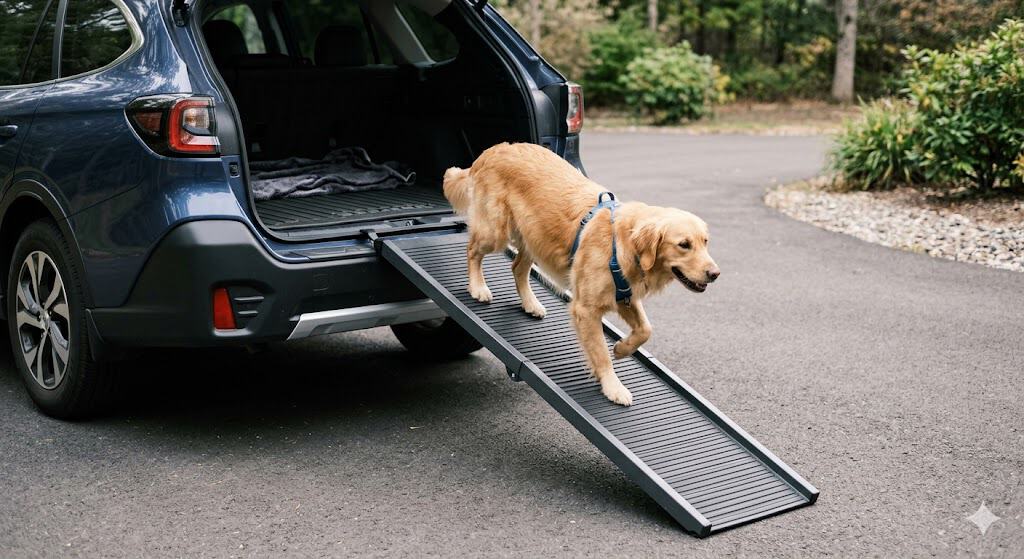
Dog ramps for SUVs are one of the most underused pieces of dog gear, partly because owners of younger dogs do not feel they need one, and partly because the ramps that exist range from genuinely excellent to actively dangerous. The wrong ramp is worse than no ramp, a slip on a poorly designed ramp can cause more injury than a careful jump, especially for senior dogs.
This guide covers the five best dog ramps for SUVs in 2026, evaluated on weight capacity, surface grip, stability, storage, and the angle math that determines whether a ramp actually works for your specific vehicle. We also cover the right way to introduce a dog to a ramp, because even the best ramp is useless if your dog refuses to use it.
Why Every SUV Owner Should Consider a Dog Ramp
The case for a dog ramp gets stronger every year a dog ages, but waiting until your dog is visibly struggling is the wrong timing.
Repeated jumping in and out of a vehicle creates cumulative joint stress that contributes to early-onset arthritis, ACL tears, and disc problems in the spine. The impact of landing from a 30-inch SUV cargo height is meaningful, a 60-pound dog generates roughly 240 pounds of force on landing, absorbed primarily by the front legs and lower spine. Multiply that by twice a day for ten years and the math is not subtle.
Senior dogs and dogs with existing joint issues have an even clearer case. By the time a dog visibly hesitates, the joint changes are already present. A ramp introduced before visible hesitation prevents the worsening curve. A ramp introduced after visible hesitation slows it.
Large breeds benefit disproportionately. Labradors, Golden Retrievers, German Shepherds, and similar breeds have genetic predispositions to hip and elbow dysplasia that jumping accelerates. Veterinary orthopedists routinely recommend ramps for these breeds starting at age five.
Small breeds with long backs, Dachshunds, Corgis, Basset Hounds, face a different but equally serious problem. Repeated jumping increases the risk of intervertebral disc disease (IVDD), a debilitating spinal condition that can require surgery or cause permanent paralysis. For these breeds, a ramp is not optional after age three.
Beyond injury prevention, ramps make daily life easier for everyone. You stop worrying about your dog’s takeoff angle. Your dog stops associating the car with physical effort. Loading and unloading become a non-event instead of a small hesitation.
What to Look For in a Dog Ramp for an SUV
The ramp market is full of products that look similar but perform very differently. Here is what actually matters.
Weight Capacity With Real Margin
A ramp’s stated weight capacity should exceed your dog’s weight by at least 50%. A 100-pound dog needs a ramp rated for at least 150 pounds, ideally 200 pounds. The reason is dynamic load, a dog walking up a ramp generates a force higher than its static weight, especially during the moment of transition between standing and stepping.
Avoid ramps with stated capacities that match your dog’s weight exactly. The capacity rating is usually the failure point under static load, not the safe operating capacity for repeated dynamic use.
Length Matched to Your SUV’s Cargo Height
The angle of the ramp determines whether your dog will use it. Steeper than 25 degrees, and most dogs balk. Steeper than 30 degrees, and even confident dogs become hesitant.
Most full-size SUVs have a cargo floor height of 28 to 36 inches. To achieve a 22-degree angle (the gold standard for dog ramps), you need:
- 28-inch cargo height: 75-inch ramp minimum
- 32-inch cargo height: 85-inch ramp minimum
- 36-inch cargo height: 96-inch ramp minimum
Most ramps on the market are 60 to 72 inches long. They produce angles of 25 to 32 degrees on most SUVs. Some dogs will use a steeper ramp without complaint. Others will refuse anything over 25 degrees. Measure your cargo height and do the math before buying.
Surface Grip That Actually Grips
Surface texture is the single biggest difference between ramps that work and ramps that fail. A smooth or slick surface creates a slip hazard worse than no ramp at all. The best ramps use either deep channel grooves with rubberized fill, sandpaper-grade traction surfaces, or fabric-covered foam designed specifically for paw grip.
Avoid ramps with smooth plastic surfaces, even those marketed as “non-slip.” The friction coefficient of paw pads on smooth plastic is genuinely dangerous, especially when the ramp is wet from rain or snow.
Stability at the Vehicle Connection
The point where the ramp meets the SUV’s cargo area is the most failure-prone moment of the loading sequence. The best ramps have a non-slip lip that hooks securely over the cargo edge, rubber feet at the ground end that prevent the base from sliding, and rigid construction that does not flex under load. Once they are in, a cargo liner keeps hair and grit off the vehicle carpet.
Telescoping and folding ramps have more potential failure points than solid ramps. The latching mechanisms must lock positively, a ramp that collapses while a dog is on it causes serious injury.
Storage Format Matched to Your Vehicle
Folding ramps are 30 to 40 inches long when folded, they fit in the cargo area without dominating it. Telescoping ramps collapse to 40 to 45 inches and are slightly heavier. Solid ramps do not collapse at all and require enough cargo space to lie flat, which is impractical for most SUVs.
For most SUV owners, a tri-fold or bi-fold ramp is the right format. The trade-off is slightly more flexible than a solid ramp, but the storage convenience is decisive for daily use.
Best Dog Ramps for SUVs in 2026: Our Top 5 Picks
Weighing ramps against the criteria above, these five stood out for their combination of safety, usability, and durability across different SUV sizes and dog profiles.
1. PetSafe Happy Ride Telescoping Pet Ramp, Best Overall
Best Overall Dog Ramp | Price: ~$130
Check Price on AmazonBest for: Most full-size SUVs, dogs 20-150 pounds, owners who want the longest possible ramp without sacrificing storage.
The PetSafe Happy Ride Telescoping Pet Ramp extends from 39 inches collapsed to 87 inches deployed, producing a 22-degree angle on a 32-inch cargo height, exactly the gold-standard angle for dog comfort and confidence. The aluminum frame supports up to 300 pounds with substantial real-world margin, and the surface uses a high-grit sandpaper-style traction strip that handles paw grip in wet and dry conditions.
The telescoping mechanism locks at the full extension and at an intermediate position, useful for vehicles with lower cargo floors like crossovers and station wagons. The locks engage with a positive click and have not failed in any of the long-term durability reports we reviewed.
What sets this ramp apart from competitors at similar price points is the rubber foot design at the ground end. The feet are deep enough to grip uneven surfaces, gravel, grass, slightly uneven pavement, without rocking. The lip at the vehicle end is rubberized and grips the cargo edge securely without scratching paint or upholstery.
Why This Ramp Leads the Category
The 87-inch length is the practical sweet spot for SUVs. Longer ramps exist, but become unwieldy to handle and store. Shorter ramps produce angles too steep for senior or hesitant dogs. The PetSafe sits exactly at the point where dogs are confident, and owners can still manage the ramp solo.
The 300-pound weight capacity covers virtually every dog scenario, including large breed dogs with handler assistance walking alongside. The aluminum construction does not corrode, does not absorb odors, and rinses clean with a hose.
The single legitimate weakness is the weight of 18 pounds. A senior owner with limited strength may find this heavy to deploy daily. For owners who can handle the weight, the trade-off is a ramp that simply does not flex, wobble, or compromise.
PROS:
- 87-inch length produces an ideal 22-degree angle on most SUVs
- 300-pound weight capacity with real safety margin
- Excellent traction surface in wet and dry conditions
- Rubberized feet and vehicle lip prevent slipping
- Durable aluminum construction with no corrosion concerns
CONS:
- 18-pound weight is heavy for daily solo use
- Telescoping mechanism requires two hands to deploy
- Higher price point than basic ramps
- Cannot be used at intermediate angles less than the ideal lock position
2. Solvit Deluxe Telescoping Pet Ramp XL, Best for Tall SUVs
Best for Tall SUVs and Trucks | Price: ~$160
Check Price on AmazonBest for: Tall SUVs (Tahoe, Suburban, Expedition), trucks with full-height beds, large breed dogs over 100 pounds, and owners who prioritize the gentlest possible angle.
The Solvit XL extends to 95 inches, long enough to produce a 22-degree angle on cargo heights up to 36 inches, the height of full-size SUVs and pickup truck beds. For owners with Suburbans, Tahoes, Expeditions, or Ford F-150s, the standard 87-inch ramp produces a steeper angle than ideal, and the Solvit XL solves that.
The construction is rugged plastic composite with metal reinforcements at stress points. The 400-pound capacity is the highest in the consumer ramp category, and the surface uses molded-in cleats that grip aggressively without becoming abrasive to paw pads.
The telescoping mechanism is similar to the PetSafe but with positive locks at three positions, allowing the ramp to be used at shorter lengths for lower vehicles. The vehicle-end lip is wider than most competitors and accommodates pickup tailgates as well as SUV cargo edges.
When to Choose Solvit XL Over PetSafe
If your cargo height is 34 inches or higher, the Solvit XL produces a meaningfully better angle than the PetSafe. The 8-inch length difference translates to about 3 degrees of slope reduction at 34-inch heights, the difference between a hesitant dog and a confident one.
If your dog is over 100 pounds, the 400-pound capacity provides better margin than the PetSafe’s 300 pounds. Dynamic load on a large dog walking with momentum can briefly exceed 1.5x static weight, and the higher rated capacity is genuine safety insurance.
If you have a standard-height SUV (28-32 inches) and a medium-sized dog, the PetSafe is the better choice. The Solvit’s extra length becomes awkward on shorter vehicles, and the higher price is not justified for the use case.
PROS:
- 95-inch length handles the tallest SUVs and pickup trucks
- 400-pound weight capacity, the highest in the consumer category
- Three lock positions accommodate multiple vehicle heights
- Wide vehicle-end lip works on tailgates and cargo edges
- Aggressive cleat grip in all weather conditions
CONS:
- 22-pound weight is the heaviest of our top picks
- Longer storage footprint when collapsed
- Premium price point
- Excessive for compact SUVs and crossovers
3. Gen7Pets Natural Step Ramp, Best for Reluctant Dogs
Best for Hesitant Dogs | Price: ~$110
Check Price on AmazonBest for: Dogs who hesitate or refuse traditional ramps, dogs new to ramp use, smaller SUVs and crossovers, and owners prioritizing the most familiar walking surface for nervous dogs.
The Gen7Pets Natural Step Ramp uses a different design philosophy than telescoping ramps. Instead of a continuous angled surface, it has molded-in horizontal step segments along the entire ramp length, creating a staircase-like surface at a continuous slope. The visual effect is closer to walking up familiar steps than walking up a slick incline, and many dogs that refuse traditional ramps walk up this one without hesitation.
The ramp is bi-fold with a 71-inch deployed length, producing a 25-degree angle on a 30-inch cargo height. The angle is slightly steeper than ideal for senior dogs, but the step pattern compensates by providing visual and tactile reference points that build confidence.
The 200-pound weight capacity covers most dogs, though large breeds over 90 pounds should consider one of the longer ramps above. The construction is high-density molded plastic with no metal components, making it lighter at 13 pounds, the easiest of our picks for daily solo deployment.
Why the Step Pattern Works
Dogs that refuse traditional ramps usually do so for one of two reasons. The smooth surface looks slippery to them, even if it has a good grip. Or the continuous slope provides no reference points, making the dog’s depth perception uncertain.
The Gen7Pets steps solve both problems. The molded steps look like solid footing. The horizontal segments provide clear reference points that anchor the dog’s spatial reasoning. Dogs that take three weeks to accept a traditional ramp often accept this one in a single training session.
The trade-off is the steeper effective angle. The step pattern adds vertical components to the dog’s path, requiring slightly more effort than a smooth slope at the same overall angle. For confident dogs, this is irrelevant. For senior dogs with significant joint issues, the smooth angle of a longer telescoping ramp is gentler.
PROS:
- Step pattern dramatically increases acceptance rate for hesitant dogs
- Lightweight 13-pound design for easy solo handling
- Bi-fold storage takes minimal cargo space
- All-plastic construction does not corrode or absorb odors
- More affordable than premium telescoping ramps
CONS:
- 71-inch length produces a steeper angle than longer ramps
- 200-pound capacity limits large breed use
- Step pattern requires more effort than a smooth slope at the same angle
- Less suitable for tall SUVs and trucks
4. Pet Gear Bi-Fold Travel Lite Ramp, Best Budget Pick
Best Budget Ramp | Price: ~$70
Check Price on AmazonBest for: Compact SUVs and crossovers, dogs under 150 pounds, occasional rather than daily use, and owners testing whether a ramp will work for their dog before investing in a premium model.
The Pet Gear Bi-Fold is a 70-inch ramp that produces a 25-degree angle on a 28-inch cargo height, adequate for compact SUVs like CR-Vs, RAV4s, and Outbacks. The 150-pound weight capacity covers most medium-sized dogs with a reasonable margin.
The construction is composite plastic with a carpeted top surface. The carpet provides excellent grip and a familiar walking texture for hesitant dogs, but it absorbs water, mud, and odors more than the all-plastic surfaces of premium ramps. For occasional use, this is fine. For daily use in wet conditions, the carpet becomes a maintenance issue.
The bi-fold mechanism is simple and reliable. There are fewer failure points than telescoping designs, and the ramp deploys in under five seconds with one hand. The 10-pound weight is the lightest of our picks.
When the Pet Gear Is the Right Choice
If you have a smaller SUV, a medium-sized dog, and primarily use the ramp for occasional vet visits or weekend trips rather than daily loading, the Pet Gear delivers good function at half the price of premium options.
Or if your dog has a visible refusal of ramps and you want to test whether a ramp will work before spending $130-160 on a premium model, the Pet Gear is the right starting point. If your dog accepts it readily, you have your ramp. And if your dog refuses, you have lost less money before stepping up to a different design.
The carpet surface deserves specific mention as both a pro and a con. The familiar texture helps with acceptance, especially for indoor-oriented dogs not used to walking on synthetic surfaces. The carpet also absorbs everything, water from rainy days, mud from trail visits, dog hair, and sometimes worse. Plan to clean it regularly if you use it in real-world conditions.
PROS:
- Most affordable ramp meeting all safety criteria
- Carpet surface increases acceptance for indoor dogs
- Simple bi-fold mechanism with minimal failure points
- Lightweight 10-pound design
- Good size for compact SUVs
CONS:
- 70-inch length too short for tall SUVs
- 150-pound capacity limits large breed use
- Carpet surface absorbs water, mud, and odors
- Less durable than aluminum or composite-only ramps
5. Solvit UltraLite Bifold Pet Ramp, Best for Frequent Travel
Best for Frequent Travelers | Price: ~$100
Check Price on AmazonBest for: Owners who frequently travel with their dog, dogs 20-200 pounds, mid-size SUVs, and owners who prioritize the lightest possible ramp without sacrificing capacity.
The Solvit UltraLite Bifold weighs only 7 pounds, half the weight of most competitors, while supporting a 200-pound capacity. The 62-inch length produces a 28-degree angle on a 30-inch cargo height, which is steeper than ideal but acceptable for most dogs, given the trade-off in portability.
The construction is high-density plastic with reinforced hinges. The surface uses molded-in tread patterns rather than carpet or sandpaper, which keeps the ramp easy to clean, a hose rinse handles most cleaning needs. The bi-fold deployment is one-handed and takes about three seconds.
For owners who travel frequently with their dog, multi-day road trips, regular weekend trips, frequent destination visits, the weight savings compound across thousands of deployments. The ramp also fits easily in a hatchback or trunk without dominating cargo space, an important consideration when packing for multi-day travel.
Why Lightweight Matters for Frequent Use
A 7-pound ramp deployed twice a day is fundamentally different from a 22-pound ramp deployed twice a day. Over a year, the heavier ramp generates significant cumulative effort and increases the chance you skip the ramp on days you are tired or rushed.
The skipped-ramp problem is real. Owners who buy heavy ramps often report deploying them less frequently after the initial enthusiasm wears off, defeating the entire point of the purchase. A lighter ramp gets used more often, and use frequency is what actually protects joints over time.
The trade-off is the steeper angle. Senior dogs with severe joint issues may find 28 degrees challenging. For those dogs, the gentler angle of the PetSafe at 22 degrees is worth the extra weight. For dogs with mild to moderate issues, most senior dogs, the UltraLite’s combination of angle and convenience hits the right balance.
PROS:
- Lightest ramp meeting safety standards at 7 pounds
- 200-pound capacity covers most dogs
- One-handed bi-fold deployment in three seconds
- Easy to clean molded tread surface
- Compact storage footprint
CONS:
- 62-inch length produces a steeper angle than longer ramps
- Less suitable for tall SUVs without acceptance work
- Lower capacity than premium options
- Less robust feel than heavier ramps
How to Introduce Your Dog to a Ramp
A ramp your dog will not use is worse than no ramp at all. The introduction process matters as much as the ramp choice.
Start With the Ramp on the Ground
Lay the ramp flat on the floor or driveway. Walk your dog across it on a leash. Reward with high-value treats at the far end. Repeat for two or three sessions until the dog walks across without hesitation.
This step exists to disconnect the ramp itself from the height anxiety. Dogs that go straight from no ramp to “ramp into a tall SUV” often refuse because the height and the unfamiliar surface combine into a single anxiety event. Separating the surface familiarity from the height work builds confidence in stages.
Add a Slight Incline
Prop one end of the ramp up six to eight inches on a step, a curb, or a low platform. Walk your dog across with treats. Repeat for two sessions until the dog handles the slight slope confidently.
Connect the Ramp to a Lower Surface First
Use a couch, an ottoman, or a low platform first, anything 12 to 18 inches high. Practice loading and unloading. Most dogs accept this transition easily because the height is manageable.
Move to the Vehicle
Once your dog walks the ramp confidently at lower heights, transition to the SUV. Position the ramp securely at the cargo edge. Walk your dog up on a leash with high-value treats waiting at the top. Some dogs walk up immediately. Others need three or four sessions of approach work before they go all the way up.
If your dog refuses the SUV after succeeding at lower heights, step back to the lower platform for more sessions. Pushing through refusal creates negative associations that take longer to undo than additional patience would have taken.
Reward the Behavior, Not Just the Outcome
For the first ten or so successful loadings, reward heavily and verbally praise the moment the dog steps onto the ramp, not just when they reach the top. The ramp use becomes the reinforced behavior, which produces the most reliable long-term ramp acceptance.
Quick Comparison Table
| Ramp | Best For | Length | Capacity | Weight |
|---|---|---|---|---|
| PetSafe Happy Ride | Most SUVs | 87″ | 300 lb | 18 lb |
| Solvit Deluxe XL | Tall SUVs | 95″ | 400 lb | 22 lb |
| Gen7Pets Natural Step | Hesitant dogs | 71″ | 200 lb | 13 lb |
| Pet Gear Bi-Fold | Budget pick | 70″ | 150 lb | 10 lb |
| Solvit UltraLite | Frequent travelers | 62″ | 200 lb | 7 lb |
Our Verdict
For most SUV owners with a senior or large-breed dog, the PetSafe Happy Ride Telescoping Pet Ramp is the right choice. The 22-degree angle produced by the 87-inch length is the gold standard for dog comfort, the 300-pound capacity covers virtually any dog with safety margin, and the build quality justifies the price across years of daily use.
If you drive a tall SUV (Tahoe, Suburban, Expedition) or a pickup truck, step up to the Solvit Deluxe XL for the additional 8 inches of length. The angle improvement on tall vehicles is meaningful, and the 400-pound capacity is genuine safety insurance for large breeds.
If your dog has refused other ramps or you have a dog that is generally cautious about new surfaces, start with the Gen7Pets Natural Step Ramp. The step pattern dramatically increases acceptance rates for hesitant dogs, and the lighter weight makes daily deployment easier.
For owners who travel frequently or who want the lightest possible ramp without sacrificing safety, the Solvit UltraLite Bifold at 7 pounds is the best portability-to-function ratio in the category.
For occasional use on a compact SUV with a medium-sized dog, the Pet Gear Bi-Fold is the budget-friendly choice that still meets the core safety criteria.
Pair any of these ramps with thoughtful introduction work and your dog will be using it confidently within a week or two, and the cumulative joint protection across years of use will pay for the ramp many times over. If you are planning longer trips, our guide on how to road trip with a dog covers the broader logistics of safe, comfortable travel, and our orthopedic dog beds for senior dogs guide covers the at-home side of joint care.
Frequently Asked Questions
Are dog ramps for SUVs actually necessary?
For senior dogs, large breeds, dogs with existing joint issues, and breeds prone to back problems (Dachshunds, Corgis, Basset Hounds), yes. The cumulative joint stress from repeated jumping into and out of an SUV contributes to arthritis, ACL injuries, and disc problems over time. For young, healthy, medium-sized dogs, a ramp is not strictly necessary but still reduces long-term wear.
What angle should a dog ramp be?
The ideal angle is 22 degrees or shallower. Most dogs accept angles up to 25 degrees without complaint. Beyond 30 degrees, even confident dogs become hesitant. To calculate the angle for your SUV, divide the cargo height by the ramp length and find the inverse sine. For most full-size SUVs, this means a ramp at least 85 inches long.
How long should a dog ramp be for an SUV?
For a typical SUV cargo height of 30 to 32 inches, the ideal ramp length is 80 to 87 inches. For tall SUVs (34 to 36 inches), step up to 90 to 95 inches. Shorter ramps produce steeper angles that many dogs refuse, especially senior dogs and dogs new to ramp use.
Can a dog ramp be used for jumping out of the SUV, too?
Yes, and unloading is actually where ramps matter most for joint protection. The impact forces on landing from a jump down are higher than the effort of jumping up. Use the ramp in both directions for full benefit.
My dog refuses to use the ramp. What should I do?
Start over with the ramp flat on the ground and treat-train the dog to walk across it. Add height gradually, six inches at a time, until the dog walks the full incline confidently. Most refusals are fixed by going back to lower-height successful sessions and rebuilding confidence step by step. The Gen7Pets Natural Step Ramp also has higher acceptance rates for chronically hesitant dogs.
How much weight can a dog ramp hold?
Quality ramps support 150 to 400 pounds depending on the model. Look for a stated capacity at least 50% above your dog’s weight to handle dynamic loads safely. The PetSafe Happy Ride supports 300 pounds, the Solvit Deluxe XL supports 400 pounds, and budget ramps typically support 150 to 200 pounds.
Are folding ramps as safe as solid ramps?
Yes, when the folding mechanism uses positive locks rather than friction or simple hinges. All five ramps in this guide use locking mechanisms that have been durability-tested for thousands of cycles. Avoid folding ramps with no positive lock, they can collapse mid-use.
How do I store a dog ramp in my SUV?
Bi-fold ramps fold in half and lay flat in most cargo areas. Telescoping ramps collapse to 39 to 45 inches and stand upright against the side of the cargo area. Both formats fit in most full-size SUVs without dominating cargo space. For compact SUVs, the bi-fold format is generally a better fit.
Related Reading
Explore more: dog crates for suvs.
More Dog Care Guides
Recommended Reading
See also our guides to dog couch covers.
See also the complete guide to choosing dog gear.
