
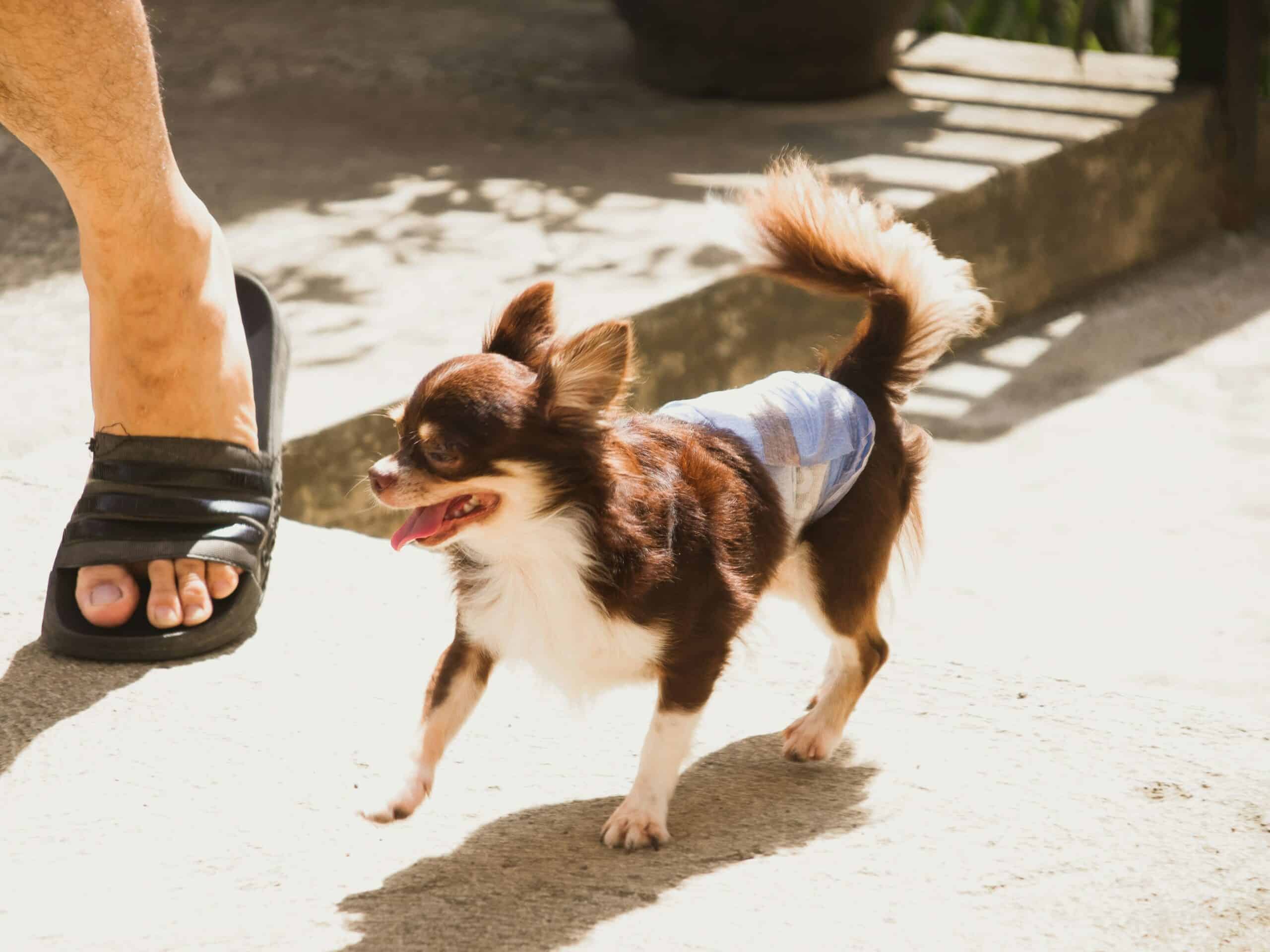
Urinary incontinence in senior dogs is more common than many owners realize and almost always more manageable than they fear. Diapers manage the symptom. An underlying cause needs veterinary evaluation.
The most common cause in spayed female dogs is urethral sphincter mechanism incompetence (USMI), with reported prevalence of 5 to 20 percent depending on the population studied1. Dogs over 15 kg are roughly seven times more likely to develop it1. USMI responds well to phenylpropanolamine (Proin), the only FDA-approved veterinary medication for the condition2.
Other causes include UTIs, bladder stones, kidney disease, diabetes, cognitive dysfunction syndrome, and mobility-related functional incontinence. Each requires different management. New incontinence always warrants veterinary investigation before assuming it’s just aging.
Diapers work alongside the diagnostic workup and any treatment plan. The right diaper depends on whether your dog is male or female, the severity of incontinence, and whether use is occasional or sustained. Five picks below cover that range.
For related senior care: orthopedic beds, stairs and ramps, and cognitive support supplements.
Last updated: May 29 2026 | By Austin Murphy
This is general information, not veterinary advice. New incontinence in any senior dog warrants veterinary evaluation. UTIs, bladder stones, kidney disease, diabetes, and other conditions present as incontinence and require diagnosis. Diapers manage the symptom, not the underlying cause.
Quick Verdict
- Best for sustained daily incontinence: Pet Parents Washable Dog Diapers at around $45 for a three-pack. Long-term cost dramatically lower than disposables.
- Skip diapers as a substitute for vet evaluation: new urinary incontinence has treatable causes in many cases. UTI antibiotics or Proin for USMI may resolve the underlying issue entirely.
Disclosure: HappyPaws is reader-supported. As an Amazon Associate, we earn from qualifying purchases made through links on this page, at no extra cost to you.
Why Senior Dog Incontinence Happens
The underlying cause matters because treatment differs significantly across conditions. Diapers manage the symptom while veterinary care addresses the cause.
Urethral sphincter mechanism incompetence (USMI)
The most common cause of urinary incontinence in spayed female dogs1. After spaying, the drop in estrogen combined with age-related muscle weakening can reduce urethral sphincter strength below the threshold needed to maintain continence.
USMI responds well to phenylpropanolamine (Proin), the FDA-approved veterinary medication for this condition2. Estrogen-based medications are also used in some cases. Many dogs become continent again with medication and only need diapers as backup during treatment adjustment.
Urinary tract infections
UTIs can cause incontinence-like symptoms in any dog. Senior dogs may have more frequent or recurrent UTIs due to immune changes, mobility issues affecting hygiene, or underlying conditions. UTI diagnosis requires urinalysis and culture. Antibiotic treatment often resolves symptoms completely.
Bladder stones and crystals
Stones in the bladder or urethra can cause partial obstruction, frequent urination, blood in urine, or true incontinence. Diagnosis requires imaging (X-ray or ultrasound). Treatment depends on stone composition and may involve diet, medication, or surgery.
Diabetes and kidney disease
Both produce increased water consumption and urine production. The volume increase can overwhelm normal continence even when sphincter function is intact. Diagnosis requires blood and urine testing. Management addresses the underlying condition rather than the incontinence symptom directly.
Cognitive dysfunction syndrome
Similar to dementia in humans. Affected dogs lose awareness of housetraining patterns they’ve maintained for years. The cognitive cause needs different management than physical incontinence. Selegiline and dietary support can help; environmental adjustments matter too.
Functional and mobility-related incontinence
Dogs with severe arthritis or hind-leg dysfunction may not be truly incontinent but unable to reach outdoor relief in time. Mobility aids, more frequent outdoor breaks, and indoor potty pads address the functional issue. Diapers handle the inevitable accidents.
Why the underlying diagnosis matters
Treating UTI with antibiotics can resolve incontinence completely. USMI responds to Proin in most cases. Diabetes treatment fixes the volume issue. Skipping the workup and going straight to diapers misses interventions that could restore normal continence. The Byron 2017 study found 39 percent of dogs had signs 1-2 years before veterinary presentation3. Don’t wait.
What to Look for in Dog Diapers
Disposable versus washable
Disposable diapers offer convenience without laundering. Daily cost runs $30-50 monthly for sustained use. Washable diapers cost more upfront but provide dramatic long-term savings: a $50 set of 4-6 replaces years of disposable purchases.
Most households eventually use both. Washable for daily home use, disposables for travel and vet visits.
Female diaper versus male belly band
Female dog diapers have tail holes positioned for full urethral coverage. Male belly bands wrap around the belly without rear coverage since male dogs urinate from the front. Buy the right type for your dog’s anatomy.
For dogs with both urinary and fecal incontinence, full-coverage diapers handle both functions. Belly bands don’t.
Accurate sizing
Manufacturer sizing varies significantly between brands. A “Medium” from one brand may not match another. Measure waist circumference and length from waist to tail, then check the specific brand’s sizing chart. Adjustable Velcro closures accommodate variation within size ranges.
Absorbency matched to severity
Mild dribbling works with lower-absorbency diapers changed frequently. Severe full-evacuation incontinence requires higher-absorbency products with extended wear time. Nighttime use generally needs higher absorbency since changes aren’t happening during sleep.
Leak protection construction
Quality diapers use elasticized leg openings, waterproof outer layers, and contoured fitting that maintains seal during movement. Cheap alternatives leak around legs or through outer material. Search reviews for specific leak complaints before buying.
Skin protection
Wet diapers held against skin for extended periods cause urine scald, bacterial growth, and skin infections. Regular changes are mandatory. For dogs prone to skin issues, hypoallergenic materials reduce irritation risk.
Our Top 5 Dog Diapers for Incontinent Senior Dogs in 2026
1. Pet Parents Washable Dog Diapers (Premium)
Best washable diapers for sustained daily use | Price: ~$45 for three-pack
Check Price on AmazonPet Parents Premium is the practical default for washable dog diapers. Three-layer construction: waterproof outer, super-absorbent inner core, soft fleece lining that holds urine away from skin.
The Velcro closure provides genuine adjustability and holds securely through normal movement. Many washable diapers fail at the closure during sustained activity; the reinforced double-strip design addresses this. Reviews from long-term users consistently report 50+ wash cycles before noticeable degradation.
Sizing is accurate to published measurements, with the XS-to-XXL range covering most breeds.
Key Features
Three-layer construction (waterproof outer, absorbent core, fleece lining). Reinforced Velcro closure. XS through XXL sizes. Machine washable. Multi-year durability.
PROS:
- Reliable leak protection across full bladder evacuations
- Multi-year durability across hundreds of washes
- Reinforced closures hold through movement
- Dramatic long-term cost savings versus disposables
- Accurate sizing across the range
CONS:
- Higher upfront cost than disposables
- Requires laundering routine
- Three-pack may be inadequate for severe incontinence
- Some sizes run small versus standard charts
- Cannot substitute for veterinary evaluation of the underlying cause
Best for: households managing sustained daily incontinence, owners wanting long-term cost-effective management, and dogs whose underlying condition is being managed but still requires symptom management.
2. Simple Solution Disposable Dog Diapers
Best disposables for travel and occasional use | Price: ~$25 for 30-pack
Check Price on AmazonSimple Solution provides reliable disposable functionality for situations where washable alternatives don’t fit. Super-absorbent core handles full bladder evacuations. Contoured fit accommodates varied dog anatomies.
The wetness indicator strip turns blue when significant absorption has occurred, simplifying change decisions. Wear time typically 6-8 hours, longer than washable alternatives because disposable material can absorb more before requiring change.
Cost math matters. At $25 for 30 diapers used 2-3 times daily, monthly cost runs $75-115 for sustained daily use. For less than 30 days or occasional use, disposables make sense. With sustained daily use, washable products save significantly.
Key Features
Super-absorbent core. Wetness indicator strip. Single-use Velcro closure. 6-8 hour typical wear time. 30-pack size.
PROS:
- Reliable absorbency for occasional or travel use
- Wetness indicator removes change-timing guesswork
- No laundering required
- Travel-friendly for vet visits and trips
- Good fit across most dog body shapes
CONS:
- High cost for sustained daily use
- Environmental impact of disposable waste
- Single-use limits long-term value
- Pack size limits to roughly 10 days at 3/day
- Cannot substitute for veterinary evaluation
Best for: occasional incontinence, travel and vet visits, post-surgical recovery, and households where laundering isn’t practical.
3. Pet Parents Washable Male Belly Bands
Best belly band for male dog urinary issues | Price: ~$30 for three-pack
Check Price on AmazonMale dogs need different protection than female dogs. Belly bands wrap around the belly and cover the male urethral opening without rear coverage.
Pet Parents uses the same three-layer construction as their female diapers: waterproof outer, absorbent core, soft fleece lining. The wraparound design with Velcro closure across the back holds securely during normal movement.
Belly bands also help manage marking behavior in senior male dogs (sometimes associated with cognitive dysfunction). Urine that would otherwise mark furniture stays contained.
Key Features
Wraparound design for male anatomy. Three-layer construction. Velcro closure across back. Multi-year durability. Three-pack.
PROS:
- Specifically designed for male dog anatomy
- Three-layer leak protection
- Helpful for marking behavior management
- Multi-year durability across washes
- Reliable closure through movement
CONS:
- Urinary protection only, not fecal
- Male dogs only
- Cannot substitute for veterinary evaluation
- Smaller size range than female diaper alternatives
- Requires laundering
Best for: male senior dogs with urinary incontinence, marking behavior management in cognitively declining males, and post-surgical containment for male dogs.
4. Vet’s Best Comfort-Fit Disposable Female Dog Diapers
Best for dogs with skin sensitivities | Price: ~$22 for 12-pack
Check Price on AmazonSome dogs develop skin reactions to standard diaper materials. The Comfort-Fit line uses softer, breathable materials marketed as hypoallergenic. These materials cost more than budget disposables but produce less skin reaction in sensitivity-prone dogs.
Stretchable side panels accommodate varied body shapes without producing pressure points. The construction differences genuinely matter for dogs that show irritation from standard diapers.
Pack size suits occasional use. For sustained daily use, the per-diaper cost compounds quickly. Match the premium material cost to specific sensitivity scenarios rather than general daily use.
Key Features
Hypoallergenic-marketed materials. Stretchable side panels. Soft texture. 12-pack size. Female-specific design.
PROS:
- Reduced irritation for sensitivity-prone dogs
- Stretchable panels accommodate varied shapes
- Soft texture minimizes friction issues
- Useful for post-surgical or short-term sensitive scenarios
- Established brand
CONS:
- Premium per-diaper cost for sustained use
- Smaller pack sizes than budget alternatives
- Hypoallergenic positioning may overstate clinical benefit
- Limited use case versus general-purpose disposables
- Cannot substitute for veterinary evaluation
Best for: dogs with confirmed skin sensitivity to standard diaper materials, post-surgical scenarios where fabric softness matters, and short-duration use where premium materials are worth the per-diaper cost.
5. Paw Inspired Disposable Dog Diapers
Best budget pick for testing or occasional use | Price: ~$18 for 32-pack
Check Price on AmazonPaw Inspired delivers basic disposable functionality at the lowest reasonable price. Functional absorbency. Adjustable Velcro closures. Adequate fit for most senior dog body shapes during typical 4-6 hour wear periods.
Trade-offs match the budget pricing. The absorbent core has lower capacity than premium alternatives, requiring more frequent changes. Outer material can develop leaks under sustained pressure or full bladder evacuations during longer wear.
Sizing tends to run small. Order one size larger than measurements suggest, particularly for dogs near the upper end of any size range.
Key Features
Basic disposable construction. 32-pack reasonable supply. Lower price point. Adjustable Velcro closures. Standard size variants.
PROS:
- Lowest price for genuine diaper function
- Reasonable pack size at low price
- Useful for testing diapers before premium investment
- Adequate for occasional or backup use
- Wide retail availability
CONS:
- Lower absorbency than premium alternatives
- Sizing runs small versus standard charts
- Outer material less reliable for extended wear
- Build quality reflects budget pricing
- Cannot substitute for veterinary evaluation
Best for: budget-constrained households, owners testing whether diapers will work for their dog, and occasional or backup use scenarios.
Which Diaper Fits Your Situation
| Your dog’s situation | Pet Parents Washable | Simple Solution Disposable | Pet Parents Belly Band | Vet’s Best Comfort-Fit | Paw Inspired |
|---|---|---|---|---|---|
| New incontinence, no veterinary evaluation yet | See your vet first. UTI, USMI, bladder stones, diabetes, and other causes have specific treatments that may resolve the incontinence entirely. | ||||
| Diagnosed USMI female on Proin, occasional breakthrough | Best fit | Workable for backup | Skip: female-specific | Workable | Workable: budget |
| Severe sustained daily incontinence, female | Best fit | Workable: expensive | Skip: female-specific | Workable: expensive | Workable: budget |
| Male senior dog with urinary incontinence | Skip: female-specific | Skip: female-specific | Best fit | Skip: female-specific | Workable if male variant |
| Combined urinary and fecal incontinence | Best fit: full coverage | Workable: full coverage | Skip: urinary only | Workable: female disposable | Workable: full coverage |
| Travel, vet visits, occasional use | Skip: laundering inconvenient | Best fit | Workable if male | Workable | Best fit: budget travel |
| Dog with confirmed diaper-related skin sensitivity | Workable: soft fleece | Skip: standard materials | Workable: soft fleece | Best fit | Skip: budget materials |
| Post-surgical short-term containment | Workable | Best fit | Workable if male | Best fit if sensitivity | Workable |
| Marking behavior in cognitively declining male | Skip: female-specific | Skip: female-specific | Best fit | Skip: female-specific | Workable if male variant |
| Budget-constrained, testing whether diapers help | Skip: high upfront cost | Workable | Skip: high upfront cost | Workable | Best fit |
Prices approximate and shift with sales. The first row applies broadly: new incontinence needs veterinary diagnosis before assuming diapers are the answer.
How to Use Diapers Safely
Change frequently
Disposable diapers typically last 4-8 hours. Washable diapers usually need changing every 3-4 hours. Change immediately after bowel movements. Watch for visible saturation.
Frequent changes prevent urine scald, bacterial growth, and the UTIs that incontinent dogs are already prone to.
Clean the skin at each change
Wipe the genital area with a pet-safe cleansing wipe or warm damp cloth at each diaper change. Air-dry briefly before putting on the next diaper. Skin barrier creams help dogs prone to irritation.
Watch for skin problems daily
Check for redness, raw spots, hair loss, or scabs at contact points. Early intervention prevents minor irritation from becoming serious skin infections.
Maintain regular outdoor breaks
Diapers are backup, not replacement for normal elimination. Continue regular outdoor breaks to support proper bladder emptying and reduce diaper dependency where possible.
Track patterns
Note when incontinence is worse: time of day, after specific activities, related to medication timing. This information helps your veterinarian adjust treatment.
Match diaper to specific use
Higher absorbency for overnight. Lower absorbency for daytime with frequent changes. Disposables for outings, washable for home. The right diaper varies by scenario.
Common Mistakes to Avoid
Going to diapers before veterinary evaluation
The Byron 2017 study found 39 percent of dogs had signs 1-2 years before owners sought veterinary help3. UTI antibiotics, Proin for USMI, diabetes management, and other interventions often resolve incontinence completely. Skipping the workup misses treatable causes.
Leaving diapers on too long
Urine held against skin produces scald, bacterial growth, and UTIs. Change schedules aren’t optional. Set timers if needed to maintain frequency.
Buying the wrong type
Female diapers on male dogs don’t work. Belly bands on female dogs don’t work. Verify anatomy match before ordering.
Ignoring skin warning signs
Redness or irritation indicates either change frequency or material sensitivity issues. Address early before serious problems develop.
Treating diapers as the complete solution
Diapers manage the symptom. The underlying cause needs separate management. Both layers of care matter.
Assuming aging means giving up
Modern veterinary care for canine incontinence is genuinely effective. Many dogs return to full continence with appropriate diagnosis and treatment. Diapers bridge the gap during workup and treatment adjustment.
When to See Your Veterinarian
- Any new urinary incontinence in a previously continent dog
- Sudden onset of frequent urination, urgency, or accidents
- Blood in urine, foul-smelling urine, or cloudy urine
- Increased water consumption alongside increased urination (potential diabetes or kidney disease)
- Straining to urinate or inability to urinate
- Behavioral changes accompanying incontinence (lethargy, appetite loss, hiding)
- Skin breakdown at diaper contact points
- Recurrent UTIs (more than 2-3 per year)
- Before starting Proin or any prescription incontinence medication
- For evaluation of cognitive dysfunction signs in senior dogs
- Any incontinence in a male dog (less common, more likely to indicate serious underlying condition)
- If incontinence worsens despite treatment
Frequently Asked Questions
Do dog diapers actually work?
Quality dog diapers manage incontinence reliably when sized properly and changed regularly. The combination of absorbent core and waterproof outer layer contains urine that would otherwise create cleanup issues. Effectiveness varies by incontinence severity. Mild dribbling responds to any decent diaper; severe incontinence needs higher-absorbency products with frequent changes.
How often should I change dog diapers?
Disposable diapers typically last 4-8 hours depending on urine output. Washable diapers usually need changing every 3-4 hours. Change immediately after bowel movements. Frequent changes prevent skin irritation, urine scald, and UTIs that incontinent dogs are already prone to.
Can dog diapers cause skin problems?
Yes if used incorrectly. Wet diapers held against skin cause urine scald and bacterial growth. Prevention requires regular changes, skin cleaning at each change, and watching for redness or irritation. Hypoallergenic materials reduce risk for sensitive dogs.
Should I see a vet about my dog’s incontinence?
Yes. New incontinence in any senior dog warrants veterinary evaluation. USMI responds to Proin in most cases. UTIs respond to antibiotics. Bladder stones may need diet or surgery. Diabetes and kidney disease have specific management. Don’t assume incontinence is just aging; diagnosis often produces interventions that meaningfully restore continence.
What’s the difference between dog diapers and belly bands?
Female dog diapers cover both the urethral area and rear, with a tail hole for fecal elimination. Male belly bands wrap around the belly to cover the male urethral opening only, providing no rear coverage. Buy based on your dog’s anatomy and incontinence type.
How do I get my dog used to wearing diapers?
Start with brief sessions (15-30 minutes) and reward calm behavior. Most dogs adapt within 1-2 weeks of patient introduction. Some try to remove diapers initially; persistence and positive reinforcement usually resolve this. Most “won’t wear diapers” problems actually trace to fit issues that cause discomfort.
Are washable or disposable diapers better?
Depends on use intensity. Disposables provide convenience without laundering at higher per-use cost. Washables cost more upfront but produce dramatic long-term savings for sustained use. Most households managing daily incontinence do best with washables. Occasional incontinence usually does better with disposables.
How long do washable dog diapers last?
Quality washable diapers last through 50-100+ wash cycles, typically 1-3 years of daily use. Premium products (Pet Parents) typically last toward the longer end. Breakeven versus disposable cost typically occurs within 30 days of regular use.
Related Reading
Explore more: how to massage senior dog, how to help senior dog arthritis, senior dog vitamins and multivitamins, and dog enrichment toys for senior dogs.
Recommended Reading
See also our guides to waterproof bed covers senior dogs, and why dogs get the zoomies.
Sources
- Forsee KM, Davis GJ, Mouat EE, Salmeri KR, Bastian RP. Evaluation of the prevalence of urinary incontinence in spayed female dogs: 566 cases (2003-2008). Journal of the American Veterinary Medical Association 2013;242(7):959-962. View source
- Today’s Veterinary Practice. Phenylpropanolamine for Urinary Incontinence. USMI is the most common cause of urinary incontinence in spayed female dogs. Proin is the only FDA-approved phenylpropanolamine medication for canine urinary incontinence due to hypotonicity of the urethral sphincter.
- Byron JK, Taylor KH, Phillips GS, Stahl MD. Urethral sphincter mechanism incompetence in 163 neutered female dogs: diagnosis, treatment, and relationship of weight and age at neuter to development of disease. Journal of Veterinary Internal Medicine 2017;31(2):442-448. View source
