
For the foundational guidance behind these picks, see the foundation principles of dog mental stimulation.
Disclosure: HappyPaws is reader-supported. As an Amazon Associate, we earn from qualifying purchases made through links on this page, at no extra cost to you.
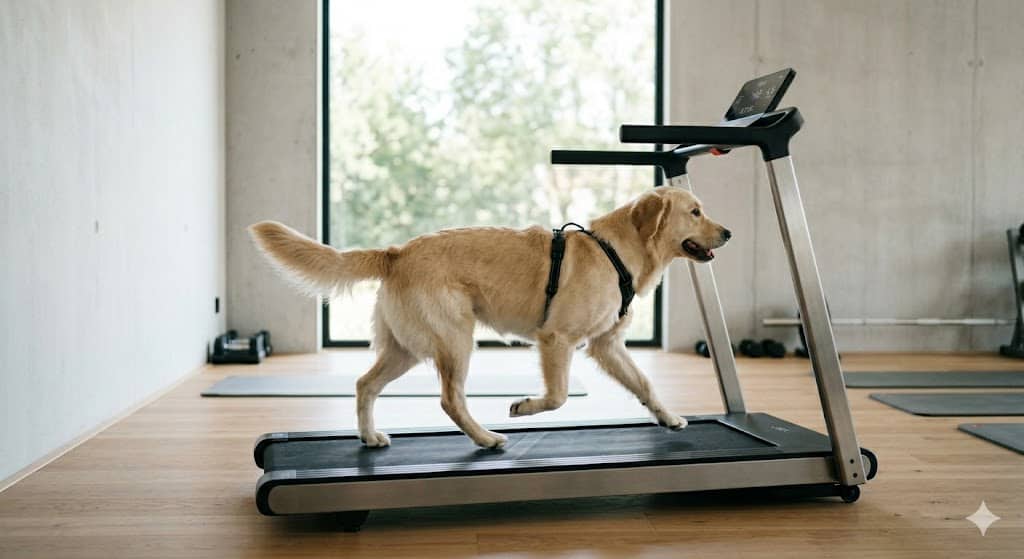
The dog treadmill for indoor use question usually comes up after weeks of frustration. Perhaps you have a high-energy breed in an apartment without easy outdoor access. Maybe you live in a climate where summer heat or winter cold makes meaningful outdoor exercise dangerous for months at a time. Or maybe your work schedule prevents the long walks your dog actually needs. Whatever drove you to this article, the underlying problem is the same: your dog isn’t getting enough exercise, and the consequences, destructive behavior, weight gain, anxiety, restless sleep, are showing up in your daily life.
This guide covers the five best dog treadmills for indoor exercise in 2026, evaluated on motor power, belt size matched to dog weight, noise levels for apartment use, and the practical question of whether the treadmill survives years of regular canine use rather than failing within months.
Why Indoor Exercise Becomes Necessary for Some Dogs
Several scenarios make outdoor exercise inadequate for meeting a dog’s actual needs.
Climate extremes are the most common driver. Phoenix summers with pavement temperatures over 160°F make daytime walks dangerous from May through September. Northern winters with extended subzero temperatures and ice make outdoor exercise risky and unpleasant for months. The dogs in these climates either get inadequate exercise during the bad seasons or require alternative solutions.
High-energy working breeds often need exercise volumes that exceed what owner schedules can provide. Border Collies, Australian Shepherds, Belgian Malinois, German Shepherds, and similar working breeds were bred to run 10-20 miles daily during their original work. Even active owners struggle to provide that volume through walks alone. A treadmill supplements rather than replaces outdoor time, allowing high-energy dogs to actually meet their exercise needs.
Apartment and urban living constrain exercise options. Building elevators, weather-protected dog runs, and limited outdoor access make sustained running difficult or impossible for some urban dog owners. A treadmill provides the cardiovascular workout that walking alone can’t match.
Physical rehabilitation cases benefit from controlled treadmill exercise. Dogs recovering from surgery, managing arthritis, or building back fitness after extended rest need controlled exercise progression that variable outdoor walks can’t provide. Veterinary rehabilitation centers use canine treadmills extensively for these cases, and home versions allow continued progression after professional rehab ends.
For broader exercise and enrichment, our guides on the best dog enrichment toys for high energy dogs and the best treat-dispensing toys for dogs cover the mental stimulation side that pairs with physical exercise in comprehensive dog wellness.
What to Look For in Dog Treadmills
Motor Power Matched to Dog Weight
Motor power determines whether the treadmill handles your specific dog without burning out. Underpowered motors fail when running larger dogs at speed; over-spec motors handle the load comfortably with extended lifespan.
With dogs under 30 pounds, 1.0-1.5 horsepower handles typical use. For 30-65 pound dogs, 1.5-2.0 horsepower is appropriate. And for dogs over 65 pounds, look for 2.0+ horsepower. Underspeccing produces motor burnout within months under regular use.
Belt Size for Stride Length
The belt must accommodate your dog’s full natural stride at running speeds. Too-short belts force unnatural gaits that produce joint stress and injury risk. The belt also needs adequate width, narrow belts force dogs to run in tight, straight lines that don’t match their natural movement.
For small dogs, a 36-inch belt length and 12-inch width handle typical use. Medium dogs need 40-48 inches by 14-16 inches. Large dogs require 60+ inch belts at 18-20 inch widths. Match the dimensions to your specific dog rather than assuming one size fits all.
Speed Range Appropriate for Canine Use
Human treadmills typically max out at 12 mph, which works for most dogs. But canine-specific treadmills offer slow walking speeds (0.5-1 mph) that human treadmills can’t reach. The slow end matters for warm-up, cool-down, and rehabilitation use where careful speed control prevents injury.
For dogs with arthritis or recovering from injury, the slow-end speed range determines whether the treadmill can produce therapeutic exercise without aggravating the underlying condition.
Side Rails and Safety Features
Canine-specific treadmills include side rails that prevent dogs from stepping off the belt unexpectedly. The rails create a confined channel that keeps the dog safely on the belt during exercise. Human treadmills lack this feature and require dog-specific modifications or constant supervision.
Emergency stop features matter more for dogs than humans because dogs can’t operate stop buttons themselves. Look for treadmills with quick-stop controls, automatic shut-off when the dog steps off, or remote stop capabilities.
Noise Level for Apartment Use
Treadmills operate at varying noise levels depending on motor design and belt construction. For apartment use, noise becomes a major variable affecting whether you can actually use the treadmill without disturbing neighbors. Look for treadmills rated below 65 dB at typical operating speeds.
DC motors typically run quieter than AC motors. Belt-driven systems run quieter than older direct-drive designs. The differences matter dramatically for apartment users, where complaints can affect lease compliance.
Best Dog Treadmills for Indoor Exercise in 2026: Our Top 5 Picks
1. dogPACER LF 3.1, Best Overall
Best Overall Dog Treadmill | Price: ~$650
Check Price on AmazonBest for: Most dog owners across small to large breeds, buyers wanting purpose-built canine treadmill engineering, and owners willing to invest in a treadmill that lasts.
The dogPACER LF 3.1 represents the practical sweet spot for canine treadmills. Designed specifically for dogs from 5 to 179 pounds, the treadmill handles the full range of typical pet sizes without requiring different models for different dogs. The 71-inch belt length accommodates extended stride at running speeds for medium and large breeds. The 1.5 HP motor handles sustained use without burnout under typical loading.
Speed range covers 0.5 to 7.5 mph, providing both rehabilitation-appropriate slow speeds and meaningful running speeds for athletic dogs. The 9-degree maximum incline adds resistance variability that flat-track running cannot provide.
Build quality genuinely matches the price point. The folding design saves space when not in use, important for apartment users who can’t dedicate permanent floor space. The side rails and safety features are well-engineered for canine use rather than retrofitted from human treadmill designs.
PROS:
- Designed specifically for dogs from 5-179 pounds
- 71-inch belt accommodates large breed strides
- Speed range from 0.5-7.5 mph covers all use cases
- Folding design for apartment storage
- Established canine treadmill brand with strong support
CONS:
- Higher price than budget alternatives
- Folding mechanism requires periodic maintenance
- 1.5 HP motor is adequate but not generous for the largest breeds at speed
- Significant footprint when deployed for use
For broader high-energy dog management, our guide on the best dog enrichment toys for high energy dogs covers mental stimulation that pairs with treadmill physical exercise in comprehensive wellness for working breeds.
2. GoPet PetRun PR700, Best Premium Pick
Best Premium Dog Treadmill | Price: ~$1,300
Check Price on AmazonBest for: Owners of large or giant breeds, buyers wanting flagship build quality, professional dog trainers, and rehabilitation specialists.
GoPet builds the PetRun PR700 for serious canine treadmill use. The 2.0 HP motor handles dogs up to 175 pounds at sustained running speeds without strain. The 65-inch belt length works for large breeds, and the 18-inch belt width accommodates wider gaits than narrower alternatives.
The build quality genuinely justifies premium positioning. Components are commercial-grade rather than consumer-grade, and the treadmill survives heavy use that breaks lighter alternatives. Many professional dog rehabilitation centers use GoPet equipment specifically because the durable handles can withstand 8-12 hours of daily use across multiple dogs.
The trade-off is price and footprint. At $1,300, the PR700 costs roughly double the dogPACER. The non-folding design requires permanent floor space, appropriate for dedicated home gyms or training spaces, but problematic for typical apartment living.
For owners with giant breeds (Mastiff, Great Dane, Saint Bernard, Newfoundland) where the dogPACER’s 179-pound limit becomes constraining, the PR700 provides the necessary capacity. For typical breeds, the dogPACER produces comparable practical results at a meaningfully lower cost.
PROS:
- Commercial-grade build for sustained heavy use
- 2.0 HP motor handles giant breeds at speed
- 18-inch belt width accommodates wide gaits
- Used in professional rehabilitation centers
- Strong manufacturer support and parts availability
CONS:
- Premium price is roughly double that of mid-tier options
- Non-folding design requires permanent floor space
- Larger footprint than alternatives
- Premium features unnecessary for typical breed sizes
3. dogPACER MiniPACER, Best for Small Dogs and Apartments
Best for Small Dogs | Price: ~$390
Check Price on AmazonBest for: Small dog owners (under 55 pounds), apartment dwellers with space constraints, buyers wanting a genuine canine treadmill at a lower price point.
The dogPACER MiniPACER scales the LF 3.1 design to small-dog dimensions and apartment-friendly specifications. The 38-inch belt length handles stride lengths for dogs up to 55 pounds without forcing unnatural gaits. The 1.0 HP motor adequately powers smaller dogs at running speeds.
The folding design is the practical differentiator. Folded dimensions are significantly smaller than the LF 3.1, fitting closets or under-bed storage in studio apartments. For urban small-dog owners, the storability often matters more than absolute capacity.
Speed range covers 0.5 to 7.5 mph, matching the LF 3.1’s range for small dog use. The MiniPACER’s smaller motor produces lower noise output than the LF 3.1, which apartment users find meaningful for both their own comfort and neighbor relations.
PROS:
- Sized specifically for small dogs and tight spaces
- Folding design fits apartment storage
- Lower noise output than larger treadmills
- More affordable than LF 3.1 for small-dog-only households
- Same dogPACER quality at a smaller scale
CONS:
- 55-pound weight limit excludes most medium and large breeds
- 38-inch belt limits the stride for taller small breeds
- 1.0 HP motor is inadequate for sustained large-dog use
- Limited use case relative to versatile alternatives
4. LifeSpan TR1200i, Best Human-Crossover Pick
Best Human-Crossover Treadmill | Price: ~$1,000
Check Price on AmazonBest for: Households wanting one treadmill for both humans and dogs, owners with medium to large dogs that fit human treadmill belt sizing, buyers prioritizing build quality without dog-specific design.
The LifeSpan TR1200i is a human treadmill that handles dog use well with appropriate modifications. The 56-inch belt length accommodates medium and large dog strides. The 2.5 HP motor handles dogs up to 90 pounds without strain. Human treadmill construction quality at this tier exceeds many dog-specific alternatives.
The trade-off is the lack of canine-specific safety features. No side rails to prevent dogs from stepping off the belt. No automatic shut-off when the dog leaves the belt. The dog requires direct supervision throughout treadmill use, with leash attachment to a fixed point above the treadmill providing the practical safety mechanism.
For households where multiple family members will use the treadmill (humans for cardio, dogs for exercise), the LifeSpan delivers solid value. For dog-only households, the dog-specific options provide meaningful safety and convenience advantages that justify their pricing.
PROS:
- High-quality human treadmill construction
- 2.5 HP motor exceeds many dog-specific alternatives
- Useful for households wanting human + dog crossover
- Strong human-treadmill brand support
- Adequate belt length for medium and large dogs
CONS:
- Lacks canine safety features (side rails, auto-stop)
- Requires direct supervision throughout dog use
- Not designed for canine ergonomics
- Higher price than dogPACER LF 3.1 without dog-specific advantages
5. PetZen DogTread, Best Budget Canine-Specific Pick
Best Budget Canine Treadmill | Price: ~$450
Check Price on AmazonBest for: Small to medium dog owners on tight budgets, buyers wanting genuine canine-specific design without premium pricing, and occasional rather than daily use scenarios.
The PetZen DogTread delivers genuine canine-specific design at the lowest reasonable price for the category. The 60-inch belt length accommodates small and medium dogs up to 75 pounds. The motor handles typical use loading without immediate burnout, though it lacks the headroom of premium alternatives.
The trade-offs match the price point. Build quality is functional rather than premium. The motor adequately handles typical use but produces a shorter usable life under sustained heavy use. The belt and rails meet basic standards without the refinement of dogPACER or GoPet alternatives.
For owners testing whether a treadmill fits their lifestyle before committing to premium options, PetZen provides genuine functionality at minimum risk. If treadmill use becomes an essential daily routine, upgrading to dogPACER produces a better long-term experience. If treadmill use remains occasional, the lower investment matches the use case.
PROS:
- Lowest price for a genuine canine-specific treadmill
- 60-inch belt accommodates small to medium dogs
- Useful for testing treadmill use before a premium investment
- Side rails and basic canine safety features included
- Available through major retailers
CONS:
- Build quality is below that of premium alternatives
- Shorter usable life under sustained heavy use
- 75-pound weight limit excludes large breeds
- Less refined controls than premium options
How to Match a Treadmill to Your Dog and Lifestyle
The right treadmill depends on your specific dog and use pattern.
For owners of small dogs (under 55 pounds) in apartments, the dogPACER MiniPACER provides appropriate sizing and folding storage that suits tight spaces. The smaller motor produces less noise, which affects apartment relationships.
Most owners with medium-to-large dogs do best with the dogPACER LF 3.1. The combination of broad weight capacity, adequate belt length, full canine safety features, and folding storage handles the practical reality of typical home use across most breeds.
Owners of giant breeds (Mastiff, Great Dane, Saint Bernard) need the GoPet PetRun PR700 for the 175-pound capacity and commercial-grade durability that the LF 3.1 doesn’t quite reach for the largest dogs.
Households wanting one treadmill for both humans and medium-to-large dogs should consider the LifeSpan TR1200i. The crossover use case justifies the additional cost compared to dog-only alternatives, though the lack of canine safety features requires constant supervision.
Budget-conscious buyers or those testing whether treadmill use fits their lifestyle benefit from the PetZen DogTread. The lower upfront cost reduces the financial risk of discovering treadmill use isn’t right for your specific dog or living situation.
How to Acclimate Your Dog to the Treadmill
A treadmill the dog refuses to use is wasted equipment. Acclimation matters as much as selection.
Start with the treadmill turned off. Encourage the dog to step onto the belt with treats and praise. Reward standing calmly on the belt for 30-60 seconds. Most dogs need 2-3 sessions of off-treadmill familiarization before progressing.
Begin with very slow speeds (0.5-1 mph) for the first powered session. Stand directly in front of the dog with treats, walking at the same pace. Most dogs walk forward naturally to follow the treats and the apparent forward motion. Build duration gradually, 2 minutes in the first session, 5 minutes in session three, 10 minutes in week one.
Increase speed gradually across the first 2-3 weeks. Most dogs reach normal walking pace (3-4 mph) by week two and running pace (5-7 mph) by week four if appropriate for the breed. Don’t push speed before the dog is comfortable at the lower end.
Maintain leash attachment for safety throughout acclimation. The leash clips to a fixed point above the treadmill, preventing the dog from stepping off the belt accidentally. After several weeks of confident use, some owners transition to off-leash treadmill use under direct supervision.
Treadmill exercise supplements, but doesn’t replace outdoor time. Even dogs with consistent treadmill use need outdoor walks for environmental enrichment, scent stimulation, and the social experience that treadmills can’t provide.
Quick Comparison Table
| Treadmill | Best For | Price | Weight Capacity | Belt Length |
|---|---|---|---|---|
| dogPACER LF 3.1 | Most owners | ~$650 | 5-179 lbs | 71″ |
| GoPet PetRun PR700 | Giant breeds | ~$1,300 | Up to 175 lbs | 65″ |
| dogPACER MiniPACER | Small dogs | ~$390 | Up to 55 lbs | 38″ |
| LifeSpan TR1200i | Human-dog crossover | ~$1,000 | Up to 90 lbs | 56″ |
| PetZen DogTread | Budget pick | ~$450 | Up to 75 lbs | 60″ |
Our Verdict
Most dog owners do best with the dogPACER LF 3.1. The combination of broad weight capacity from small to large breeds, 71-inch belt length, full canine-specific safety features, and folding storage delivers reliable performance for typical home use at a price that doesn’t require premium investment. Buy this unless you have specific reasons to choose differently.
Owners of giant breeds or those wanting commercial-grade durability for sustained heavy use should look at the GoPet PetRun PR700. The 2.0 HP motor and reinforced construction handle loads that defeat consumer-tier alternatives.
Small-dog owners in apartments where space matters more than capacity benefit from dogPACER MiniPACER. The folding design and quieter operation suit urban living constraints that the larger LF 3.1 doesn’t address.
Households wanting a single treadmill for human and dog use can consider LifeSpan TR1200i, accepting that the lack of canine safety features requires direct supervision throughout dog sessions.
Budget-conscious buyers or those testing whether treadmill exercise fits their lifestyle should start with PetZen DogTread. The lower price reduces the financial risk of discovering the treadmill isn’t right for your specific situation.
Pair the right treadmill with enrichment toys for mental stimulation, appropriate cooling vests for warm climates, and continued outdoor time for environmental enrichment, and you have a comprehensive exercise approach that handles the realities of weather, schedule, and living situation while still providing the variety that dogs need.
Frequently Asked Questions
Are dog treadmills worth it?
For high-energy breeds, owners in extreme climates, apartment dwellers, and dogs with rehabilitation needs, yes. The treadmill solves the exercise problem when outdoor walks alone can’t meet the dog’s actual needs. For typical breeds in moderate climates with adequate outdoor access, treadmills are convenient but not essential. The investment makes sense when you can identify specific scenarios where outdoor exercise is inadequate.
Can I use a human treadmill for my dog?
Possibly, with safety modifications. Human treadmills lack canine safety features like side rails and automatic shut-off when the dog steps off. They require direct supervision throughout dog use, with the dog leashed to a fixed point above the treadmill for safety. Belt sizing on human treadmills works for medium and large dogs but may be too narrow for natural canine gaits. Dog-specific treadmills provide better safety and ergonomics than modified human alternatives.
How long should a dog run on a treadmill?
Most dogs benefit from 15-30 minutes of moderate-paced treadmill exercise, supplementing rather than replacing outdoor walks. Working breeds and high-energy dogs may benefit from 30-45 minutes. Start with shorter sessions (10-15 minutes) and build up over weeks. Watch for signs of overexertion, heavy panting, slowing pace, looking back at you frequently, and stop before the dog becomes exhausted.
What size dog can use a treadmill?
Treadmills exist for dogs from 5 pounds (small chihuahuas, toy breeds) to 175+ pounds (giant breeds like Mastiffs and Great Danes). Match the treadmill’s weight capacity and belt size to your specific dog. Small dogs need smaller belts and lower motor power; large dogs need substantial belts and high-power motors. The dogPACER LF 3.1 handles the broadest range; specialized treadmills exist for the extremes.
How do I get my dog to use the treadmill?
Start with the treadmill turned off, using treats to encourage stepping on and standing calmly. Progress to very slow speeds (0.5-1 mph) with you walking at the same pace in front of the treadmill. Build speed and duration gradually over 2-3 weeks. Maintain leash attachment to a fixed point above the treadmill for safety throughout acclimation. Most dogs adapt to treadmill use within 1-3 weeks of patient introduction.
Are treadmills safe for puppies?
Generally not for puppies under 12 months, depending on breed. Growing joints and developing musculoskeletal systems aren’t ready for the repetitive loading of treadmill exercise. Wait until your puppy reaches roughly 80-90% of expected adult size before introducing treadmill use. For large and giant breeds, this often means 14-18 months. Consult your vet about the appropriate timing for your specific puppy.
How loud are dog treadmills?
Quality canine treadmills run between 55-70 dB at typical operating speeds, comparable to normal conversation. Premium models with DC motors run quieter than budget alternatives with AC motors. For apartment use, look for treadmills rated below 65 dB to minimize disturbance to neighbors. Operating the treadmill on a rubber mat further reduces noise transmission through floors.
Should I exercise my dog daily on the treadmill?
Most dogs benefit from 4-5 treadmill sessions per week rather than daily use. Rest days allow muscular recovery and reduce repetitive-stress injury risk. Combine treadmill exercise with outdoor walks (for variety, scent stimulation, and environmental enrichment) and indoor mental stimulation through enrichment toys. Treadmill exercise alone, even daily, doesn’t substitute for the variety dogs need for full physical and mental wellness.
Recommended Reading
See also our guides to dog playpens for indoor use, heated outdoor dog houses, and indoor dog agility equipment.
Related Reading
Explore more: cat exercise wheels, how to care for an indoor cat, indoor cat grass kits, indoor dog agility equipment, dog playpens for indoor use, how to stop a dog from barking, dog hiking backpacks, and dog ramps for suvs.
