
Disclosure: HappyPaws is reader-supported. As an Amazon Associate, we earn from qualifying purchases made through links on this page, at no extra cost to you.
Your indoor cat sits at the window watching birds for hours. You’ve noticed she perks up when you open the patio door, watching outdoor cats with what looks like envy. Maybe you’ve thought about leash training her, letting her experience grass, sunlight, and the scents she clearly wants to explore without the risks of fully outdoor life. Then you saw a video of a cat in a harness, backing out of it in 3 seconds flat and bolting under a car, and the idea suddenly seemed terrifying.
Cat harnesses are one of the most misunderstood pet products on the market. Unlike dogs, who typically accept harnesses readily and can be trained to walk on leash in weeks, cats require specific harness designs that account for their unique anatomy, flexible spines, pronounced shoulder blades that they can physically compress to slip out of loose fittings, and escape instincts that dogs simply don’t have. A harness that fits a 20-pound dog perfectly will fail on a 10-pound cat because the failure modes are different. Dogs pull forward; cats back up. Dogs’ shoulder blades are relatively fixed; cats can compress theirs inward voluntarily.
The right cat harness is a piece of equipment that needs to resist a cat’s specific escape maneuvers, distribute pressure safely across the chest rather than the throat, fit snugly enough to prevent backing out while loose enough to allow natural movement, and maintain these properties as your cat ages and their body changes. The wrong harness is either an escape hazard that puts your cat in danger, a distressing pressure source that makes outdoor training impossible, or a poorly fitted accessory that chafes and causes behavioral resistance. Getting harness choice right is the foundation of successful cat leash training.
This guide walks through the five best cat harnesses available in 2026, the specific design criteria that separate escape-proof harnesses from marketing claims, and how to introduce a harness successfully to a cat who’s never worn one. If you’re building a broader outdoor adventure setup for your cat, this article pairs well with our guide on the best gps cat collars for multi-pet households.
Why cat harness design matters more than most owners realize
Cat anatomy and behavior create harness requirements that dog-focused designs simply don’t account for. Understanding these differences explains why specific products work and others produce escape events that terrify owners and endanger cats.
The first anatomical difference is spinal flexibility. Cats have 30 vertebrae (humans have 33, dogs have 30), but their intervertebral discs are more flexible, allowing them to rotate their bodies nearly 180 degrees, which means they can turn around within a loose harness and chew at connection points that a dog couldn’t physically reach. Harness designs that work on dogs fail on cats because cats can access their own harness in ways dogs cannot.
The second difference is shoulder blade mobility. A cat’s shoulder blades are attached only through muscle and tendons, not through a rigid bone structure like the human or dog shoulder. This means cats can voluntarily compress their chests, pulling their shoulder blades together and making their chest circumference 1-2 inches smaller than at rest. A harness fitted “snug” to a relaxed cat can become loose enough for backward escape the moment the cat tries to flee. Dogs cannot do this; a harness fitted snugly to a relaxed dog stays snug during movement.
The third difference is the escape reflex. When a cat becomes frightened, their instinct is to back away and flatten their body, the opposite of a dog’s forward-pulling escape instinct. This backing behavior, combined with shoulder blade compression, creates the characteristic “cat escape” where a cat appears to slip backward out of a harness in 2-3 seconds. Harness designs that account for this specifically, additional connection points, layered construction, or escape-prevention panels, prevent these escapes.
The fourth difference is throat sensitivity. Cats’ tracheas are more delicate than dogs’ tracheas, and pressure against a cat’s throat can cause respiratory distress rapidly. Harnesses that distribute pressure to the throat (collar-style attachments, H-style harnesses with throat straps) can injure cats during escape attempts. Proper cat harnesses distribute all pressure across the chest and shoulders, never the throat.
What cat harnesses do NOT solve: A cat’s general unwillingness to be outdoors, anxiety about unfamiliar environments, or fear of unpredictable outdoor stimuli (loud noises, dogs, other cats). A harness is a safety tool that enables outdoor training; it doesn’t produce outdoor-comfortable cats by itself. Cats who resist the harness entirely may never become comfortable outdoors, regardless of which harness you buy. For cats that will not accept a harness, our stroller picks are the alternative route outdoors.
What to look for in a cat harness
The cat harness category contains genuinely escape-proof products and products that will fail under predictable circumstances. Here’s what separates reliable harnesses from marketing claims.
Vest-style construction (not H-style)
Cat harnesses come in two primary designs: H-style (two straps connected by a bar along the back) and vest-style (fabric panels that cover most of the chest and shoulders). Vest-style harnesses are dramatically more escape-resistant for cats because they don’t allow the shoulder-blade compression escape route. H-style harnesses rely on the two straps fitting tightly enough that cats can’t back out, which requires fitting tighter than is comfortable for most cats.
For first-time cat harness buyers, always choose a vest-style. H-style harnesses can work for cats that are already leash-trained and aren’t prone to escape behavior, but they’re the wrong choice for introducing a cat to outdoor training.
Multiple adjustment points
Quality cat harnesses have 4-6 adjustment points (neck, chest width, chest length, belly strap). This multi-point adjustability lets you achieve a true snug fit that accounts for your cat’s specific body proportions. Budget harnesses often have 1-2 adjustment points, which means “snug” in one dimension often means “loose” in another, creating escape opportunities.
Test the fit by the “two-finger rule”, you should be able to slide two fingers flat between the harness and your cat’s body at any point. Fewer than two fingers means the harness is too tight; three or more fingers means it’s loose enough for a cat to potentially back out.
Breathable fabric construction
Cats are more heat-sensitive than dogs. Solid fabric harnesses that cover large chest areas can cause overheating during warm weather, leading to cat distress that looks like “harness resistance” but is actually temperature-related. Look for harnesses with mesh panels, breathable fabrics, or ventilation features that prevent heat buildup. Avoid heavy-canvas or fleece-lined harnesses for anything but cold-weather use.
D-ring leash attachment on the back, not the neck
The leash attachment point matters for both safety and control. A D-ring on the back (between the shoulder blades) distributes pull pressure across the chest and shoulders, the strongest parts of a cat’s body. A D-ring near the neck forces any pull into the throat area, which is both uncomfortable for the cat and potentially dangerous during sudden movements.
Some harnesses have front-attachment options in addition to back attachment. For cats, stick with the back attachment only. Front attachments are useful for dog training (they redirect pulling), but don’t translate well to cats.
Escape-prevention features
Premium cat harnesses include specific escape-prevention features that budget alternatives lack. These include: overlapping fabric panels (preventing the harness from loosening when chest compresses), dual-strap construction (two straps per body zone instead of one), leash clips at both the shoulders and between the shoulder blades (redundant attachment points), and locking buckle mechanisms that cats can’t manipulate with paws.
Look for language like “escape-proof,” “double-secured,” or “backward-escape prevention” in product descriptions. These features matter, and manufacturers who include them typically advertise them clearly.
Appropriate weight range for your specific cat
Cat harness sizing varies more than dog harness sizing because cat body size variations are proportionally larger, a 6-pound cat and a 15-pound cat have body frames that differ by 40-50% in circumference. Harnesses labeled “cat size” often fit 8-12 pound cats; smaller or larger cats need specifically sized products. Measure your cat’s chest circumference (behind the front legs, at the widest point) and neck circumference, then match to the harness manufacturer’s size guide.
Never assume sizing translates between brands. A “medium” from one manufacturer can be sized completely differently from a “medium” from another. Check specific measurements in product details.
Best cat harnesses in 2026: our top 5 picks
Five picks covering the full range of cat leash training needs: best overall for most cats, best escape-proof for experienced escape artists, best for adventure cats doing serious outdoor activity, best budget option for introductory training, and best for kittens or small cats.
1. Kitty Holster Cat Harness, Best Overall
Best for most leash-training cats | Price: ~$30
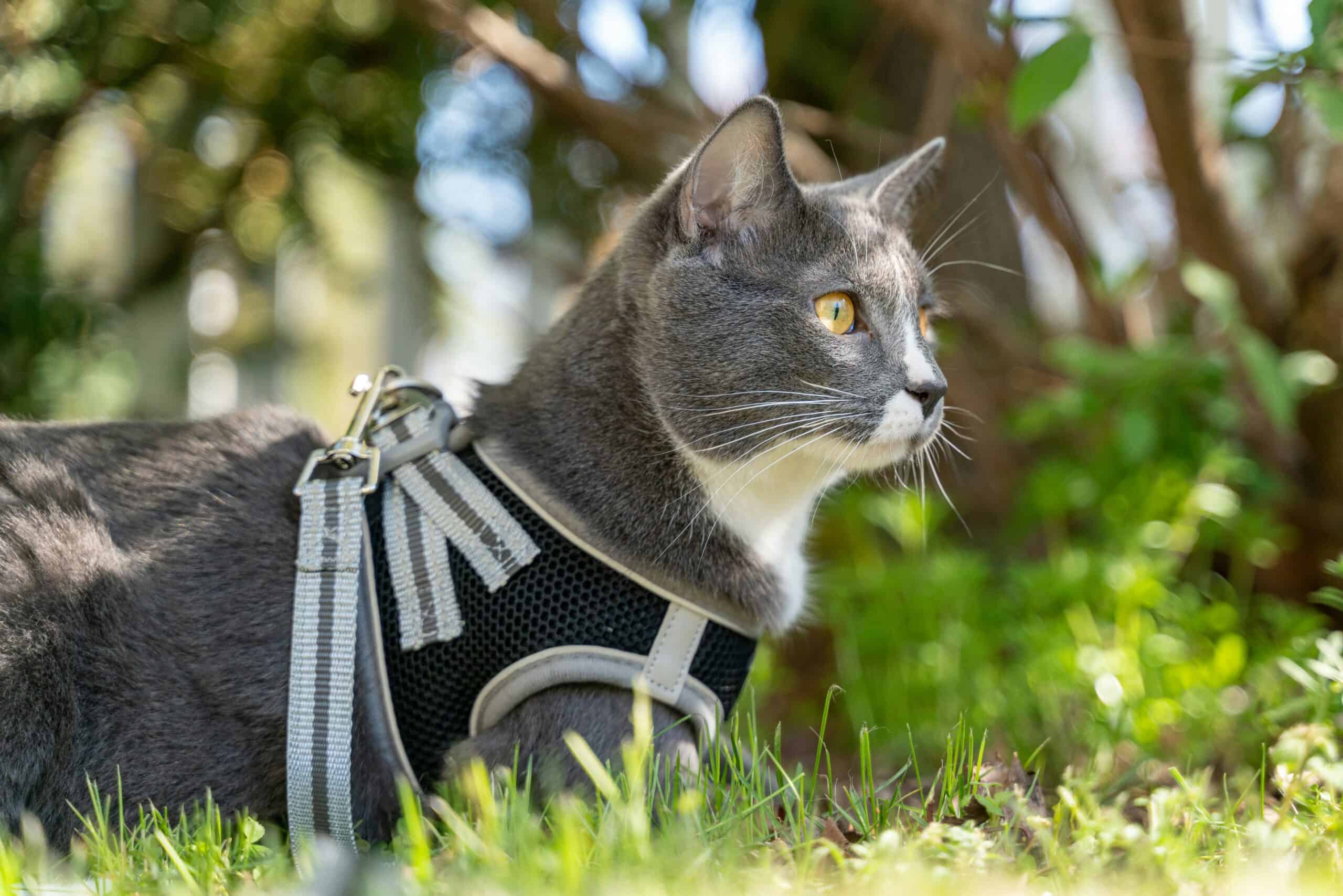
Check Price on AmazonThe Kitty Holster has been the default cat harness recommendation among experienced cat-walking enthusiasts for over a decade. The vest-style construction with breathable cotton fabric, hook-and-loop closure at both the neck and belly, and D-ring attachment between the shoulder blades produces a harness that fits securely without distressing most cats during the adjustment period. The design prioritizes practical function over aesthetic complexity, and the result is a harness that experienced cat owners return to buy again for subsequent cats.
Kitty Holster’s Vest Design Philosophy
The Kitty Holster was designed specifically by cat owners for cat owners, not adapted from dog harness designs. This origin matters because the design decisions reflect actual cat anatomy rather than assumptions carried over from dog equipment. The vest covers the chest and shoulders completely while leaving the belly open for temperature regulation, uses hook-and-loop closures that can be precisely adjusted (versus buckles that have discrete positions), and positions the D-ring where pull pressure distributes across the shoulders rather than concentrating on any single point.
The cotton fabric is substantial enough to provide structure (preventing the harness from collapsing into a loose state when the cat moves) while remaining breathable and washable. Multiple color options let you choose visibility for outdoor settings, high-visibility colors are recommended for cats that might escape and need to be found.
The harness is sized by chest circumference rather than weight, with sizes small (10″-13″), medium (13″-16″), and large (16″-19″). Measure carefully; the difference between sizes is significant and incorrect sizing produces either escape risk or discomfort.
Why it works for most cats
The Kitty Holster’s combination of vest construction, multiple adjustment points, and thoughtful design produces a harness that most cats adjust to within 1-2 weeks of patient introduction. The hook-and-loop closure makes putting the harness on and off genuinely easy, a meaningful consideration when you’re harnessing a cat who may be resistant. The back D-ring distributes pull pressure safely, and the overall design gives cats appropriate mobility without escape risk.
For first-time cat harness buyers introducing leash training to a resident cat, this is the right first purchase. The $30 investment is modest enough that if leash training doesn’t succeed for your specific cat (some cats never adjust), the cost isn’t devastating. If leash training does succeed, you have years of reliable use from this harness.
Best for: First-time leash-training setups, most domestic shorthair and medium-length-haired cats, owners introducing outdoor adventure to indoor cats, buyers wanting a proven design.
PROS:
- Designed specifically for cat anatomy
- Vest-style construction prevents backward escape
- Breathable cotton fabric
- Hook-and-loop adjustment for precise fit
- Back D-ring distributes pull pressure
- Multiple size options and color choices
- Machine washable
- Reasonable price point
CONS:
- Hook-and-loop closures may loosen after 50+ wash cycles
- Cotton fabric can shrink if dried at high heat
- Not suitable for cats with documented escape history (upgrade to dedicated escape-proof design)
- Sizing requires careful measurement
2. Rabbitgoo Cat Harness Escape Proof, Best Escape-Proof
Best for cats with escape history | Price: ~$22
Check Price on AmazonFor cats who have already escaped from harnesses, owners upgrading from a previous harness failure, or especially wiry cats whose body compression is particularly dramatic, the Rabbitgoo escape-proof harness adds specific construction features designed to prevent backing-out behavior. The harness uses dual-strap construction with adjustable straps at the neck, chest, and belly, along with overlapping fabric panels that maintain their secure position even when the cat attempts to compress their chest for escape.
Rabbitgoo’s Dual-Strap Escape Prevention
The key escape-prevention feature is the harness’s use of multiple overlapping adjustment points rather than a simple two-piece vest design. When a cat attempts backward escape, they typically try to slip their front legs out of the shoulder openings. The Rabbitgoo’s construction creates multiple fabric layers over the shoulder zone, so even if the cat compresses their chest and slips one strap, the secondary strap maintains secure attachment.
The harness also uses quick-release buckles rather than hook-and-loop closures, which maintain exact sizing over hundreds of use cycles. Hook-and-loop closures can loosen slightly over time through normal use and washing; buckles maintain their original secure fit for years.
The padded chest panel distributes pressure comfortably while providing visual volume that reassures nervous cats, some cats actually calm down in vest-style harnesses because the pressure sensation mimics being held, which is why “thundershirts” work for anxious pets.
Why it works for escape-prone cats
If you have a cat who has escaped from a previous harness, this is the logical next purchase. The multi-layer construction addresses the specific failure mode that traditional cat harnesses have, a single-layer fabric that loses security when the cat compresses their chest. The buckle closures eliminate the hook-and-loop loosening problem that develops over time.
For first-time harness buyers without escape history, this harness is usually unnecessary. The Kitty Holster suffices for most cats, and the Rabbitgoo’s additional features matter primarily for cats with documented escape behavior.
Best for: Cats with documented escape history, especially wiry or anxious cats, owners recovering from a frightening escape event, buyers who prioritize security over first-purchase cost savings.
PROS:
- Dual-strap construction prevents typical escape maneuvers
- Quick-release buckles maintain exact sizing over time
- Multiple adjustment points for a precise fit
- Padded chest panel for comfort and pressure reassurance
- Reflective strips for low-light visibility
- Works for cats 5-20 pounds with appropriate sizing
- Reasonable price for escape-prevention features
CONS:
- More complex to put on than simple vest styles
- Heavier fabric may overheat in warm weather
- Cats may resist initially due to a more substantial feel
- Size adjustment takes longer during initial fitting
- Overkill for non-escape-prone cats
3. Supakit Cat Harness, Best for Adventure Cats
Best for serious outdoor activity | Price: ~$60
Check Price on AmazonFor owners who plan serious outdoor adventures with their cats, hiking, camping, extended outdoor time, or travel, the Supakit represents the premium tier of cat harness equipment. The harness uses outdoor-specific materials (weatherproof fabrics, reinforced stitching, heavy-duty hardware), includes features that matter for serious adventure (waterproof construction, enhanced reflectivity, reinforced leash attachment), and comes with sizing that accommodates adventure cat-specific needs like larger breeds (Maine Coons, Bengals, etc.) more reliably than mainstream harnesses.
Supakit’s Adventure-Specific Engineering
The Supakit harness is designed around the reality that adventure cats face conditions that most indoor cats never encounter. Rain, mud, multi-hour outdoor sessions, varied terrain, and extended leash time all stress harness materials differently than backyard grass time. Supakit’s fabric is weatherproof rather than water-absorbent, the stitching is triple-reinforced at stress points, and the hardware (buckles, D-ring) is marine-grade rated for saltwater and chlorine exposure.
The harness is also designed to work with the Supakit leash ecosystem, harness, leash, and collar designed to integrate rather than be sourced from separate manufacturers. This integration matters for adventure use because failure points in multi-brand setups (where a harness D-ring connects to a third-party leash clip) are often where real-world failures happen.
Supakit operates as a British company focused specifically on adventure cat equipment. The customer base skews toward experienced cat enthusiasts who travel with cats, hike with cats, or live active outdoor lifestyles with their pets. The pricing reflects this specialty market positioning.
Why it works for serious adventure cats
If you’re planning to hike with your cat, travel with your cat, or engage in activities beyond backyard leash time, the Supakit is the right investment. The material quality and engineering specifically address conditions that mainstream cat harnesses weren’t designed for. The $60 price reflects specialty market positioning, but it’s the right price for specialty needs.
For casual backyard leash time or brief outdoor sessions, the Supakit is overkill. Save the money and buy a Kitty Holster or similar; save the Supakit for actual adventure cat ownership.
Best for: Adventure cat owners, travelers with cats, hikers with cats, owners of large breeds (Maine Coons, Bengals), serious outdoor-cat enthusiasts.
PROS:
- Weatherproof outdoor-specific construction
- Marine-grade hardware
- Triple-reinforced stress points
- Integrated ecosystem with Supakit leashes and collars
- Designed for larger cat breeds
- Premium aesthetic and build quality
- Suitable for extended outdoor sessions
CONS:
- Highest price point in our guide
- Overkill for casual backyard use
- International shipping for some regions
- Stiffer material requires a longer break-in period
- Premium positioning may not match casual owner budgets
4. rabbitgoo Cat Harness Basic, Best Budget Option
Best entry-level cat harness | Price: ~$15
Check Price on AmazonFor owners who want to test whether their cat will accept a harness before investing in premium alternatives, rabbitgoo’s basic cat harness at approximately $15 delivers functional performance for validation. The harness uses vest-style construction with two adjustment points, fabric that’s adequate for gentle outdoor exposure, and the basic features (back D-ring, belly strap, neck strap) that make it functional for standard use cases. The compromises are subtle but real, shorter expected lifespan, less sophisticated escape prevention, and cheaper materials throughout, but for first-time buyers testing whether their cat accepts harnessing, it delivers the validation at minimal cost.
rabbitgoo’s Budget-Tier Manufacturing
Rabbitgoo operates at a significant scale in the budget pet products category, which allows them to deliver functional products at accessible prices. The basic harness uses standard polyester fabric (rather than cotton or premium materials), standard plastic buckles (rather than metal or marine-grade), and simplified construction (rather than the multi-layer escape prevention of their premium line).
None of these compromises makes the harness unsafe for normal cats in standard use. The vest construction still prevents the primary escape mode; the back D-ring still distributes pressure correctly; the adjustment still allows proper fit. What you lose at this price point is long-term durability (2-4 years vs 5-7 years for premium), and the additional escape-prevention features that matter for cats with established escape behavior.
Why does it work as a validation purchase?
Cat leash training has a real success rate of maybe 60-70% among indoor cats. Some cats adjust to harnesses and enjoy outdoor time; other cats never adjust and remain fundamentally resistant. For first-time owners introducing leash training, spending $60 on a Supakit before knowing whether your cat will cooperate creates a significant risk of wasted money.
Starting with the $15 rabbitgoo lets you validate whether your cat will cooperate with harness training. If they do, you can upgrade to a premium harness once you know it’s worth the investment. If they don’t, you’ve only spent $15 to learn that your cat isn’t a leash-training candidate.
Best for: First-time harness buyers validating feasibility, budget-constrained households, secondary harnesses for households with multiple cats, backup harnesses for travel or as spares.
PROS:
- Lowest price in our roundup at ~$15
- Functional vest-style construction
- Basic but adequate escape prevention
- Two adjustment points for acceptable fit
- Available in multiple sizes and colors
- Good introduction to the harness category
- Low-risk validation purchase
CONS:
- Shorter expected lifespan (2-4 years)
- Less sophisticated escape prevention than premium alternatives
- Polyester fabric less comfortable than cotton in warm weather
- Plastic buckles can degrade under UV exposure
- Not appropriate for cats with escape history
5. Best Pet Supplies Voyager Step-In Cat Harness, Best for Kittens or Small Cats
Best for kittens and small cats | Price: ~$20
Check Price on AmazonSmall cats (under 8 pounds) and kittens need harnesses sized and designed specifically for their proportions. Standard cat harnesses often fit too loosely on small cats or create proportional discomfort (too much fabric relative to body size). The Voyager step-in harness is designed for smaller body types with sizing starting as small as 6″ chest circumference, making it appropriate for kittens from approximately 3 months old and small adult cats of all ages.
Voyager’s Small-Body Design
The step-in construction is particularly useful for kittens and small cats because it avoids the over-the-head application that larger harnesses require, which can be distressing for small animals. Instead, the cat steps into the harness’s leg openings (one paw at a time), and the harness closes over the back. This application method is gentler for small animals learning about being handled.
The fabric is mesh rather than solid cotton or polyester, which keeps small cats comfortable (they overheat faster than larger cats) and lightweight (important for animals with less physical capacity to carry harness weight). The D-ring attachment is positioned between the shoulder blades for proper pressure distribution.
Multiple sizing options allow growth, if you buy a kitten-sized harness, you’ll likely need to upgrade within 6-12 months as the kitten grows. Plan to purchase an adult-sized harness separately as your cat reaches full adult size (typically 12-18 months depending on breed).
Why does it work for kittens and small cats
Starting leash training early, during kittenhood, dramatically increases success rates for adult cat outdoor adventures. Kittens are more adaptable to new equipment, less resistant to handling, and more likely to form positive associations with harnesses. The Voyager’s small-body design makes this early training possible with equipment that actually fits.
For adult cats under 8 pounds (common in breeds like Singapuras, Cornish Rexes, Devon Rexes, and many domestic shorthairs), the Voyager’s small-end sizing provides proper fit where mainstream cat harnesses would be too loose.
Best for: Kittens 3+ months old, small adult cats under 8 pounds, small-breed cats (Singapuras, Devons, Cornish Rexes), households starting leash training during kittenhood.
PROS:
- Sizing appropriate for kittens and small cats
- Step-in application avoids over-the-head distress
- Mesh fabric prevents overheating
- Lightweight for small cats
- Multiple size options for growth
- Reasonable price point
- Strong option for early leash training
CONS:
- Step-in design requires cooperation during initial training
- Mesh less durable than woven fabric alternatives
- Will need replacement as kittens grow to adulthood
- Not suitable for cats larger than 10 pounds
- Escape prevention less robust than dedicated escape-proof designs
Quick comparison
- Kitty Holster, best overall, vest construction, proven design, ~$30
- Rabbitgoo Escape Proof, best escape-proof, dual-strap construction, ~$22
- Supakit, best for adventure cats, weatherproof premium, ~$60
- rabbitgoo Basic, best budget option, validation purchase, ~$15
- Voyager Step-In, best for kittens and small cats, ~$20
How to choose the right cat harness
The right harness depends on your cat’s size, escape history, and your activity plans. Here’s the decision framework.
If your cat has never worn a harness and has no escape history: Kitty Holster. The default recommendation for most first-time harness buyers. Proven design, reasonable price, works for the vast majority of cats.
If your cat has escaped from a previous harness: Rabbitgoo Escape Proof. The dual-strap construction addresses the specific failure mode that caused the previous escape. Don’t repeat the mistake with the same harness type.
If you plan adventure activities (hiking, camping, travel): Supakit. The premium pricing reflects genuine engineering improvements for outdoor-specific use. The investment is justified for serious adventure cat ownership.
If budget is the primary constraint or you’re validating feasibility: rabbitgoo Basic. Test whether your cat will cooperate before investing in premium alternatives. Upgrade later if leash training succeeds.
If you have a kitten or small adult cat: Voyager Step-In. Proper fit matters more for small cats because ill-fitting harnesses are both uncomfortable AND escape-prone. Start with appropriate sizing.
How to introduce a harness to your cat
Buying the right harness is only the first step. Successful leash training requires a specific introduction protocol that most owners get wrong.
Phase 1 (Days 1-7): Harness existence. Simply leave the harness in locations your cat frequents, near their food bowl, on their favorite resting spot, near play areas. Let your cat investigate the harness voluntarily. Don’t force any interaction. The goal is neutral association.
Phase 2 (Days 7-14): Harness touching. Begin touching your cat briefly with the harness during positive interactions (treat time, play time, calm moments). Don’t attempt to put it on; just allow the cat to feel the fabric against their body while they’re already relaxed.
Phase 3 (Days 14-21): Partial harness on. Begin putting the harness around your cat’s neck without fastening it fully. Reward immediately with high-value treats. Remove after 10-15 seconds. Repeat several times per day, gradually extending the time.
Phase 4 (Days 21-35): Full harness fitted. Fasten the harness properly but don’t attempt leash walking yet. Let your cat wear the harness indoors for 5-15 minute sessions, with lots of positive reinforcement. Most cats exhibit “frozen cat syndrome” initially, they’ll stop moving and act like they’re paralyzed. This is normal; wait it out patiently. They’ll resume normal behavior after 5-10 minutes.
Phase 5 (Days 35-49): Leash added indoors. Attach a leash to the harness and let your cat drag it around inside the house. This gets them accustomed to the weight and feel of the leash without the unfamiliar stress of outdoor stimuli simultaneously.
Phase 6 (Days 49+): Outdoor introduction. Start with a quiet, safe outdoor location, your own backyard, a quiet side yard. Let your cat set the pace. They’ll likely want to investigate slowly; don’t try to walk them like a dog. Outdoor cats lead, humans follow. Build outdoor comfort gradually over weeks.
Total timeline: Expect 2-3 months from harness purchase to comfortable outdoor adventures. Cats who rush through this process often develop resistance or escape motivation. Cats who get the slow, patient introduction often become confident outdoor companions for years.
What to do if your cat resists the harness
Despite patient introduction, some cats never accept harnesses. Recognize the signs and know when to stop trying.
Signs of moderate resistance (continue training with more patience):
- Initial freezing when the harness is put on
- Walking oddly for the first few sessions
- Reluctance to move during the first outdoor sessions
- Trying to back out during initial wear (if harness is secure, this is normal and decreases over time)
Signs of severe resistance (consider stopping):
- Trying to remove the harness by rolling, chewing, or scratching for extended periods
- Extreme vocalization or panic behaviors during wear
- Urination or defecation from stress while wearing
- Persistent aggression toward family members while harnessed
- No improvement after 6-8 weeks of patient introduction
Some cats are fundamentally not leash-training candidates, usually cats with significant anxiety, feral backgrounds, or strong territorial preferences for indoor-only living. Forcing harness use on severely resistant cats isn’t kind to the cat and doesn’t succeed long-term. Accept that leash training isn’t for every cat, and your cat may be one that prefers window watching to outdoor adventure.
For cats who show moderate resistance that persists beyond 8 weeks, consult a veterinary behaviorist. Some cats benefit from anti-anxiety support (pheromone products, behavioral modification, or medication in severe cases) that enables harness acceptance they couldn’t achieve otherwise.
The annualized cost math
Cat harness costs are modest, but the long-term value calculation differs by tier.
Budget tier ($15 rabbitgoo Basic, 2-4 year lifespan): Approximately $4-7/year. Adequate for validation or secondary harnesses.
Standard tier ($20-30 Kitty Holster or Voyager, 5-7 year lifespan): Approximately $4-6/year. Best value for most cats.
Escape-proof tier ($22 Rabbitgoo Escape Proof, 5-7 year lifespan): Approximately $3-5/year. Good value for cats with escape history.
Premium tier ($60 Supakit, 8-10 year lifespan): Approximately $6-8/year. Justified by serious adventure use.
The overall conclusion: harness costs are genuinely low. Don’t under-invest. A $15 harness that fails during escape costs you far more than the original savings, in stress, potential injury to your cat, or worst case, a lost cat. For cats without specific constraints, spend $30 on the Kitty Holster and enjoy reliable use for years.
Accessories worth pairing with your cat harness
Some companions that improve cat leash training.
A lightweight leash designed for cats (4-6 feet, approximately 1/4 inch wide). Dog leashes are typically too heavy for cats and create a pulling sensation that cats find uncomfortable. Dedicated cat leashes are lighter and more appropriate.
Treats for positive reinforcement during the introduction process. High-value treats (lickable puree tubes, freeze-dried chicken, small amounts of wet food) work better than dry kibble for harness training. The treatment value matters for overcoming natural resistance.
A secure carrier for transport to safe outdoor locations. Many cats adapt better to leash walking in unfamiliar environments when they arrive via carrier rather than being carried in arms. Our general best cat carriers for vet visits coverage includes carrier options appropriate for cats.
Reflective or light-up collars for secondary safety. Harnesses aren’t collars; they don’t hold ID tags or bells. A lightweight collar with ID information provides backup identification if your cat escapes, which can happen even with excellent harnesses. A collar is a different tool, and a breakaway buckle is the safety feature that matters most on one.
A cat identification microchip (if your cat isn’t already chipped). Microchipping is a permanent identification that survives harness failures, collar loss, or any escape scenario. This one-time procedure at your vet is essential for any cat that spends time outdoors.
Our verdict
The Kitty Holster is the right cat harness for most first-time buyers introducing their cat to leash training. The proven vest design, breathable cotton fabric, and thoughtful construction make it the default recommendation for domestic cats without specific additional needs. At $30, it’s an investment modest enough to justify before knowing whether your cat will cooperate with harness training.
Cats with documented escape history need the Rabbitgoo Escape Proof. The dual-strap construction addresses the specific failure mode of basic harnesses and prevents the repeat escape scenarios that terrify owners and endanger cats.
Adventure cat owners should invest in the Supakit. The weatherproof materials, marine-grade hardware, and outdoor-specific engineering make it the right choice for serious outdoor activity. For casual backyard use, save the money.
Budget-constrained first-time buyers or those validating whether their cat will accept harnessing should start with the rabbitgoo Basic. Test feasibility at minimum cost, upgrade later if leash training succeeds.
Kittens and small adult cats need the Voyager Step-In. Proper fit matters more for small cats than larger ones, and starting leash training during kittenhood produces better adult outcomes.
The broader point: cat leash training is genuinely doable for the majority of indoor cats, and the right harness is the foundation that makes it possible. Don’t skimp, escape events terrify cats and owners and often end leash training forever. Start with the appropriate harness for your cat’s specific situation, follow the patient introduction protocol, and expect weeks of preparation before outdoor adventures. Most cats who succeed at leash training become confident, curious outdoor companions who enjoy decades of adventures. Your choice of equipment and your patience during the introduction determine whether your cat becomes one of them.
Frequently asked questions
Are cat harnesses safe?
Yes, when you choose appropriate designs and follow proper introduction protocols. Vest-style harnesses with back D-ring attachments distribute pressure safely and prevent the escape scenarios that make H-style harnesses risky for cats. Never use collar-style leash attachments or harnesses designed for dogs on cats, both can cause injury during escape attempts. Proper cat harnesses from reputable manufacturers are designed specifically for cat anatomy and are safe for daily use.
How do I know if my cat’s harness fits correctly?
Use the two-finger rule. You should be able to slide two fingers flat between the harness and your cat’s body at any adjustment point. Fewer than two fingers means the harness is too tight and may cause discomfort or restrict breathing. Three or more fingers means the harness is loose enough for escape attempts to succeed. The fit should be snug but not constrictive. Your cat should be able to breathe normally, move freely, and not be able to reach the harness with their teeth.
How long does it take to leash train a cat?
Most cats take 2-3 months from initial harness introduction to comfortable outdoor leash walking. Some cats adapt faster (2-4 weeks); others take 4-6 months or never fully adapt. The timeline depends on the cat’s individual temperament, age, previous experiences, and the owner’s consistency with patient introduction. Rushing the process often produces worse outcomes than slow, patient training. Don’t expect immediate results.
Can all cats be leash-trained?
No. Approximately 60-70% of indoor cats can adapt to harness and leash use with patient introduction. The remaining 30-40% never fully adapt and remain resistant regardless of training effort. Cats with significant anxiety, feral backgrounds, or strong preferences for indoor-only life often fall into the non-trainable category. Accept that leash training isn’t for every cat, and forcing it on severely resistant cats isn’t kind or effective.
What’s the difference between H-style and vest-style cat harnesses?
H-style harnesses use two straps connected by a bar along the back. Vest-style harnesses use fabric panels that cover most of the chest and shoulders. For cats specifically, vest-style is dramatically more escape-resistant because it doesn’t allow the shoulder-blade compression escape route. H-style harnesses rely on the straps fitting tight enough to prevent backing out, which is often uncomfortable for cats. Always choose vest-style for first-time cat harness buyers.
How often do cat harnesses need replacement?
Budget cat harnesses ($15-20) typically last 2-4 years with regular use. Standard harnesses ($25-35) last 5-7 years. Premium outdoor-specific harnesses ($50+) last 8-10 years. Replace harnesses earlier if you notice: loose stitching, frayed fabric, malfunctioning buckles, D-ring weakness, or any escape event (even if the harness appears intact, the cat has likely learned the escape and the harness should be replaced with a different design).
Can I use a dog harness on my cat?
No. Cat and dog anatomy differ significantly, and harnesses designed for dog escape patterns fail against cat escape patterns. Additionally, most dog harnesses don’t size small enough for cats, a “small” dog harness is typically designed for 10-20 pound dogs, which is much larger than many adult cats. Always use cat-specific harnesses on cats. The price difference is minimal, and the safety difference is substantial.
Should I harness-train an older cat?
It’s possible, but harder than training kittens or young adults. Older cats (10+ years) have established behaviors and are more resistant to novel experiences. Some older cats adapt to harnesses successfully with extra-patient introduction; others never adapt. Don’t rule it out, but adjust expectations, a kitten might take 2 weeks to accept a harness, while an older cat might take 4-6 months or never accept it. Use the same introduction protocol with even more patience and higher-value rewards.
Related Reading
Explore more: dog lift harnesses, and no pull harnesses large dogs.
More Dog Gear Guides
Recommended Reading
See also our guides to cat dental treats and chews, and why does my cat meow so much.
Explore more: cat calming products for anxiety.
A harness is what the internal tether clips to on a pack. Backpack carriers and their safety features explains why that matters.
