
Disclosure: HappyPaws is reader-supported. As an Amazon Associate, we earn from qualifying purchases made through links on this page, at no extra cost to you.
The Indoor Cat Problem That Tunnels Solve Better Than Most Toys
Indoor cats live in an environmental paradox. They are safe, well-fed, and comfortable, and profoundly understimulated relative to their neurological needs. The domestic cat’s brain is structurally identical to its wild counterpart’s: wired for stalking, ambushing, hiding, and hunting across varied terrain throughout the day. An indoor cat’s territory consists of flat, visible, predictable spaces where nothing requires stalking and nothing hides. The result is boredom-driven behavior that owners recognize, excessive sleeping, destructive scratching, attention-seeking aggression, and the vacant stare at walls that signals an understimulated brain.
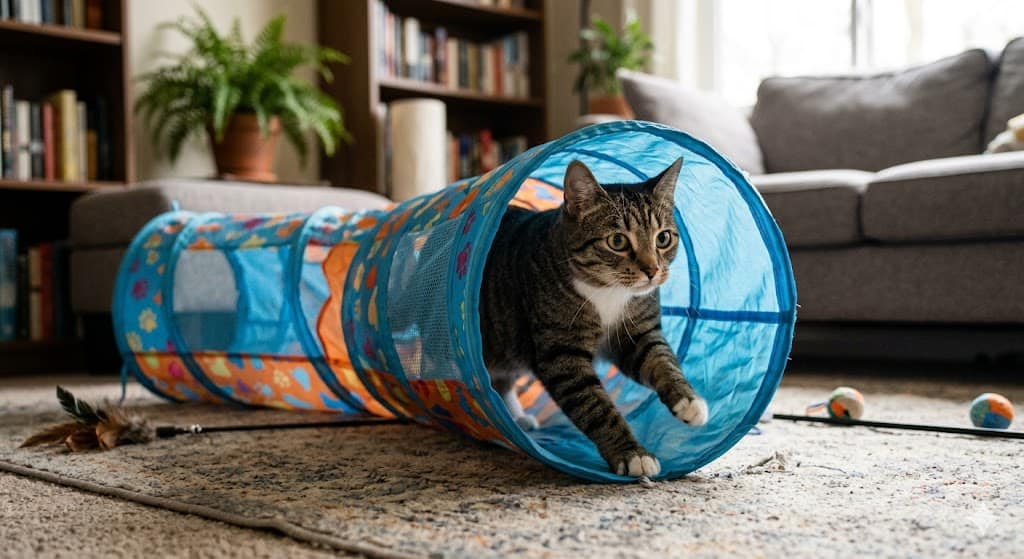
Tunnel toys address a specific and underserved feline enrichment need: the experience of navigating enclosed, dark spaces that simulate the hunting and hiding behavior cats are neurologically driven to perform. A cat entering a tunnel is not playing, from a neurological standpoint, it is engaging the same circuitry that governs ambush predation. The stalking movement through the tunnel, the burst exit, the hiding-to-attack positioning that tunnels enable, these activate the dopaminergic reward pathways that environmental enrichment researchers have identified as essential for indoor cat behavioral health.
The practical benefit for owners is significant. A cat that has had its stalking and hiding instincts satisfied through tunnel play shows reduced destructive behavior, improved mood, and better sleep quality, the same pattern that other forms of instinct-appropriate enrichment produce. For cat owners whose cats also exhibit anxiety-related behaviors, our guide to the best cat beds for indoor cats covers the secure, enclosed sleeping spaces that complement tunnel play by addressing the same security-seeking instinct.
What Makes a Cat Tunnel Worth Buying
Crinkle sound material is the feature that most distinguishes tunnels cats actually use from tunnels cats investigate once and ignore. The crinkle sound produced by polyester with a Mylar inner layer triggers the auditory prey detection response, cats associate rustling sounds with small animal movement, making the crinkle material intrinsically stimulating rather than requiring the owner to create interest through additional toys. Tunnels without crinkle material are functionally inert without active owner participation.
Diameter determines which cats use the tunnel comfortably. A 12-inch internal diameter suits most cats up to approximately 12 pounds. Larger cats, Maine Coons, Ragdolls, Norwegian Forest Cats, need a 14 to 16-inch internal diameter to move through without their sides pressing the walls, which creates claustrophobic pressure that causes avoidance rather than engagement. Always check the internal diameter against your cat’s approximate shoulder width before purchasing.
Multiple openings create the ambush dynamic that single-entry tunnels cannot replicate. A tunnel with one entry is a hiding space. A tunnel with openings at both ends and one or two side openings becomes an ambush scenario, the cat can enter one opening, hear movement near another, and burst out through a third. This multi-directional engagement is what produces sustained play rather than brief investigation.
Collapsibility and storage determine daily deployment frequency. A tunnel that requires five minutes of assembly gets used twice a week. A tunnel that pops open from a stored flat position gets used daily. The frequency of deployment matters more than the quality of any individual play session for enrichment benefit, daily brief play is neurologically more beneficial than weekly extended sessions.
Attachment points for dangling toys extend tunnel engagement by adding an active prey element to the passive exploration experience. A feather wand inserted through a side opening while the cat is inside the tunnel triggers the burst-exit ambush response that represents peak feline play engagement.
Best Cat Tunnel Toys in 2026: Our Top 5 Picks
1. ZUCKER Cat Tunnel with Peek Hole, Best Overall
Best Overall | Price: ~$20
The ZUCKER three-section collapsible tunnel combines crinkled Mylar construction, a peek hole in the middle section, and an interactive dangling ball at the center opening, the three features that produce sustained play engagement rather than brief curiosity. The three-section design creates a tunnel long enough to produce the full stalking-and-ambush behavioral sequence, a short tunnel collapses the spatial requirement that makes tunnel play neurologically meaningful. At approximately $20, it delivers more instinct-appropriate enrichment features than tunnels costing twice as much.
ZUCKER, Three Sections and a Center Peek Hole That Create Genuine Ambush Scenarios
The peek hole at the center section is the design detail that separates the ZUCKER from single-exit tunnels. A cat positioned inside the tunnel with access to a center peek hole can monitor external movement while hidden, the exact behavioral position that feline hunting strategy uses when waiting in concealment for prey to approach. When a feather toy or another cat appears near the peek hole, the burst-exit response activates. The center dangling ball extends independent play without owner participation, the cat inside the tunnel bats at the dangling toy while maintaining the covered, hidden position that tunnels are neurologically designed to provide.
Learning curve for owners: Week one, place the tunnel near where the cat already rests, not in the center of the room, where novelty requires investigation of an exposed space. Week two, drag a feather through the tunnel while the cat watches. Week three, the cat will begin using it independently as the crinkle texture becomes associated with successful play. Cats that ignore tunnels for the first week typically engage by week two to three when the tunnel is in the right location.
Best for: Most indoor cats, the crinkle material, multi-section design, peek hole, and center ball cover the enrichment features that produce sustained engagement across different play styles.
PROS:
- Three-section design for the full stalking behavioral sequence
- Crinkle Mylar construction triggers auditory prey response
- Center peek hole for ambush positioning
- Dangling ball for independent play without owner participation
- Approximately $20, exceptional value for feature count
CONS:
- 12-inch diameter, may be tight for very large breeds over 15 pounds
- Crinkle sound may disturb noise-sensitive owners during nighttime use
- Dangling ball attachment can wear at the hinge point after several months of heavy use
2. YOFUN Pop Up Cat Tunnel, Best for Multiple Cats
Best for Multiple Cats | Price: ~$25
The YOFUN tunnel’s T-shaped or X-shaped design, available in both configurations, creates the multi-directional intersection that produces genuine multi-cat play dynamics. Two cats can enter from opposite ends and meet at the center junction, triggering the chase, retreat, and ambush sequences that multi-cat play generates when the tunnel constrains movement to predictable pathways. Single-cat households benefit from the additional openings for feather toy insertion from multiple angles, the owner can create unpredictable prey movement patterns that a straight-through tunnel cannot produce.
YOFUN, T-Shape Intersection That Single-Path Tunnels Cannot Replicate for Multi-Cat Play
The intersection point creates what cat behaviorists describe as a “contested resource”, a space both cats want simultaneously that generates appropriate play competition without the territorial aggression that contested physical spaces in the open environment sometimes produce. The tunnel constrains the interaction to a play context that both cats understand as play rather than territory assertion, producing the social enrichment that multi-cat households need alongside individual enrichment.
Best for: Households with two or more cats, the intersection design produces multi-cat play dynamics that straight tunnels cannot. Also excellent for single cats with highly active owners who want to create complex prey movement patterns through multiple entry points.
PROS:
- T or X shape creates a multi-directional intersection for complex play
- Produces genuine multi-cat play dynamics
- Crinkle construction throughout
- Multiple entry points for feather toy insertion from various angles
- Accessible price at approximately $25
CONS:
- Takes more floor space than straight tunnel designs
- Intersection junction can collapse under sustained heavy use from large cats
- Less suitable for solo cats whose owners do not actively participate in tunnel play
3. Prosper Pet Cat Tunnel, Best Large Cat Option
Best for Large Cats | Price: ~$25
The Prosper Pet tunnel offers a 14-inch internal diameter, two inches wider than the standard 12-inch that constrains larger breeds. For Maine Coons, Ragdolls, Norwegian Forest Cats, and any cat over 12 pounds, the additional diameter removes the shoulder-contact discomfort that makes standard tunnels aversive rather than engaging. A cat that experiences lateral wall pressure when moving through a tunnel learns to associate the tunnel with an uncomfortable sensation, avoidance develops rapidly and resists retraining. Getting the diameter right from the first purchase prevents this conditioned avoidance.
Best for: Large breed cats over 12 pounds, Maine Coons, Ragdolls, Norwegian Forest Cats, and large mixed breeds for whom standard 12-inch tunnels create shoulder contact that produces tunnel avoidance.
PROS:
- 14-inch internal diameter for large breeds
- Three sections for a full behavioral sequence
- Crinkle Mylar construction
- Collapsible for storage
- Mid-range price at approximately $25
CONS:
- Larger diameter increases storage footprint compared to standard tunnels
- Less widely available than ZUCKER and YOFUN in retail
- Fewer additional features than ZUCKER at a similar price
4. Potaroma Flapping Bird Cat Tunnel, Best Interactive
Best Interactive | Price: ~$35
The Potaroma tunnel integrates a battery-powered flapping bird toy at the center opening, a motorized interactive element that produces unpredictable movement without owner participation. The flapping motion mimics avian prey movement that activates the aerial predation response, distinct from the ground prey response that standard dangling balls trigger. For cats that show strong interest in birds, window-watching behavior focused on outdoor birds, chattering at birds through glass, the flapping mechanism engages a prey category that standard tunnel toys do not address.
Best for: Bird-focused cats whose play interests center on aerial prey movement, any cat whose window-watching behavior demonstrates primary interest in bird prey rather than ground prey.
PROS:
- Battery-powered flapping bird for autonomous interactive play
- Aerial prey movement category distinct from standard ground-prey toys
- Produces independent play without owner participation
- Crinkle tunnel construction
- Suitable for high-energy cats that require motorized prey simulation
CONS:
- Higher price at approximately $35
- Battery replacement ongoing cost
- Motor can fail within 3-6 months of daily use under heavy play
- Flapping movement may overstimulate some anxious cats
5. Beeztees Kattentunnel, Best Budget
Best Budget | Price: ~$12
A basic single-section crinkle tunnel at approximately $12 provides the fundamental tunnel enrichment experience at minimum cost, appropriate for households testing whether their cat engages with tunnel play before investing in multi-section or feature-rich alternatives. Some cats are tunnel-averse regardless of design quality, the enclosed space triggers anxiety rather than exploration in cats with certain temperament profiles. Testing engagement with a $12 basic tunnel before purchasing a $25 to $35 option is simply rational purchasing for households without prior tunnel experience.
Best for: First-time tunnel buyers testing cat engagement before investing in premium options, any household where cat tunnel preference is unknown, and the $12 cost reduces the financial risk of a rejected toy.
PROS:
- Lowest price on this list is approximately $12
- Crinkle construction for basic auditory stimulation
- Collapsible for storage
- Adequate for testing tunnel engagement preference
- Fast replacement if the cat destroys it through heavy play
CONS:
- Single section limits the full stalking behavioral sequence
- No peek holes or interactive attachments
- Basic construction shows wear faster than premium alternatives
- Provides a minimum rather than an optimal enrichment experience
Quick Comparison: Best Cat Tunnel Toys 2026
| Tunnel | Price | Diameter | Sections | Best For | Score |
|---|---|---|---|---|---|
| ZUCKER with Peek Hole | ~$20 | 12″ | 3 | Best overall | 9.3 |
| YOFUN Pop Up | ~$25 | 12″ | T/X shape | Multiple cats | 9.1 |
| Prosper Pet Large | ~$25 | 14″ | 3 | Large cats | 9.0 |
| Potaroma Flapping Bird | ~$35 | 12″ | 3 | Interactive | 8.9 |
| Basic Budget Tunnel | ~$12 | 11″ | 1 | Budget test | 8.7 |
Our Verdict on the Best Cat Tunnel Toys
ZUCKER at $20 is the recommendation for most households, the combination of three sections, center peek hole, crinkle material, and dangling ball delivers more enrichment features per dollar than anything else on this list. YOFUN at $25 is the specific recommendation for multi-cat households where the intersection design produces play dynamics that straight tunnels cannot replicate.
Large breed owners need the Prosper Pet 14-inch, getting the diameter right is more important than any feature difference between the other options, because undersized tunnels create aversion that resists retraining. Potaroma at $35 is specifically for bird-focused cats, where autonomous motorized play justifies the price. And the $12 basic option is specifically for households testing tunnel preference before committing.
Frequently Asked Questions: Best Cat Tunnel Toys
Why won’t my cat use the tunnel?
Location is the most common cause, a tunnel placed in the center of an open room requires the cat to approach exposed space before engaging, which conflicts with the security-seeking motivation that makes tunnels appealing. Place the tunnel against a wall or piece of furniture where one side is already covered, reducing the exposed approach. Scent introduction helps, place a worn t-shirt or familiar bedding inside the tunnel before the first introduction. Most cats that initially ignore tunnels engage within two to three weeks when placement and introduction follow this protocol.
How long should cat tunnel play sessions be?
10 to 15 minutes of active play twice daily produces the enrichment benefit that behavioral researchers identify as sufficient for indoor cat welfare. Longer single sessions produce diminishing returns as the cat’s prey drive becomes temporarily satisfied, cats that have “won” a hunt disengage from further play. Two shorter sessions with several hours between them maintain the prey drive activation that makes each session engaging. The tunnel can remain deployed between sessions for passive hiding and resting use, which adds incidental enrichment throughout the day.
Can kittens use cat tunnels?
Yes, tunnels are among the most age-appropriate enrichment tools for kittens whose prey drive is at peak intensity during the socialization period from 8 to 16 weeks. Kittens under 6 months benefit from the full-body physical engagement that tunnel navigation requires. Ensure the tunnel diameter is large enough that a growing kitten does not get stuck, a tunnel appropriate for a 10-pound adult cat will accommodate a kitten throughout its growth. Monitor initial use to confirm the kitten can reverse direction inside the tunnel without becoming distressed.
How do I clean a cat tunnel?
Shake out loose debris and cat hair after each play session. Most fabric tunnels can be wiped down with a damp cloth and mild soap, avoid saturating the Mylar layer, which can delaminate from the fabric when wet. Do not machine wash crinkle tunnels, the Mylar layer does not survive the washing machine agitation cycle. For deep cleaning, spray with a pet-safe enzymatic cleaner, wipe clean, and allow to fully dry before redeployment.
Do cat tunnels help with anxiety?
Yes, enclosed spaces activate the feline security response that reduces cortisol and associated anxiety behavior in cats with generalized environmental anxiety. The tunnel provides a covered hiding space that gives anxious cats a felt sense of protection that open beds do not provide. For cats with separation anxiety specifically, a deployed tunnel during owner absence gives the cat an enrichment option and a security retreat simultaneously. Our guide to the best interactive cat toys for indoor cats covers the equivalent anxiety-reduction products for dogs if your household includes both species.
Recommended Reading
See also our guides to cat carriers for vet visits, and catios outdoor cat enclosures.
Related Reading
Explore more: cat carriers for vet visits, cat flea treatment, cat window perches, cat probiotics for digestive health, cat toys for mental stimulation, and cat scratching posts.
