
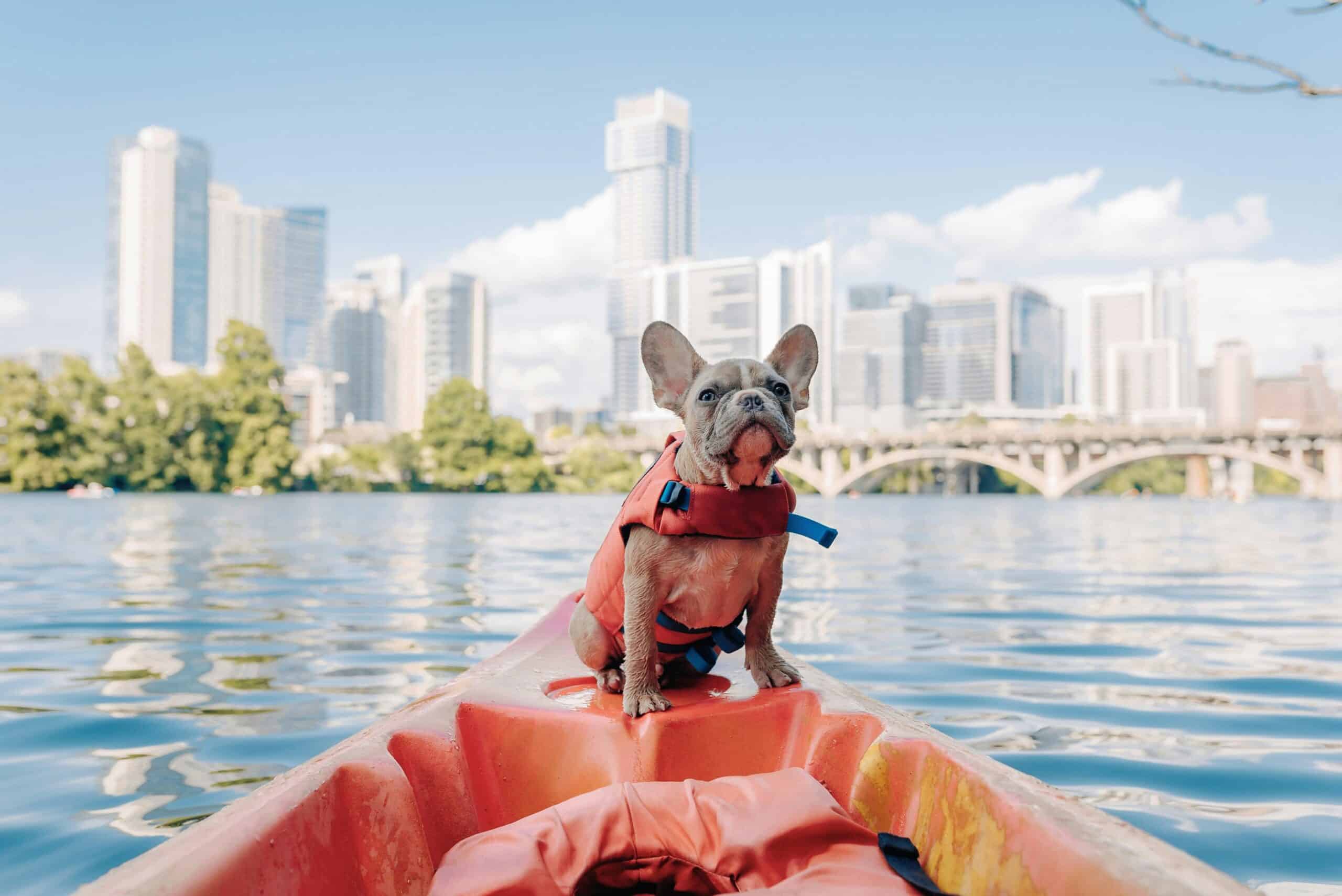
You’re on a paddleboard, and your Labrador has decided that this is a floating game. She leaps off the side, comes back, leaps off again, and by the third round, you realize she’s getting tired. Her head is lower in the water than it was 10 minutes ago, her swimming stroke looks labored, and when she tries to climb back onto the board, she can’t quite make it. You haul her up yourself and notice she’s actually exhausted, this dog who swims in the backyard pool for 20 minutes without issues is struggling after 15 minutes of open-water swimming. If you hadn’t been watching, if there had been a current, if she had been just slightly further away, this nice afternoon could have turned into an emergency.
Disclosure: HappyPaws is reader-supported. As an Amazon Associate, we earn from qualifying purchases made through links on this page, at no extra cost to you.
The dangerous myth that all dogs can swim
The myth that “all dogs can swim” is one of the most dangerous beliefs in dog ownership. Some breeds are genuinely aquatic, Labradors, Portuguese Water Dogs, and Newfoundlands evolved for water work and have the body structure, coat, and swimming capacity to handle significant swimming. Other breeds, Bulldogs, Pugs, Dachshunds, Greyhounds, are fundamentally poor swimmers whose body proportions make even short swims dangerous. And even aquatic breeds have limits. A 4-year-old Labrador who swims beautifully in familiar conditions can tire faster than expected in cold water, become disoriented in unfamiliar lakes, or panic in open ocean.
Life jackets address these realities. A well-designed dog life jacket provides buoyancy that prevents drowning, handles that let you lift your dog into a boat or onto shore, visibility features that help you locate your dog in water, and sizing that actually fits different breed body types. The wrong life jacket either doesn’t provide adequate buoyancy, slips off during swimming, causes chafing that makes your dog refuse to wear it, or fits so poorly that it can actually impair swimming rather than assist it.
This guide walks through the five best dog life jackets available in 2026, the specific criteria that separate genuinely safe life jackets from marketing claims, and how to match a life jacket to your dog’s specific needs. If you’re also looking at related water gear or harness options, our guide on best dog harnesses for pulling covers complementary equipment.
Why dog life jackets matter more than most owners realize
The basic math of dog drowning is sobering. Dogs drown in the United States at a rate of approximately 5,000 per year, many in swimming pools that owners considered safe, many in open water during what were intended as casual swimming experiences.
Unlike humans, who can float with minimal effort, dogs must actively swim to stay above water. When a dog becomes exhausted, disoriented, or panicked, the swimming stops and sinking begins within minutes.
A life jacket buys time. A tired dog in a life jacket floats; a tired dog without one drowns. This difference matters even in seemingly safe environments like backyard pools, where dogs have drowned while owners were 20 feet away.
Why life jacket choice matters for different situations
Dog life jackets span wildly different designs for different use cases. Understanding the use case determines which features matter.
Recreational swimming in calm water
For dogs who swim in pools, calm lakes, or slow rivers during casual recreation, a basic life jacket with moderate buoyancy suffices. The priorities are: fit that doesn’t restrict movement, buoyancy adequate for typical breeds, and construction durable enough for regular use.
Emergency features (rescue handles, reflective strips, high-visibility colors) matter less for this use case because owners are typically nearby and water conditions are controlled.
Boating and watercraft activities
For dogs accompanying owners on boats, paddleboards, kayaks, or jet skis, the priorities shift. Life jackets must keep dogs afloat during unexpected water entries, provide handles for lifting dogs out of water, include high-visibility colors, and resist wear from wet-dry cycling.
Boating-specific life jackets typically offer 20-30% more buoyancy than recreational versions and include rescue handles as standard features.
Ocean and open-water use
Ocean use adds requirements beyond boating. Saltwater accelerates metal corrosion on D-rings and buckles. Surf conditions require higher buoyancy to keep dogs above wave action. Currents demand that the jacket stay securely in place even when water pulls strongly against it.
Ocean-rated life jackets use marine-grade hardware, higher buoyancy ratings, and reinforced construction at stress points.
Emergency rescue scenarios
For dogs who may encounter emergencies, working dogs, search and rescue dogs, or dogs in flood-prone areas, life jackets must support emergency rescue. This means rescue handles strong enough to lift the dog’s full weight, visibility features for locating dogs in poor conditions, and buoyancy that keeps the dog floating indefinitely.
These scenarios also require training, dogs need to practice wearing the life jacket in controlled conditions before emergency use.
Senior dogs and dogs with health issues
Older dogs or dogs with arthritis, recent surgery, or other health concerns benefit from life jackets even in calm water. Their swimming endurance may be limited, and small issues can become emergencies quickly.
These dogs typically benefit from higher-buoyancy jackets that allow resting in the water without sinking.
What to look for in a dog life jacket
The category contains genuinely protective products and inadequate alternatives at similar price points. Here’s what separates safety equipment from marketing claims.
Coast Guard rating or equivalent buoyancy
Human life jackets carry Coast Guard ratings (Type I, II, III, or V) that indicate buoyancy levels. Dog life jackets don’t have equivalent federal rating systems, but quality manufacturers publish buoyancy specifications.
Look for dog life jackets that specify buoyancy in pounds or Newtons. The target is approximately 20-25% of your dog’s body weight for recreational use, and 30-40% for boating or ocean use.
Proper buoyancy distribution
Buoyancy placement matters as much as total buoyancy amount. Life jackets should position buoyancy predominantly under the dog’s chest and belly, which keeps the dog horizontal (the natural swimming position).
Life jackets with buoyancy concentrated along the back can cause dogs to float with their heads pointed downward, potentially submerging the face and causing the dog to panic. Quality life jackets position 60-70% of buoyancy on the underside.
Rescue handle on top
A reinforced grab handle on the top of the life jacket is essential for boating and deep-water use. You need to be able to lift your dog into a boat, onto a dock, or out of water when they’re too tired to climb out themselves.
The handle should be sewn to multiple layers of fabric, not attached to a single surface layer. Single-layer attachments fail when you need them most, under the stress of lifting a wet, struggling dog.
Adjustable straps for proper fit
Fit matters more for life jackets than almost any other equipment. A loose life jacket slides off during swimming; a tight life jacket restricts breathing and movement.
Look for at least 3-4 adjustment points: belly strap, chest strap, and neck closure at a minimum. Better jackets have 5-6 adjustment points for a precise fit across different body proportions.
Sizing by weight alone is insufficient, chest circumference matters more than weight for proper fit. Quality manufacturers publish sizing charts including both measurements.
High-visibility colors and reflective features
Dogs in water can be genuinely hard to see, especially in rough conditions or poor light. High-visibility colors (orange, yellow, red) make dogs findable at a distance.
Reflective strips add visibility during dawn, dusk, or night boating. These features are standard on quality life jackets and should be non-negotiable for boating use.
Durable outer fabric
Life jackets endure wet-dry cycling, UV exposure, saltwater, and claws scratching against the fabric. Quality jackets use heavy-duty nylon outer fabrics that resist fading, tearing, and puncture.
Budget life jackets often use thinner fabrics that fail within 1-2 seasons of regular use. For dogs who spend significant time in water, durable construction pays back through a longer functional lifespan.
Quick-release buckles
Emergencies sometimes require removing the life jacket quickly, if it snags on underwater obstacles, if your dog is caught in a current, or if a medical emergency requires access to the dog’s body.
Quick-release buckles (similar to those on child car seats) allow rapid removal. Standard buckles require 5-10 seconds of manipulation; quick-release buckles allow removal in 1-2 seconds.
Flotation material quality
Life jackets use different flotation materials, each with trade-offs.
Foam-filled is the standard approach. Closed-cell polyethylene foam maintains buoyancy indefinitely and doesn’t absorb water.
Inflatable life jackets inflate via pull-tab or automatic water sensor. These provide excellent buoyancy when inflated, but can fail if the inflation mechanism malfunctions. Not generally recommended for dogs who can’t manually activate inflation.
Hybrid designs combine foam with inflatable bladders for boosted buoyancy. These offer good safety but add cost and complexity.
For most dogs, foam-filled life jackets are the right choice, reliable, affordable, and don’t depend on mechanical activation.
Best dog life jackets in 2026: our top 5 picks
Five picks covering the full range of needs: best overall for most dogs, best heavy-duty for serious boating, best for small dogs, best budget option, and best for senior or medically-compromised dogs.
1. Ruffwear Float Coat, Best Overall
Best for most dogs | Price: ~$100
Check Price on AmazonThe Ruffwear Float Coat has been the default dog life jacket recommendation among boaters, paddleboarders, and water-focused dog enthusiasts for over a decade. The combination of proper buoyancy distribution, reinforced grab handle, quick-release buckles, and high-visibility colors produces a life jacket that delivers safety features across the full range of recreational water activities.
The 5 sizes fit dogs from 10 to 170 pounds, with appropriate buoyancy scaled to body size.
Ruffwear’s Purpose-Built Design
Ruffwear has specialized in dog outdoor equipment for over 30 years, and the Float Coat represents the mature result of multiple design iterations. The buoyancy distribution places 65% of the flotation material under the dog’s chest and belly, keeping the dog horizontal during swimming.
The telescoping neck closure accommodates breeds with different neck-to-chest proportions. Bulldogs and other short-necked breeds get proper fit without neck compression; longer-necked breeds like Greyhounds get adequate coverage without gaps.
Reinforced Rescue Handle
The grab handle uses webbing sewn to multiple layers of reinforced fabric, creating a lift point that’s rated to support dogs up to 120 pounds. The handle is centered over the dog’s center of gravity, making lifts balanced and controlled.
This is the handle you’ll actually grab when your dog is tired or in distress. The strength rating matters, budget alternatives with flimsy handles can tear free when you need them most.
High-Visibility Color Options
The Float Coat comes in safety orange, blazing yellow, and red, all tested for visibility in water under various conditions. The bright colors remain vivid even after extensive UV exposure thanks to quality dye penetration.
Reflective strips on all sides add visibility for dawn, dusk, or night boating use.
Construction and Durability
The outer fabric is heavy-duty nylon with reinforcement at chafe zones (under the front legs, around the chest strap). The closed-cell foam maintains buoyancy indefinitely without degradation from sun or water exposure.
Expected functional lifespan is 5-10 years with regular use, substantially longer than most alternatives.
Best for: Most dogs, boating enthusiasts, paddleboarders, dogs who swim regularly, households wanting one reliable life jacket for multiple activities.
PROS:
- Proper buoyancy distribution keeps dogs horizontal
- Reinforced rescue handle rated for 120 pounds
- Quick-release buckles for emergency removal
- Multiple high-visibility color options with reflective strips
- Durable construction for multi-season use
- 5 sizes fit dogs from 10-170 pounds
- Ruffwear’s warranty and customer service
CONS:
- Premium price point vs budget alternatives
- May be overkill for dogs with minimal water exposure
- Requires careful sizing (don’t estimate)
- Safety orange shows fading over many seasons
- Handle position adds bulk that some dogs dislike initially
2. Outward Hound Granby Splash, Best Heavy-Duty
Best for serious boating use | Price: ~$60
Check Price on AmazonFor owners spending significant time boating, ocean-going, or on open water where conditions can change unpredictably, the Outward Hound Granby Splash delivers heavy-duty construction specifically designed for demanding water conditions. The reinforced neck float, redundant flotation panels, and marine-grade hardware handle the specific stresses that ocean and boating use impose.
The design prioritizes safety features over sleek aesthetics, appropriate for actual water-use scenarios.
Reinforced Neck Flotation
The Granby Splash includes additional buoyancy in a padded neck collar that keeps the dog’s head elevated above water even in wave action. This matters specifically for boating, when a dog falls off a boat unexpectedly, wave action can disorient even experienced swimmers.
The neck flotation is separate from the main jacket flotation, so if the main panels shift during an emergency, the neck panel continues supporting the head.
Dual D-Rings for Leash Attachment
Two D-rings (one at the top center and one at the back) provide flexible leash attachment options. The top D-ring allows secure leash attachment during boat travel. The back D-ring works for typical walking when the life jacket doubles as a harness.
Dual attachment also supports rescue scenarios where multiple connection points provide redundancy.
Reflective Piping and Rescue Handle
Reflective piping runs around the entire perimeter of the jacket, providing 360-degree visibility in low-light conditions. The reinforced rescue handle on top has redundant stitching for maximum strength.
Marine-Grade Hardware
All buckles and D-rings use marine-grade plastic and metal that resists corrosion from salt water. Budget life jackets often use hardware that corrodes within 1-2 seasons of ocean use.
Best for: Serious boaters, ocean-going owners, dogs who spend extensive time on watercraft, and owners prioritizing safety features over minimalist design.
PROS:
- Reinforced neck flotation keeps the head elevated
- Dual D-rings for flexible attachment
- 360-degree reflective piping
- Marine-grade hardware resists salt corrosion
- Reasonable price for heavy-duty construction
- Outward Hound’s established outdoor reputation
- Appropriate for demanding water conditions
CONS:
- Bulkier than minimalist alternatives
- May feel restrictive for dogs new to life jackets
- Larger neck flotation takes getting used to
- Color options more limited than Ruffwear
- Fewer sizing options than premium alternatives
3. Kurgo Surf N Turf, Best for Small Dogs
Best for small breeds | Price: ~$40
Check Price on AmazonSmall dogs (under 25 pounds) need life jackets sized and designed specifically for their proportions. Standard life jackets often fit too loosely on small dogs or distribute buoyancy incorrectly for small body types. The Kurgo Surf N Turf addresses small-dog-specific needs with appropriate sizing, proportional buoyancy, and features scaled to smaller body structures.
Small-Dog Specific Design
The jacket uses a rounded-front design that doesn’t interfere with small dogs’ shorter legs. Standard life jacket designs, scaled down to small sizes, often extend too far forward for small breeds.
Buoyancy is distributed appropriately for small body proportions, more concentrated under the chest rather than extending along the full back length. This placement keeps small dogs horizontal without over-weighting them.
Reversible Design Feature
The Surf N Turf has a removable floatation jacket that converts the life jacket to a standard harness on land. This dual-purpose design is particularly useful for small dogs whose outings often combine water and land activities, the life jacket portion can be removed for hiking or street walking.
Appropriate Features at Small Dog Scale
The rescue handle is sized appropriately for lifting small dogs (up to 35 pounds). Reflective strips run along both sides. Quick-release buckles allow emergency removal.
Multiple attachment points accommodate small dog leash connections, including front-clip harness options.
Budget-Friendly Quality
At approximately $40, the Surf N Turf provides genuine safety features at a price point appropriate for small dog owners who may not need the heavy-duty construction of premium alternatives.
Expected lifespan is 3-5 years with regular use, shorter than Ruffwear’s 5-10 years but adequate for the price point.
Best for: Small breeds under 25 pounds, households combining water and land activities, dogs who need life jackets only occasionally, and budget-conscious small dog owners.
PROS:
- Designed specifically for small dog proportions
- Reversible to a land harness
- Proper buoyancy distribution for small bodies
- Reflective features on both sides
- Reasonable price for a small dog-specific design
- Quick-release buckles
- Lighter weight than standard alternatives
CONS:
- Limited to small dogs only (25 pounds max)
- Shorter expected lifespan than premium options
- Less rescue handle strength than heavy-duty alternatives
- Fewer color options
- Dual-purpose design adds complexity
4. Paws Aboard Doggy Life Jacket, Best Budget
Best budget dog life jacket | Price: ~$25
Check Price on AmazonFor budget-constrained dog owners needing functional life jacket protection without premium pricing, Paws Aboard’s Doggy Life Jacket provides adequate buoyancy and basic safety features at approximately $25. The construction uses standard materials and basic features, enough for occasional use but not sufficient for heavy boating or ocean scenarios.
The compromises are predictable: less durable construction, less refined fit, and less sophisticated features.
Adequate Core Function
The jacket provides proper buoyancy distribution for typical dog sizes. The adjustable straps accommodate most breeds within the specified weight range.
A basic rescue handle (not reinforced to heavy-duty standards) provides lift capability for emergencies. Reflective strips add moderate visibility.
Budget-Tier Construction
The outer fabric is lighter-weight than premium alternatives. This affects durability across multiple seasons, expect replacement within 2-3 years of regular use.
Buckle quality is acceptable but not marine-grade. For freshwater use, this is adequate; saltwater use will degrade buckles faster than premium alternatives.
Appropriate for Specific Use Cases
This life jacket works best for:
- Occasional pool or calm-lake swimming
- Dogs with minimal water exposure
- First-time life jacket purchases to test the category
- Backup life jackets for multiple-dog households
- Short-term rental or vacation use
Cost Calculation
At $25, the economic case is straightforward. If you need a life jacket occasionally, spending $100 for premium quality may be hard to justify. The Paws Aboard provides 70-80% of the safety benefit at 25% of the price, making it the right choice for specific use cases despite the compromises.
Best for: Budget-constrained owners, occasional water users, first-time life jacket buyers, backup jackets for multi-dog households, and short-term needs.
PROS:
- Lowest price point for a functional life jacket
- Provides basic safety features
- Adjustable for most breed sizes
- Rescue handle included
- Reflective strips for visibility
- Acceptable for occasional use
- Low-risk category entry
CONS:
- Shorter expected lifespan (2-3 years)
- Lighter fabric less durable
- Basic hardware (not marine-grade)
- Less sophisticated fit than premium alternatives
- Not appropriate for heavy boating or ocean use
- Limited color options
5. Paws Aboard Neoprene Designer Dog Life Jacket, Best for Senior Dogs
Best for senior or medically-compromised dogs | Price: ~$65
Check Price on AmazonSenior dogs, dogs with arthritis or recent surgery, dogs with anxiety around water, or dogs with breathing issues benefit from higher-buoyancy jackets that allow extended resting in the water without exhaustion. Paws Aboard’s Neoprene Designer line provides 20-30% more buoyancy than standard life jackets, appropriate for dogs who need extra support.
The neoprene material provides comfort for dogs whose skin is sensitive to rougher fabrics.
Enhanced Buoyancy for Extended Water Rest
The jacket’s flotation panels are 25% thicker than standard alternatives, providing buoyancy that can support a resting dog indefinitely without the dog needing to swim. This matters for senior dogs whose endurance is limited, or dogs recovering from surgery who need water access for rehabilitation but can’t sustain long swimming sessions.
The distribution places maximum buoyancy under the chest, supporting the dog in a natural floating position.
Neoprene Material Benefits
Neoprene (the same material used in wetsuits) provides thermal insulation that benefits senior dogs in cool water. Traditional nylon life jackets don’t add warmth; neoprene life jackets provide moderate insulation that extends comfortable water time for older or smaller dogs.
The material is also softer against the dog’s skin, reducing chafing and skin irritation that bother senior dogs more than younger ones.
Rehabilitation and Therapy Use
The Neoprene Designer is often used in canine water therapy contexts. The higher buoyancy allows a gradual return to movement without requiring full swimming capacity. This makes it appropriate for post-surgical rehabilitation or arthritis management that involves water exercise.
Quality Construction
Despite the focus on therapeutic use, the jacket maintains quality construction with rescue handles, adjustable straps, reflective features, and quick-release buckles. It’s not a compromised jacket that sacrifices safety for comfort, it’s a life jacket designed with specific needs in mind.
Best for: Senior dogs, dogs with arthritis, post-surgical rehabilitation, dogs with anxiety around water, dogs needing extended water rest, therapy or wellness applications.
PROS:
- 25% higher buoyancy than standard
- Neoprene material adds thermal insulation
- Soft against sensitive skin
- Appropriate for therapeutic use
- Allows extended resting in water
- Maintains safety features alongside comfort features
- Reasonable price for specialty design
CONS:
- Overkill for healthy adult dogs
- Heavier than standard alternatives
- Neoprene can feel warm in hot conditions
- More expensive than budget alternatives
- Less breathable during non-water wear
Quick comparison
- Ruffwear Float Coat, best overall, premium features, ~$100
- Outward Hound Granby Splash, best heavy-duty for boating, ~$60
- Kurgo Surf N Turf, best for small dogs, reversible design, ~$40
- Paws Aboard Doggy Life Jacket, best budget option, ~$25
- Paws Aboard Neoprene Designer, best for senior/medical needs, ~$65
How to choose the right life jacket for your dog
The right life jacket depends on your dog’s size, your water activities, and your budget. Here’s the decision framework.
Match the jacket to your primary use
Pool or calm lake swimming only: Budget tier (Paws Aboard Doggy) is adequate. Don’t overspend for occasional use.
Regular boating or paddleboarding: Standard tier (Ruffwear Float Coat) is appropriate. Features matter more than budget savings.
Ocean or heavy water use: Heavy-duty tier (Outward Hound Granby Splash). Enhanced features justify the investment.
Specialized needs (small dogs, seniors, medical): Match tier to specific need (Kurgo for small, Paws Aboard Neoprene for seniors).
Match the size to your dog
Measure your dog before purchasing: chest circumference (around the broadest part of the rib cage), neck circumference (at the base of the neck where a collar sits), and back length (from the base of the neck to the base of the tail).
Weight alone is insufficient for sizing. A 50-pound Labrador has different proportions than a 50-pound Greyhound, the chest circumference differs significantly.
Consult each manufacturer’s sizing chart rather than assuming size labels are consistent across brands.
Test fit before water use
After purchasing, have your dog wear the life jacket on land for 15-30 minutes. Check for: proper snugness (you should fit two fingers between jacket and body), freedom of movement (dog can walk, sit, and lie down comfortably), and security (jacket doesn’t shift when dog moves).
If fit is wrong, return for the proper size before any water use. A poorly-fitted life jacket can cause more problems than no life jacket.
Consider your specific conditions
Cold water (below 65°F): Neoprene provides insulation benefits alongside buoyancy.
Saltwater regularly: Marine-grade hardware and salt-resistant materials matter.
Night or dawn activities: Reflective features become essential.
Long-duration boating: Rescue handle strength matters for fatigue scenarios.
How to introduce your dog to a life jacket
Buying the right life jacket is only half the equation. Many dogs resist life jackets initially, and improper introduction creates long-term resistance.
Phase 1: Dry introduction
Put the life jacket on your dog in the house with all straps adjusted properly. Reward with treats and praise. Don’t do anything else, just let them wear it for 15-30 minutes.
Some dogs walk stiffly in a life jacket initially, as if the jacket is preventing movement. This is normal and resolves within a few sessions.
Phase 2: Walking and movement
Take your dog for walks wearing the life jacket. The movement helps them get comfortable with how it feels during activity. Continue positive reinforcement.
Some dogs need 3-5 short sessions before they accept the jacket as normal equipment.
Phase 3: Shallow water introduction
Introduce water in shallow conditions where your dog can stand. Wading pools, shallow streams, or beach surf zones let them experience the buoyancy sensation without panic.
This is also where you verify the fit is correct, the jacket should stay secure during water movement without loosening or shifting.
Phase 4: Swimming with supervision
Progress to actual swimming in a controlled environment (pool, calm cove) with immediate backup (you or another swimmer nearby).
Dogs accustomed to swimming without life jackets sometimes resist the feel of the jacket initially. Be patient, within 1-3 sessions, most dogs swim normally while wearing the jacket.
Phase 5: Boating or advanced use
Once your dog accepts swimming in the life jacket, introduce boating or paddleboarding. Make sure the dog is comfortable wearing the life jacket for extended periods before taking them on longer outings.
The rescue handle practice matters here, practice lifting your dog out of water by the handle in controlled conditions, so you’re both comfortable with the maneuver before an emergency.
Common life jacket mistakes to avoid
Several specific mistakes appear in dog life jacket usage. Here are the most common errors.
Wrong sizing
Using weight alone for sizing, estimating measurements instead of measuring, or buying the “next size up to grow into” all cause fit problems. Measure precisely and match to manufacturer’s sizing charts.
Not adjusting straps
Some owners leave default strap positions or over-tighten all straps equally. Proper fit requires adjusting each strap independently for specific tension at each point.
Skipping land introduction
Rushing straight to water use creates negative associations for dogs who need time to accept the equipment. Always complete a dry introduction before water use.
Using a life jacket as an excuse for complacency
A life jacket reduces drowning risk but doesn’t eliminate it. Some owners reduce their vigilance when dogs wear life jackets. Don’t, life jackets are safety equipment, not unsupervised swim enablers.
Reusing damaged life jackets
Life jackets with fraying fabric, damaged buckles, compressed flotation, or visible wear should be replaced. Don’t risk safety equipment failure by using compromised jackets.
Storing life jackets improperly
Leaving wet life jackets in dark compartments promotes mildew and fabric breakdown. Let jackets dry completely before storage, and store in well-ventilated areas when possible.
How to maintain your dog’s life jacket
Proper maintenance extends the life jacket’s lifespan significantly.
Rinse after saltwater use
Salt water accelerates metal corrosion and degrades fabric. After any ocean or salt water use, rinse the jacket thoroughly with fresh water before drying.
Focus especially on hardware (D-rings, buckles) where salt deposits cause the most damage.
Dry completely before storage
Wet storage creates mildew and breaks down fabric over time. Hang the jacket in a well-ventilated area until completely dry before putting it away.
Avoid direct sunlight for extended drying, UV exposure degrades the outer fabric over time.
Inspect regularly for damage
Before each water use, inspect the jacket for fraying stitching, compressed flotation, damaged buckles, and torn fabric. Address issues before they become safety problems.
Pay particular attention to the rescue handle attachment, if stitching shows fraying, the handle may fail when you need it most.
Clean periodically
Rinse occasionally with mild soap and water to remove accumulated dirt, dog hair, and residues. Don’t machine wash, the agitation damages the flotation material.
Replace when compromised
Life jackets have functional lifespans of 3-10 years, depending on use and quality. Signs that require replacement: compressed or waterlogged flotation material, failed buckles that can’t be replaced, significant fabric damage, or warranty expiration combined with heavy use.
Don’t cling to old life jackets that compromise safety. The economic value of prolonged use is trivial compared to the safety risk.
The annualized cost math
Life jacket costs per year vary by tier and usage frequency.
Budget tier ($25, 2-3 year lifespan): $8-12/year. Appropriate for occasional or specific use scenarios.
Small-dog specialty ($40 Kurgo, 3-5 year lifespan): $8-13/year. Appropriate for small dog owners with specific fit needs.
Standard tier ($60-65, 4-6 year lifespan): $10-16/year. Best value for regular water users.
Premium tier ($100 Ruffwear, 5-10 year lifespan): $10-20/year. Justified by features, durability, and reliability.
The math favors premium options for regular users but budget options for occasional users. Match the tier to your actual water activity frequency.
Accessories worth pairing with your dog’s life jacket
Several companions improve life jacket use.
Dog-specific water equipment
Dog paddleboard/kayak leash: A leash designed specifically for watercraft prevents your dog from swimming away while allowing necessary mobility.
Waterproof collar or harness: Standard collars can be uncomfortable when wet. Waterproof alternatives maintain comfort during water activities. Our best dog harnesses for pulling guide covers harness options.
Dog booties for rocky shores: Protect paws from sharp rocks or shells when entering/exiting water.
Safety accessories
Waterproof GPS tracker: If your dog is likely to swim away or get separated, a GPS tracker attached to the life jacket enables recovery.
Dog first aid kit for water incidents: Specific water-related issues (near-drowning, secondary drowning, salt water ingestion) require specific first aid knowledge and supplies.
Towels and drying supplies: Quick drying after water activities prevents skin issues.
Training resources
Swimming training for dogs: Some dogs benefit from formal swimming lessons. Look for dog swim schools in your area.
Life jacket practice sessions: Regular practice with the life jacket in controlled conditions builds comfort that prevents panic in real emergencies.
Our verdict
The Ruffwear Float Coat is the right life jacket for most dog owners. At $100, it provides purpose-built construction, reinforced rescue handle, quick-release buckles, and high-visibility design that makes it safe for virtually any recreational water activity. For dogs who swim regularly or owners who boat frequently, the premium price pays back through 5-10 years of reliable service.
Heavy boaters and ocean users should consider the Outward Hound Granby Splash. The reinforced neck float, dual D-rings, and marine-grade hardware address the specific stresses of demanding water conditions. The $60 price reflects specialty features for specific use cases.
Small dog owners should choose the Kurgo Surf N Turf. The small-dog-specific design provides proper fit and proportional buoyancy that standard life jackets can’t match at a comparable scale. The reversible land harness design adds versatility for mixed activities.
Budget-constrained owners or those with occasional water use can start with the Paws Aboard Doggy Life Jacket. The basic safety features are adequate for calm water scenarios, and the $25 price makes it accessible. Plan for replacement in 2-3 years.
Senior dogs, post-surgical dogs, or dogs with specific medical needs benefit from the Paws Aboard Neoprene Designer. The enhanced buoyancy and neoprene material address specific challenges that standard life jackets don’t.
The broader point: life jackets are safety equipment for an environment where dogs can genuinely drown. Don’t treat them as optional accessories or skimp on quality for occasional use. A life jacket that fails in an emergency is worse than no life jacket because it creates false security. Buy quality from established manufacturers, size correctly, introduce gradually, and maintain properly. Most dogs love water when they’re properly equipped, but properly equipped is non-negotiable for safety.
Frequently asked questions
Does my dog really need a life jacket?
Yes, for any water activity beyond immediate poolside supervision. Dogs drown more often than owners realize, approximately 5,000 dogs drown in the United States each year. Life jackets dramatically reduce this risk by providing buoyancy during exhaustion, panic, or disorientation. Even strong-swimming breeds like Labradors benefit from life jackets during extended swimming, cold water, or unfamiliar conditions.
How do I know what size life jacket to buy?
Measure your dog’s chest circumference (around the broadest part of the rib cage) and consult the manufacturer’s sizing chart. Weight alone isn’t sufficient because different breeds have different proportions at the same weight. Chest circumference plus back length provides accurate sizing. When in doubt, size up rather than down, loose jackets are safer than tight ones.
Should I use a human life jacket on my dog?
No. Human life jackets are designed for human body proportions and don’t fit dog anatomy. They can actually impair swimming by distributing buoyancy incorrectly or slip off entirely during swimming. Use dog-specific life jackets that account for dog body structure and swimming mechanics.
How long does a dog life jacket last?
Budget jackets typically last 2-3 years with regular use. Standard quality jackets last 4-6 years. Premium jackets last 5-10 years. Lifespan depends on usage frequency, water type (salt water degrades faster), UV exposure, and storage conditions. Replace jackets immediately if you see compressed flotation, failed buckles, or significant fabric damage.
Can my dog wear a life jacket all day?
No, life jackets should be worn only during active water use or when water access is imminent. Continuous wear can cause chafing, heat buildup, and skin issues. Remove the life jacket during rest periods, meals, and whenever the dog is not actively near water.
Do life jackets work for all breeds?
Most breeds can use appropriately-sized life jackets successfully. Brachycephalic breeds (Bulldogs, Pugs, Boxers) benefit especially because they swim poorly without flotation. Very deep-chested breeds (Greyhounds, Great Danes) may need specific sizing that accommodates their proportions. Some breeds with water coats (Labradors, Newfoundlands) handle water well without life jackets in calm conditions but still benefit during boating or open water.
How do I train my dog to accept a life jacket?
Gradually. Start with dry land work for 15-30 minutes with positive reinforcement. Progress to walking while wearing it. Then, a shallow water introduction. Then controlled swimming. Only after all these phases should you use the life jacket for boating or advanced activities. Rushing this process creates dogs who resist life jackets and associate them negatively.
Can life jackets prevent drowning completely?
Life jackets dramatically reduce drowning risk but don’t eliminate it. Dogs can still drown from face submersion during panic, entrapment against objects, head trauma, or jacket failure from damage or improper fit. Treat life jackets as safety equipment that supports vigilant supervision, not as replacements for it. Dogs wearing life jackets still need adult supervision during water activities.
Related Reading
Explore more: dog jackets cold weather.
More Dog Care Guides
Recommended Reading
See also our guides to dog jackets cold weather.
For the full rundown, see the comprehensive dog travel preparation guide.
More in this guide: dog bike trailers, the best dog backpacks for hiking, our dog car seat covers guide, our dog strollers guide.
